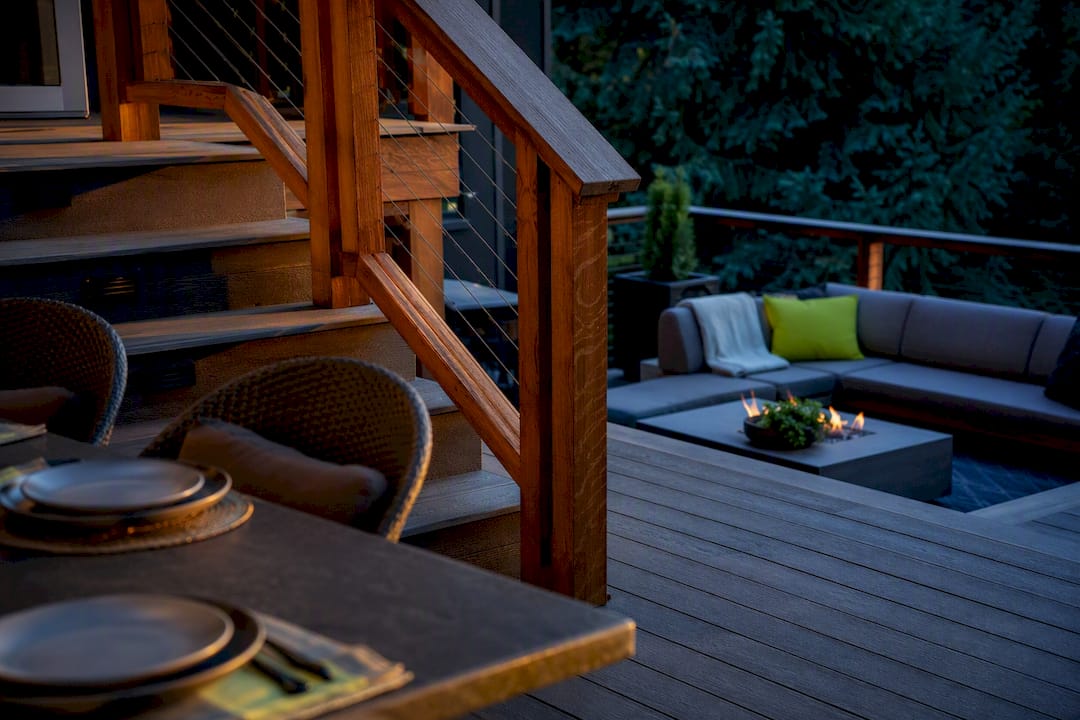


A deck is safe for kids when five things are right: a guardrail with openings too small for a child to pass through, nothing to climb near that rail, a gate at the top of the stairs, sound and non-slippery boards, and heat and chemicals kept out of reach. Most of it comes down to the railing, the stairs and regular checks. This guide walks through each one, shows what to look for, and explains when a repair is no longer a weekend job.
We build and replace decks in Everett, Washington, so we also point out where local permit rules come into play.
TL;DR
- Falls are the main danger. The usual causes are climbing on horizontal rails, slipping through gaps in the railing, climbing on furniture placed near the rail, and no adult watching.
- Balusters should not be spaced more than 4 inches apart, and a safety gate belongs at the top of the stairs when small children live in the house or visit.
- Check boards and fasteners twice a year. Decay, loose rails, mildew and debris are the hazards inspectors flag most.
- Keep fire pits and grills away from flammable surfaces, and store chemicals and fuel where children cannot reach them.
- If a rail wobbles, boards are soft, or the deck is old, replacement is often safer than patching. In Everett, ask the city whether the work needs a permit.
Table of Contents
- Where kids actually get hurt on a deck
- Railings: the most important safety feature
- Stairs: gates, handrails and even risers
- Boards and surfaces: splinters, slipping and heat
- Fire, grills and chemicals
- Inspect your deck twice a year
- When to repair and when to replace
- Everett rules to know before you build
- Our perspective: design for the child you have in five years
- Plan a safer deck with us
- FAQ
- Sources
Where kids actually get hurt on a deck
Think of a deck as a raised platform with edges. The risk is not mysterious, and it is mostly about height and openings.
A Queensland government guideline on decks, balconies and windows lists the most common causes of child falls: climbing on horizontal balustrades, passing through gaps in railing infill, climbing on furniture placed near railings, and a lack of adult supervision. The guideline is Australian, but it cites US Consumer Product Safety Commission work too, and a toddler’s body works the same way in Washington as anywhere else.
The second group of hazards is the condition of the deck itself. The National Association of Deck and Railing professionals’ Check Your Deck list names decaying wood, loose railings, slippery leaves or debris, mildew, and cluttered stair paths. Those are the things that turn a normal tumble into an injury.
Railings: the most important safety feature
A railing protects a child only if it is tall enough, strong enough and tight enough. Each piece matters.
Gaps between balusters
A baby’s body can pass through a space that looks too small to an adult. The common guidance is that balusters should not be spaced more than 4 inches apart. Measure the clear gap between balusters, not center to center, at the widest point. Check the gap under the bottom rail too, and the space where the railing meets a post or the house.
If your existing rail has wider gaps, you have two realistic choices: add more balusters, or replace the railing system. Clip-on netting sold for this purpose is a stopgap for rental homes and short visits, not a substitute for a rail built correctly.
Rails that kids can climb
Horizontal rails act like a ladder. If you have a cable or horizontal-slat design and young children, think hard about it. Vertical balusters give a small climber nothing to grip with a foot. Our deck railing height guide covers the height requirements, and the guardrail versus handrail article explains why the two are different parts with different jobs.
Cable systems deserve a specific caution. The CPSC announced a recall of certain Vevor cable railing kits in 2025 because a hole in the cable support posts posed an entrapment hazard. The agency told owners to stop using them and keep children away. If you own a cable railing kit from a mass online seller, check the CPSC recall list for your brand.
Wobble is a warning
Grab the top rail and push hard, the way a child leaning or running into it would. A rail that moves needs repair, because posts bolted poorly or fastened into rotted framing can give way when it matters. The NADRA checklist says guardrails and stair handrails should be secure. If tightening hardware does not stop the movement, the framing underneath may be the problem.
Keep furniture away from the edge
Chairs, benches, planters and storage boxes beside the rail give a child a step up. Move seating away from the guardrail, and choose a storage box whose latch a child cannot open. NADRA’s checklist specifically mentions childproof latches on storage boxes, since a lid can trap or injure a small child.

Stairs: gates, handrails and even risers
Stairs are where toddlers go first. A few things to fix:
- Install a gate at the top. For homes with small children, inspectors expect a safety gate at the top of the stairs. Choose a hardware-mounted gate, not a pressure-mounted one, at the top of any stairs.
- Check handrails. Loose, incomplete or missing handrails are listed defects.
- Look at riser heights. Uneven riser heights can contribute to stairway injuries. Kids run down stairs, and an unexpected inch makes them trip.
- Keep the path clear. Toys, planters and wet leaves on the steps are a fall waiting to happen.
- Light the steps. NADRA recommends considering lighting for steps and pathways, and checking that existing lights work.
Stair rules are detailed. Our deck stairs code guide goes through the International Residential Code requirements, and we can build or rebuild deck stairs with gates and handrails matched to your family.
Boards and surfaces: splinters, slipping and heat
Bare feet and hands touch the deck surface all summer, so the material counts.
- Splinters. Older, weathered wood sheds splinters as it cracks and splits. Composite and PVC boards do not splinter in the same way, which is one reason families often choose them. Cedar is a good-looking natural option, but it needs regular sealing and sanding of any rough spots.
- Slipping. Wet leaves, mildew and algae make any surface slick. Regular sweeping and cleaning matters more than the material. If your boards are slick after rain, there are cleaning methods to make decks less slippery, including non-harsh, low-VOC products. Test any cleaner on a small hidden spot first and keep kids and pets off until it has dried.
- Heat. Dark boards in full afternoon sun can get uncomfortably hot, whatever they are made of. If your deck faces south or west, ask about lighter colors, shade from a cover or a pergola, and a few outdoor rugs for bare feet. In the Pacific Northwest this is less severe than in the Southwest, but a July afternoon is enough to matter for toddlers.
- Treatment chemicals. Pressure-treated lumber and many stains and sealers are not products for children to chew or lick. Read the manufacturer’s label for the specific product on your deck and follow its guidance, and wash hands after play. If you have a crawling baby or a child who mouths everything, a low-maintenance board surface that does not need regular coating reduces how often you handle these products.
We work with composite, PVC and cedar, and we choose boards with you based on your family, your yard’s sun exposure and how much upkeep you want to do.
Fire, grills and chemicals
Kids and heat are a bad mix. NADRA advises you to keep fire features away from flammable surfaces or protect the deck with a non-flammable pad, and to store deck-related chemicals away from children. That means lighter fluid, propane, stain, and cleaners belong in a locked cabinet or garage, not under the deck stairs.
We have separate guides on fire pit placement and heat barriers and grilling on a composite deck. The short version for families: set a clear no-go zone around anything hot, and never leave a lit fire or a warm grill with children unattended.
If you play or lounge on the grass beside or under a low deck, soft surfacing matters. A comparison of rubber versus wood mulch explains the ASTM safety rules for playground-style surfacing. Keep mulch well clear of any grill or fire feature.

Inspect your deck twice a year
A quick, regular check catches problems before kids find them. A spring and fall routine works well in western Washington, where moisture is the main enemy.
- Probe the wood. NADRA suggests checking wood for decay with an ice pick or screwdriver. Soft or crumbling spots mean rot. Look especially at posts, the ends of boards, and where the stairs meet the deck.
- Tighten fasteners. Loose screws, nails that have worked up, and loose bolts are all worth fixing at once.
- Shake every rail and post. Push on them like a child would.
- Check the ledger and framing. Where a deck is attached to the house, failures can be severe. Our guide on freestanding versus attached decks explains the issue, and a professional inspection is the right answer if you see rust, gaps or water staining at the connection.
- Test the lights. Make sure step and path lighting works.
- Clear debris. Sweep leaves and clean off mildew.
A deck also has to hold what you put on it. InterNACHI explains that a deck must be designed to support people, snow loads and objects, and to resist wind or seismic loads. A birthday party of 20 kids and parents is a real load. Read our piece on how much weight a deck can hold if you are planning a crowd.
When to repair and when to replace
Repair makes sense for loose screws, a few cracked boards, or a rail whose hardware needs tightening. Replacement starts to make sense when:
- probing finds rot in posts, joists or the ledger area;
- the railing has gaps wider than 4 inches that cannot be fixed with added balusters;
- the posts are loose because the framing is weak;
- the stairs have uneven risers or no proper handrail; or
- the deck is too small or oddly laid out for how your family uses it.
We can walk you through deck replacement and explain what is salvageable and what is not. Our composite replacement project with gated stairs in Everett shows what a family-focused rebuild can look like.
Everett rules to know before you build
National advice is a floor, not a ceiling, and your city has its own requirements. The City of Everett’s residential deck handout says decks cannot sit inside rear or side yard setbacks, advises contacting Planning to confirm setbacks, and asks for construction plans when a permit is required. It also states that a licensed architect or engineer is required for decks that support hot tubs, spas or other heavy objects, including heavy deck coverings, or that fall outside the prescriptive method in 2021 IRC Section R507.
That last point matters if you want a hot tub or a heavy roof over a deck where kids will play. The same city page says that consulting a professional designer familiar with code is the best way to complete a complex deck project.
One more detail for decks next to the house: the Virginia residential code, which follows the same model code basis, requires safety glazing for certain windows beside a deck. That applies when a glass pane is over 9 square feet, its bottom edge is under 18 inches above the deck and its top edge is more than 36 inches above it. Check with Everett’s permit office for how your city handles it.
Our perspective: design for the child you have in five years
Parents often ask us how to make a deck safe for a toddler. Our answer is to design it for a toddler and for a ten-year-old, because the risks change. The toddler squeezes through gaps and falls down stairs. The ten-year-old climbs rails, throws parties and uses the deck harder than anyone.
So we start by asking how your family uses the space. Where does the door open? Where do children enter and leave? Where will the grill and table go? A good layout puts the grill away from the play zone and the table away from the rail, with stairs that have a gate. That is more effective than bolting safety add-ons on later.
We use our own in-house crew, not subcontractors, so the person who builds your railing is part of the same team that planned it. Our installations are warranty-backed, and we pay attention to eco-conscious materials suited to the Northwest climate, where moisture and moss are what age a deck fastest. We would rather tell you your deck needs a new rail than patch something that a child will lean on.
— Vlad
Plan a safer deck with us
If your deck has wide gaps, a wobbly rail, soft boards or stairs without a gate, we can assess it and suggest a fix that fits your budget. We handle design, permitting and construction for homeowners in Everett and nearby communities, using composite, PVC or cedar.
Start with Everett deck design service if you are planning something new, or look at our deck railing systems if the guardrail is the main concern. You can also reach us through Cactus Decking to book a consultation.
FAQ
How far apart can deck balusters be to keep kids safe?
The guidance inspectors use is that balusters should be no more than 4 inches apart. Measure the clear opening, not the center-to-center distance. Check the gap at the bottom of the rail and beside posts too.
Does a low deck need a railing if I have toddlers?
Requirements depend on height and local code, so confirm with your city. In Everett, contact the permit office. Even where a rail is not required, a toddler can still fall and be hurt, so consider a rail, a fence or a gate on any open edge.
Is composite decking safer for kids than wood?
Composite and PVC do not splinter the way aging wood does, and they do not need regular coatings. They can still get hot in the sun and slippery when wet, so choose a color and texture with that in mind and keep the surface clean.
How often should I inspect my deck?
Twice a year is a practical routine, in spring and fall, plus after any major storm. Probe the wood for decay, tighten fasteners, push on every rail and post, and test the lights. Call a professional if you find rot or movement at the ledger.
Do I need a permit to replace a deck railing or stairs in Everett?
It depends on the scope of the work. Contact the City of Everett’s permit services before you start, since city rules cover setbacks and plans. We can handle permitting for projects we build.
Sources
- Deck, balcony and window safety guideline, Queensland Department of Housing and Public Works
- Check Your Deck, NADRA
- Stairway Inspection, InterNACHI
- Inspecting a Deck, Illustrated, InterNACHI
- CPSC recall of Vevor cable railing kits
- Residential Decks, City of Everett
- Typical Deck Details, Warrenton, VA
- Make decks less slippery
- Rubber versus wood mulch