Deck Safety for Homeowners: Horizontal Railing Codes and When to Avoid
A code first homeowner guide: what codes require, when to avoid horizontal infill for kids, and DIY checks to spot railing failures.
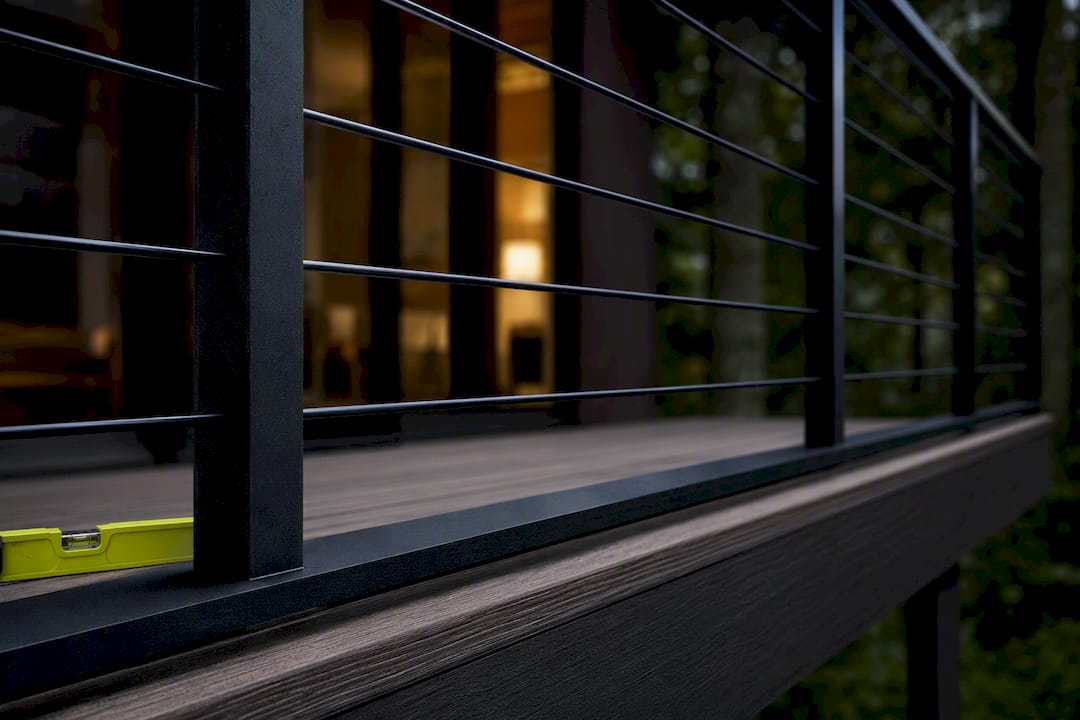
Deck Safety for Homeowners: Horizontal Railing Codes and When to Avoid
Horizontal deck railings are safe when they’re built to code, with correct opening sizes, structural anchorage, and load capacity. The real risk isn’t the orientation itself, it’s climbing behavior around young children and installation shortcuts. Most horizontal railing failures trace back to weak post connections or corroded fasteners, not the horizontal design. If kids under six are regularly on the deck unsupervised, a vertical or anti-climb design is the safer default.
TL;DR:
Horizontal railings require secure through-bolted post connections and proper tensioning to meet code safety standards for load capacity.
The main safety concern is climbing risk, especially with children under six, making vertical or anti-climb designs advisable in such households.
The code regulates guard height, opening size, and load resistance equally for horizontal and vertical infill, with no specific rules for orientation.
Materials like cable, aluminum, and glass depend on maintenance and climate conditions, influencing long-term safety and durability.
Regular inspections for loose fasteners, sagging cables, or post movement are crucial for maintaining safety over time.
Cactusdeckingcactusdecking.comBuild A Safer, Better-Fitting DeckCactus Decking creates tailored outdoor spaces with quality craftsmanship, durable material options, and railing systems designed around your needs.Explore Cactus Decking
Table of Contents
How Building Codes Treat Horizontal Railing Safety
The Ladder Effect: Does Horizontal Railing Increase Climbing Risk?
Installation Details That Keep Horizontal Railings Safe
Which Materials Hold Up Best for Horizontal Railing Safety?
How to Inspect Your Horizontal Deck Railing for Safety Issues
When Should You Avoid Horizontal Railing Infill?
Cactus Decking’s Approach to Horizontal Railing Safety
Get a Code-Compliant Railing Built Right the First Time
Codes and Standards Worth Bookmarking
Sources
How Building Codes Treat Horizontal Railing Safety
Building departments don’t regulate railing orientation directly. They regulate three measurable things: when a guard is required, how big the openings can be, and how much force the assembly has to withstand. Horizontal cable railing safety and vertical picket safety get evaluated against the exact same numbers.
A guard becomes mandatory under the International Residential Code once a walking surface sits more than the low threshold height above grade, measured at any point within a short horizontal distance of the open edge. Below that threshold, most jurisdictions don’t require a guard at all, though plenty of homeowners install one anyway for peace of mind.
Once a guard is required, height and opening size take over as the two enforceable standards:
Height: 36 inches minimum for most residential decks; many commercial and multi-family applications under the IBC require 42 inches.
Opening size: No gap in the guard, including under the bottom rail, can allow a 4-inch sphere to pass through.
Measurement method: Inspectors check the clear opening, not the distance between cable or picket centers. A cable spaced 4 inches on-center with 3/8-inch cable leaves less than 4 inches of actual clearance, which passes. Get the math wrong and it fails.
Structural loads matter just as much as geometry. Guards need to resist a 200-pound concentrated load applied at any point on the top rail, plus a uniform load of 50 pounds per linear foot. That’s not a theoretical number. It’s roughly what happens when an adult leans hard on a rail or two people lean against it at a party. A railing that looks solid but was fastened with a handful of screws into thin decking board will fail that test long before it fails visually.
The Ladder Effect: Does Horizontal Railing Increase Climbing Risk?
Yes, horizontal railings create footholds that vertical pickets don’t, and that’s a behavioral risk codes don’t fully address. Building codes are engineered to stop kids from falling through a railing. They say almost nothing about kids climbing up one. That gap is where the so-called “ladder effect” lives, and it’s the single biggest safety debate around is horizontal railing safe for family homes.
Horizontal cables, rails, or slats spaced at regular intervals give a small child something to grip and step on, the same way a ladder works. A 4-inch sphere test can pass perfectly while the same railing still functions as a climbing frame for a determined three-year-old. Decks.com’s guidance reflects this directly, recommending vertical or rigid anti-climb infill specifically for homes with young children, independent of what the local code minimum requires.
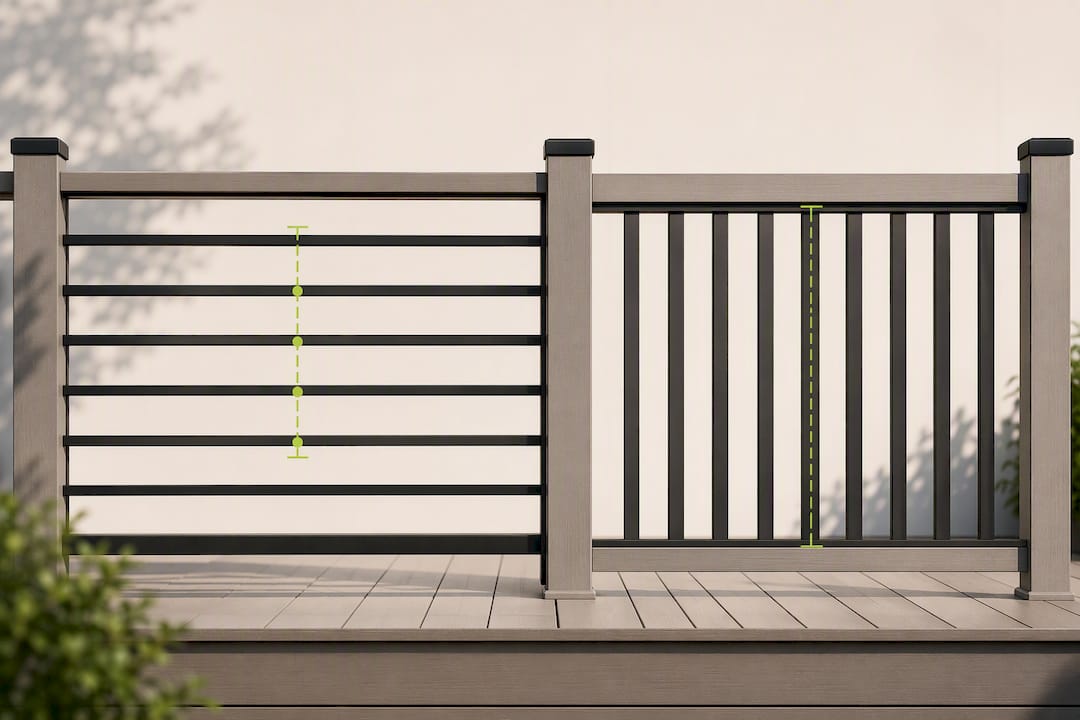
Hard data on orientation-specific fall injuries is thin. Nobody tracks “vertical picket fall” versus “horizontal cable fall” as separate categories in injury statistics, so the recommendation to favor vertical designs rests on documented climbing mechanics and professional judgment rather than a large injury dataset. That doesn’t make the concern any less real. It just means the honest answer is “the risk is plausible and well-documented in principle, but not quantified at scale.”
Before choosing a horizontal system, walk through your actual household:
Are there children under six who use the deck regularly, including visiting grandkids or neighbor kids?
Is there built-in seating, planters, or furniture near the rail line that could act as a first step up?
Is supervision consistent, or does the deck get used when adults are inside or distracted?
Pro Tip: If you’re on the fence, install horizontal infill on the sections farthest from doors and high-traffic paths, and use vertical pickets or tempered glass on the sections closest to where kids actually play.
Installation Details That Keep Horizontal Railings Safe
Code compliance on paper and code compliance in the ground are two different things, and the gap between them is almost always the post connection. Here’s what separates a horizontal railing that holds up for twenty years from one that gets wobbly in five:
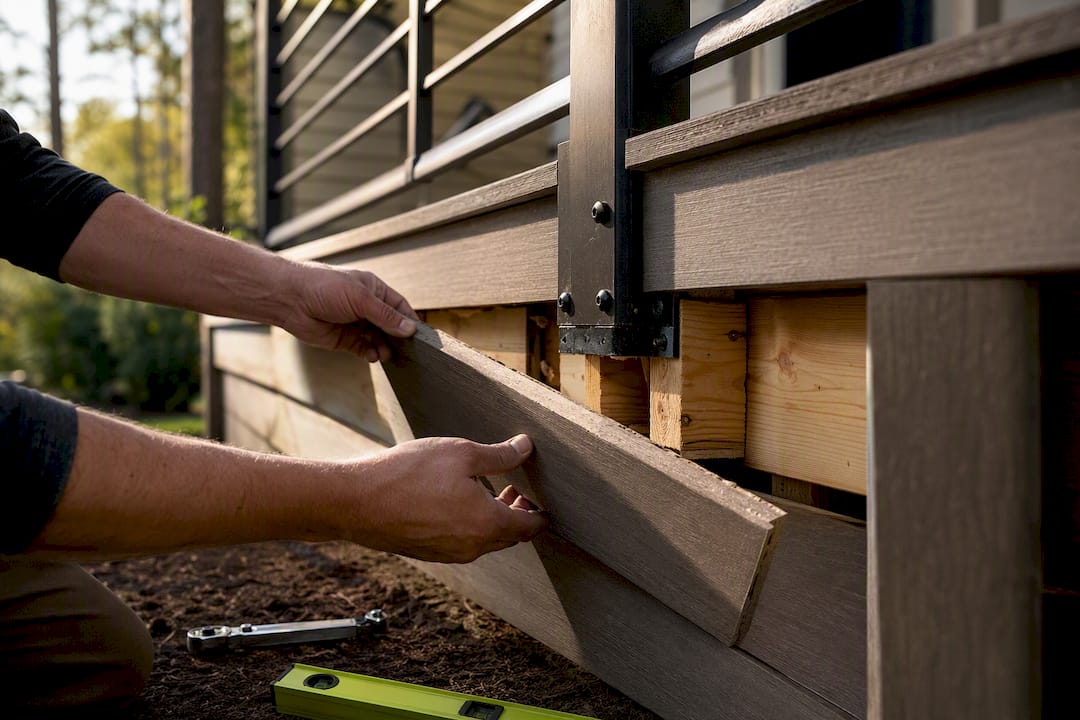
Bolt through, don’t just screw in. Post-to-deck connections should use through-bolts with blocking underneath the deck framing, not lag screws driven into a single joist. This is the detail inspectors and railing manufacturers flag most often, and it’s the one most likely to get skipped on a budget install.
Tension cable systems correctly and recheck them. Cable railing relies on tension to keep the 4-inch sphere from slipping through under load. Loose cable that passed inspection on day one can sag enough within a year or two to fail the same test. Intermediate posts and deflection control are what keep a long cable run from bowing under the 50 lb/ft uniform load.
Use 316 stainless hardware near coastal air. Standard stainless corrodes faster than most homeowners expect within a mile or two of saltwater. Manufacturer-tested cable specs call out 316 stainless for exactly this reason, along with specific fastener diameters and mounting schedules that shouldn’t be improvised.
Design out the footholds you can control. A flush bottom rail with no gap above the deck surface, tighter spacing on the lowest one or two horizontal members, or a removable mesh screen for the first few years of a toddler’s life all cut climbability without abandoning the horizontal look.
Post spacing deserves its own mention. Wider spans feel cheaper and look cleaner, but every extra foot between posts adds leverage that the connection has to resist. Following the manufacturer’s tested span limits rather than eyeballing “it looks strong enough” is where a surprising number of DIY installs go wrong.
Pro Tip: Ask your contractor to show you the blocking under the deck before the skirting goes on. A five-minute look now saves a five-figure repair later.
Which Materials Hold Up Best for Horizontal Railing Safety?
Material choice affects safety mostly through maintenance, not raw strength, since almost anything engineered correctly can meet the load and opening requirements. What changes is how much attention each option demands over time and how it behaves in your climate.
Cable: Best sightlines on the market and a favorite for view lots. Horizontal cable railing safety depends entirely on maintaining tension, since correctly engineered cable systems pass code and resist required loads only when tensioning stays within spec. Higher upfront cost, low visual weight.
Metal rods and aluminum: Stable and largely maintenance-free once specified correctly. Aluminum resists corrosion well in coastal areas where steel would rust within a few seasons.
Wood slats: Warm, traditional look that many homeowners want for a cedar deck, but wood needs sealing on a regular cycle and inspection at the post base, where moisture collects and rot starts quietly.
Glass panels: Fully unobstructed views, but every panel needs engineered support and safety-rated glazing. Glass still has to meet the same height, opening, and load rules as any other infill, it’s not exempt just because it’s solid.
Climate should drive the final call as much as looks. Coastal exposure pushes toward 316 stainless and aluminum. Freeze thaw regions are harder on wood post bases and on standard cable hardware that wasn’t rated for the swing in temperature.
How to Inspect Your Horizontal Deck Railing for Safety Issues
You can catch most horizontal railing problems yourself with two simple checks, twice a year and after any major storm.
Run the 4-inch sphere test everywhere, not just at eye level. Check under the bottom rail and at the deck surface, where gaps tend to open up first as cable sags or wood shrinks.
Push firmly on the top rail at several points along its run. Some give is normal; a post that visibly rocks at its base is not. That’s a feel test any homeowner can do; a full structural load test to the 200-pound standard is a job for a qualified inspector.
Look specifically for post pullout, corroded or rusted fasteners, sagging cable runs, and soft or discolored wood at the post base. Post-to-deck connections are the most commonly implicated failure point in railing incidents, which is exactly why that connection deserves the closest look.
Inspect twice a year, plus once after any significant storm, and call a contractor the moment a post moves under hand pressure or fasteners show real corrosion rather than surface tarnish.
When Should You Avoid Horizontal Railing Infill?
If your household includes unsupervised children under roughly six, or you get frequent visits from toddlers who won’t be watched every second, skip horizontal infill on the sections they use most. That’s the single clearest decision rule in this entire topic.
Workable alternatives and hybrids include:
Vertical pickets, which offer no horizontal foothold at all.
Tempered glass panels, engineered and code-rated, with nothing to grip.
Closely spaced slats that reduce, though don’t eliminate, the ladder effect.
A hybrid design: vertical infill on child-heavy sections, horizontal cable on higher, adult-only areas like a rooftop deck edge.
Temporary fixes like removable mesh screens or strategic furniture placement can bridge a few years while kids are small, but permanent redesign holds up better for resale and for your own liability if you ever rent the property out. Buyers and inspectors both notice horizontal infill on a listing, and disclosure expectations vary by state, so it’s worth checking with your agent or local building department before you sell.
Cactus Decking’s Approach to Horizontal Railing Safety
We treat every horizontal railing request as a code review first, design conversation second. Specialist crews use engineered anchorage details, through-bolted post connections, and tested hardware specs rather than guessing at what will hold. When a family with young kids wants the cable look, we typically pair it with a flush bottom rail or intermediate rail to cut down on footholds while keeping the sightlines they’re after. Warranty-backed installs and eco-conscious material options help ensure fewer surprises over time, not just at final inspection.
Get a Code-Compliant Railing Built Right the First Time
A horizontal railing done wrong isn’t a design problem, it’s a liability sitting on your deck. If you want the clean, modern look of cable or horizontal rail without wondering whether the post connections will hold up in year six, that’s exactly where a professional install earns its cost back. Cactus Decking’s deck railing systems start with a code review specific to your local jurisdiction, then move into engineered mounting details, permit support, and a warranty that covers the installation, not just the materials.
If your existing deck structure is aging out and can’t safely anchor a new railing, our deck replacement service handles the framing and railing together, so you’re not building a nice railing on top of a shaky foundation. And if you’re starting from scratch, deck installation covers the whole build with our local, in-house crews in composite, PVC, or cedar. Reach out for a consultation and we’ll walk your property, flag anything code related, and give you options that fit your household and your budget.
Codes and Standards Worth Bookmarking
IRC 2024 guard and railing sections for baseline federal model code language.
Decks.com’s deck railing code guide for plain-language breakdowns.
Your local building department, since amendments to these baseline codes are common.
Sources
FAQ
Are Horizontal Deck Railings Safe?
Yes, when built to code with proper opening sizes, load capacity, and secure post anchorage. The main added risk is climbing behavior in homes with young children, not the horizontal design itself.
What Is the Code for Horizontal Deck Railing?
The same code applies to horizontal infill as any other guard type: a 36 inch minimum residential height, a 4 inch maximum sphere opening, and resistance to a 200 pound concentrated load plus 50 lb/ft uniform load. There’s no separate code specifically for horizontal versus vertical orientation.
Are Horizontal Railings Legal?
Yes, horizontal railings are legal in most jurisdictions as long as the finished assembly meets the same height, opening, and load requirements every other railing type has to meet. A small number of local amendments restrict horizontal infill specifically for climbing concerns, so it’s worth a quick call to your building department before you commit to a design.
What Are the Pros and Cons of Horizontal Versus Vertical Balusters?
Horizontal railings offer better sightlines and a more modern look, but they create footholds that make climbing easier for young children. Vertical pickets sacrifice some of that open view but essentially eliminate the ladder effect, which is why many contractors, including Cactus Decking, recommend them for decks used regularly by kids under six.
Do I Need a Professional to Install a Code-Compliant Horizontal Railing?
You don’t legally need one in most areas, but the post connection and cable tensioning details that keep a horizontal railing safe over time are easy to get wrong without experience. A professional install backed by a warranty, like Cactus Decking’s railing systems, removes the guesswork on anchorage and load capacity.