
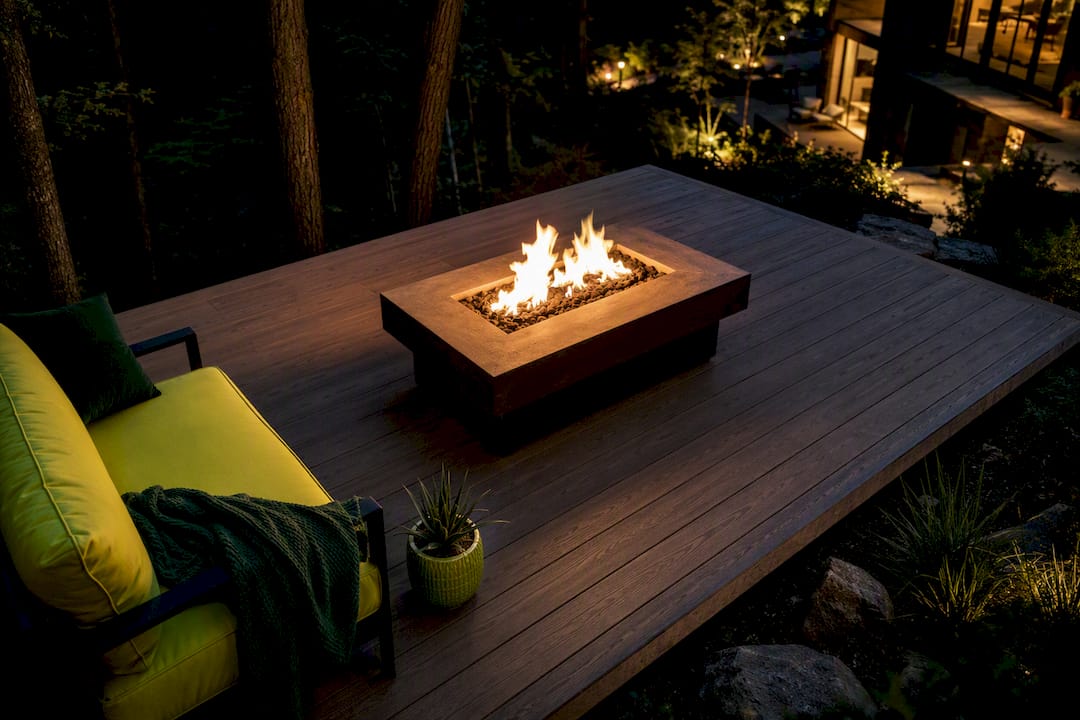
Yes, a fire pit can go on a deck, but only with the right setup. Gas or propane units are the safer choice, and any pit needs a proper heat barrier between it and the decking, not direct contact with the boards. Before you buy or light anything, check the manufacturer’s clearance-below-unit spec and your local fire code.
TL;DR:
- Gas and propane fire tables are safest for decks because they produce no embers and often come with certification for combustible surfaces.
- Most composite and PVC decking can withstand heat temporarily but may soften, discolor, or weaken over time from sustained radiant heat exposure around 800°F.
- Proper heat barriers like layered heat-rated mats with pavers or elevated stands reduce the risk of damage from radiant and conductive heat transfer.
- Maintaining minimum clearances of three feet side, six to ten feet overhead, and at least ten feet from the house is critical to safety and complying with codes.
- Always verify your deck’s structural capacity and consult professionals for permanent installations involving heavy fire pits or gas lines to prevent damage and code violations.
Table of Contents
- Fire Pit on Deck: Which Fuel Type Actually Works
- How Your Deck Material Handles Sustained Heat
- Building a Real Heat Barrier: Mats, Pavers, and Stands
- Fire Pit Placement and Clearance Checklist
- Does Your Deck Have the Structural Capacity?
- Your Fire Pit Safety Checklist: Before, During, and After
- Codes, HOA Rules, and Insurance: Who Else Needs to Sign Off
- When to Bring in a Professional Deck Contractor
- Choosing the Right Size and Style for Your Deck
- Emergency Preparedness Beyond the Extinguisher
- Air Quality and Environmental Impact of Deck Fire Pits
- Protecting Plants, Furniture, and Landscaping Nearby
- A Builder’s Take on Fire Pits and Decks
- Get Your Deck Fire-Pit Ready with Cactus Decking
- Where to Verify Fire Pit and Deck Safety Rules
- Sources
Fire Pit on Deck: Which Fuel Type Actually Works
Fuel type decides most of your risk before you even think about mats or clearances. Gas and propane fire tables produce no embers and give you controllable, adjustable heat, and many carry manufacturer documentation stating they’re approved for use on combustible surfaces like wood or composite decking. Natural gas is the same idea, but it requires a professional hookup and a permanent gas line, which changes the project entirely.
Wood-burning pits are the trickiest call for elevated decks. They throw embers, drop hot ash, and radiate heat unevenly, so most guides discourage them unless the manufacturer explicitly allows it and you build a heavy, non-combustible base underneath.
- Gas/propane fire tables: no embers, adjustable flame, often certified for deck use with documentation.
- Natural gas fire pits: clean-burning but require licensed plumbing and permanent installation.
- Wood-burning pits: highest ember and ash risk, generally not recommended on elevated decking.
- Gel or tabletop burners: low ember output, but check the manual for heat rating and approved surfaces before assuming they’re deck-safe.
If your deck already has a wood-burning fire pit in mind, gas is worth reconsidering, since gas/propane models are commonly recommended over wood-burning units on wood or composite decking.
How Your Deck Material Handles Sustained Heat
Wood, composite, and PVC decking each fail differently under a fire pit, and none of them handle direct, sustained heat well. Wood is combustible outright. Embers or prolonged radiant heat can char boards or, worse, ignite them if airflow and dryness line up wrong.
Composite and PVC decking won’t catch fire as easily, but they have a different problem: heat softens the polymer resin that holds them together. Enough sustained exposure and you get discoloration, warping, or a soft spot that never fully recovers. Some fire pits reach surface temperatures around 800°F and can radiate 200 to 400°F down onto whatever is beneath them, which is well past what most composite boards are rated to tolerate according to deck-protection research from DeckProtect.
The damage isn’t always cosmetic or surface-level, either:
- Fasteners and clips under the boards can weaken with repeated heat cycling.
- Substructure framing (especially if it’s older wood) can dry out and become more brittle over time.
- Heat staining often shows up gradually, not after one use, so a single “it looked fine” test isn’t proof of safety.
Pro Tip: If you’re not sure what your decking is made of, check the manufacturer’s warranty paperwork or the original invoice. Composite and PVC brands stamp product lines on packaging, and that ID tells you exactly what heat tolerance you’re working with.
Building a Real Heat Barrier: Mats, Pavers, and Stands
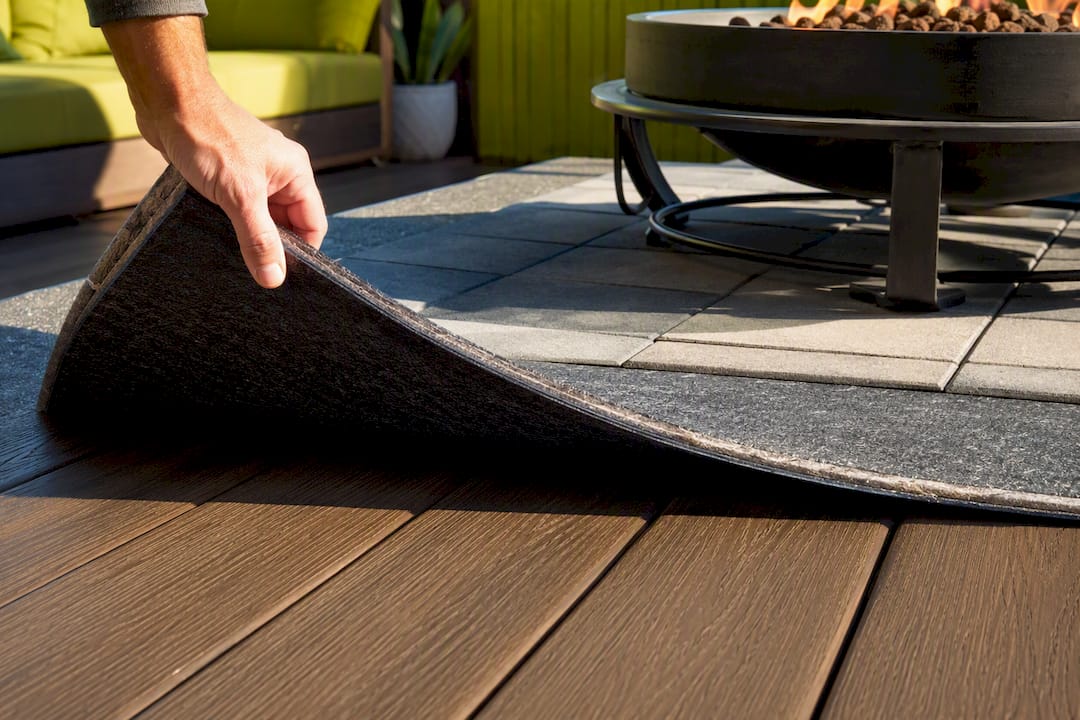
A heat-rated fire pit mat is the minimum, not the finish line. Look for mats rated for high sustained temperatures, ideally with a stated temperature threshold from the manufacturer, and made from materials designed to block conductive heat transfer, not just catch stray sparks.
Layering beats a single mat every time. Layering a heat-rated mat with pavers or elevated legs cuts down both radiant and conductive heating, which is standard practice among installers who deal with this regularly.
- Mat only: acceptable for lightweight, low-heat-output units, but the weakest option for anything burning hot or often.
- Mat plus pavers: stack fire-rated pavers on top of the mat to add mass and an air gap; this is the setup most pros recommend for gas fire tables.
- Mat plus elevated stand: raising the unit on legs creates airflow underneath, which is often the best defense against sustained radiant heat.
For extension beyond the unit’s footprint, retail guidance commonly recommends a 24-inch non-combustible pad extension when wood-burning units are manufacturer-approved for deck use.
Pro Tip: Don’t leave a permanent pad down all season. Trapped moisture underneath a mat can stain or rot boards just as effectively as heat can. Lift it periodically to let the deck breathe, and shift the fire pit’s position occasionally to avoid a permanent ring of discoloration.
Fire Pit Placement and Clearance Checklist
Clearance numbers aren’t optional guesswork, they’re often spelled out in your fire pit’s manual and your local fire code. Measure before you buy, not after.
- Side clearance: keep at least 3 feet from railings, furniture, and any combustible material, though check your local code and manual for stricter numbers.
- Overhead clearance: aim for 6 to 10 feet minimum under any roof, pergola, or awning, more if the unit runs hot.
- Distance from the house: 10 feet or more from siding is the safer target where your deck layout allows it.
- Test before committing: mark your proposed spot with tape, check the flame height against the unit’s BTU rating, and if you have an infrared thermometer, run the pit at low flame for 15 to 20 minutes and check the deck surface temperature underneath, a method outlined by Bali Outdoors for propane fire pit installations.
Covered decks, pergolas, and screened porches need extra caution, as detailed in our Covered Patio with Fireplace: A Tampa Bay Planning Guide. Trapped smoke and reduced airflow change how heat behaves overhead, so treat those overhead clearance numbers as a floor, not a target.
Does Your Deck Have the Structural Capacity?
Most residential decks are built to a standard live-load baseline of about 40 pounds per square foot spread evenly across the surface. A loaded fire table, especially one with a stone or concrete surround, concentrates a lot of that weight into a much smaller footprint than the code assumed.
Before you place anything heavy, walk your deck and look for warning signs:
- Noticeable sag or bounce when you walk across the area you’re planning to use.
- Loose, rusted, or pulled fasteners at joist connections.
- An older cantilevered section that was never designed for extra point loads.
If you spot any of that, get a professional to run the numbers rather than guessing. Ask them specifically about load calculations for the exact unit you’re considering, joist spacing and condition, and ledger board integrity, since that’s usually where older decks fail first.
Your Fire Pit Safety Checklist: Before, During, and After
A little routine goes a long way here. Treat every session the same way, whether it’s the first burn of the season or the fiftieth.
- Before lighting: confirm the heat mat or pavers are correctly positioned, check gas connections for leaks, verify your clearances haven’t shifted (furniture moves), and keep an extinguisher or garden hose within reach.
- While burning: never leave it unattended, keep the flame at a controlled height, skip accelerants entirely, and don’t run it on windy days when embers or heat can travel unpredictably.
- After use: let gas units cool fully before covering them, clean out ash completely if you’re running a wood-burning setup, and periodically lift the mat to check for heat staining or moisture damage on the boards below.
House fires connected to outdoor heating equipment are a real category tracked by fire safety organizations, and most incidents trace back to skipped basics: no barrier, poor clearance, or an unattended flame. The checklist habits outlined by FirePitSurplus exist because they catch the mistakes that actually cause damage, not the rare freak accident.
Codes, HOA Rules, and Insurance: Who Else Needs to Sign Off
Your local fire marshal and building department have the final say, not the retailer selling you the fire pit. Call them before you buy anything permanent. Many jurisdictions restrict or ban open wood-burning fires on elevated decks entirely, and running a natural gas line almost always triggers a permit requirement.
A few other boxes worth checking:
- Review your HOA covenants if you have one; some ban open flame features outright regardless of fuel type.
- Call your homeowner’s insurance provider and ask if a fire pit affects your policy or requires disclosure.
- Keep your fire pit’s installation manual and purchase receipt on file. If you ever file a claim, that documentation is often what determines whether it’s covered.
When in doubt, get written approval before you modify the deck structure or run a gas line. Verbal “it should be fine” answers don’t hold up later.
When to Bring in a Professional Deck Contractor
Some fire pit installs are a weekend project. Others aren’t, and pretending otherwise is how decks get damaged or codes get violated. Reinforcing joists to handle a heavy fire table’s concentrated load, building a recessed non-combustible paver zone, or running a natural gas line all call for licensed, qualified work. Natural gas plumbing specifically requires a licensed professional to size the piping correctly and install an accessible shut-off valve, something DIY installs frequently get wrong.
Cactus Decking’s in-house crew handles this kind of work directly, from accurate load calculations to permit paperwork to a clean, sealed transition between a non-combustible zone and the surrounding decking. Every installation is warranty-backed, so if you’re planning a permanent fire feature rather than a portable unit you can move around, that’s the point where a professional consultation earns its cost.
Choosing the Right Size and Style for Your Deck
Bigger isn’t automatically better, and an oversized fire pit on a modest deck creates clearance problems you can’t easily solve after the fact. Start by measuring your available space, subtract your required clearances (3 feet minimum on all sides, more toward the house), and see what footprint is actually left. That number, not the showroom display, should drive your size decision.
For most residential decks, a fire table in the 30 to 42 inch diameter range strikes a workable balance between real heat output and manageable clearance needs. Anything larger usually demands more deck real estate than a typical outdoor living space can spare without crowding furniture or walkways.
Design matters almost as much as size. Low, wide fire tables with a surrounding ledge tend to double as a place to set drinks, which keeps guests from crowding too close to the flame. Units with a glass wind guard cut down on flame flicker in breezy conditions and add a layer of ember containment, useful if your deck sits in an open, wind-exposed spot.
Match the style to your fuel choice too. Gas fire tables generally come in square, round, or rectangular builds with a clean, finished top, while wood-burning bowls are usually deeper and more open, which is part of why they throw more radiant heat and embers. If your deck space is tight, a rectangular linear burner along a railing edge often uses space more efficiently than a large round table sitting in the middle of your traffic flow.
Emergency Preparedness Beyond the Extinguisher
An extinguisher is the baseline, not the whole plan. A garden hose connected and within reach adds a fast, high-volume response option that an extinguisher can’t match if flames spread beyond the pit itself. Keep it uncoiled and accessible during every burn session, not stored in a shed thirty feet away.
A fire blanket is worth keeping nearby too, particularly if kids or pets are around. It’s a fast way to smother a small flare-up on clothing or nearby furniture without the mess or corrosive residue that some extinguisher types leave behind.
Know your shut-off points before you ever need them. For gas and propane units, that means knowing exactly where the tank valve or gas line shut-off is and confirming it’s not blocked by furniture, planters, or anything else. Obstructed valves or hoses are a common code violation precisely because they turn a minor issue into a slower, more dangerous response.
Finally, tell everyone in the house where the shut-off is and how to use it, not just the person who usually operates the fire pit. A fire emergency doesn’t wait for the one person who knows the system to be the one who notices it.
Air Quality and Environmental Impact of Deck Fire Pits
Wood-burning fire pits release particulate matter and smoke that settle on surrounding surfaces, including your deck, siding, and outdoor furniture. On an elevated deck close to your house, that smoke often drifts directly toward windows, vents, and outdoor seating areas instead of dispersing the way it might in an open backyard.
Gas and propane units burn considerably cleaner, producing minimal particulate output and no ash residue, which is one more reason they’re the better fit for enclosed or semi-enclosed deck spaces. If air quality near your home is already a concern, whether from local wildfire smoke, allergies, or a household member with respiratory sensitivity, that alone can be reason enough to choose gas over wood.
Consider your neighbors, too. Smoke and burning smells travel further from an elevated deck than a ground-level fire pit, particularly if your deck sits above neighboring properties or shares airspace with nearby homes. Some municipalities now factor air quality complaints into local burn restrictions, on top of the structural fire-code concerns already in play.
Protecting Plants, Furniture, and Landscaping Nearby
Heat and sparks don’t stay contained to the fire pit itself, and nearby vegetation or furniture can take damage you won’t notice until it’s already done. Potted plants close to a fire pit can dry out, scorch, or die from sustained radiant heat even without a direct ember landing on them, so keep planters at least a few feet clear of your established side clearance zone.

Outdoor furniture, especially anything with synthetic cushions or resin construction, is vulnerable to both direct sparks and prolonged heat exposure. Rearrange seating so nothing sits within your minimum clearance distance, and consider fire-resistant furniture covers if pieces have to stay nearby.
A spark screen is a simple, inexpensive way to catch stray embers before they reach anything flammable, and it’s especially worth using on breezy days or when wood-burning units are involved. Keep in mind that a spark screen protects against embers, not radiant heat, so it doesn’t replace your clearance distances or heat mat.
If your deck has built-in planters or landscaping integrated into the structure itself, treat those the same as furniture: measure the distance, and if it’s under your safe clearance zone, either relocate the plants or don’t install the fire pit in that spot.
A Builder’s Take on Fire Pits and Decks
The safety math here isn’t complicated: gas over wood, a real heat barrier over none, and a manual you actually read before buying. Most of the deck damage I’ve seen tied to fire pits traces back to someone skipping one of those three things, not to bad luck. Check your fire pit’s manual, confirm your local codes, and if the structural or gas-line work feels beyond a weekend project, call a professional before you start cutting into decking you already paid for.
— Vlad
Get Your Deck Fire-Pit Ready with Cactus Decking
Skipping the structural check is where most fire pit projects on decks go wrong, not the fire pit itself. Cactus Decking’s in-house crew handles the part homeowners usually can’t: verifying your joists can carry a loaded fire table, framing a recessed non-combustible paver zone that sits flush with your decking, and pulling the permits your local building department requires before any gas line goes in. Every project comes with warranty-backed installation, so the work holds up the way it’s supposed to.
If you’re planning a permanent fire feature rather than a portable unit you’ll move around, start with a Everett deck design service so the reinforcement, clearances, and layout get planned correctly from day one instead of retrofitted later.
Where to Verify Fire Pit and Deck Safety Rules
Your manufacturer’s manual is the first stop, since it states the exact clearance-below-unit spec for your model. Beyond that, the National Fire Protection Association publishes the code guidance most local fire departments reference for clearance and placement rules. Nficertified and industry certification bodies track which units carry CSA or ETL listings for deck-safe use. Local fire marshals and building departments have final authority over permits, bans, and code enforcement in your area.
Sources
- Can I Put a Fire Pit on a Wood Deck? - Trex Protect
- National Fire Protection Association (NFPA)
- How to Safely Use a Fire Pit on a Deck - FirePitSurplus


