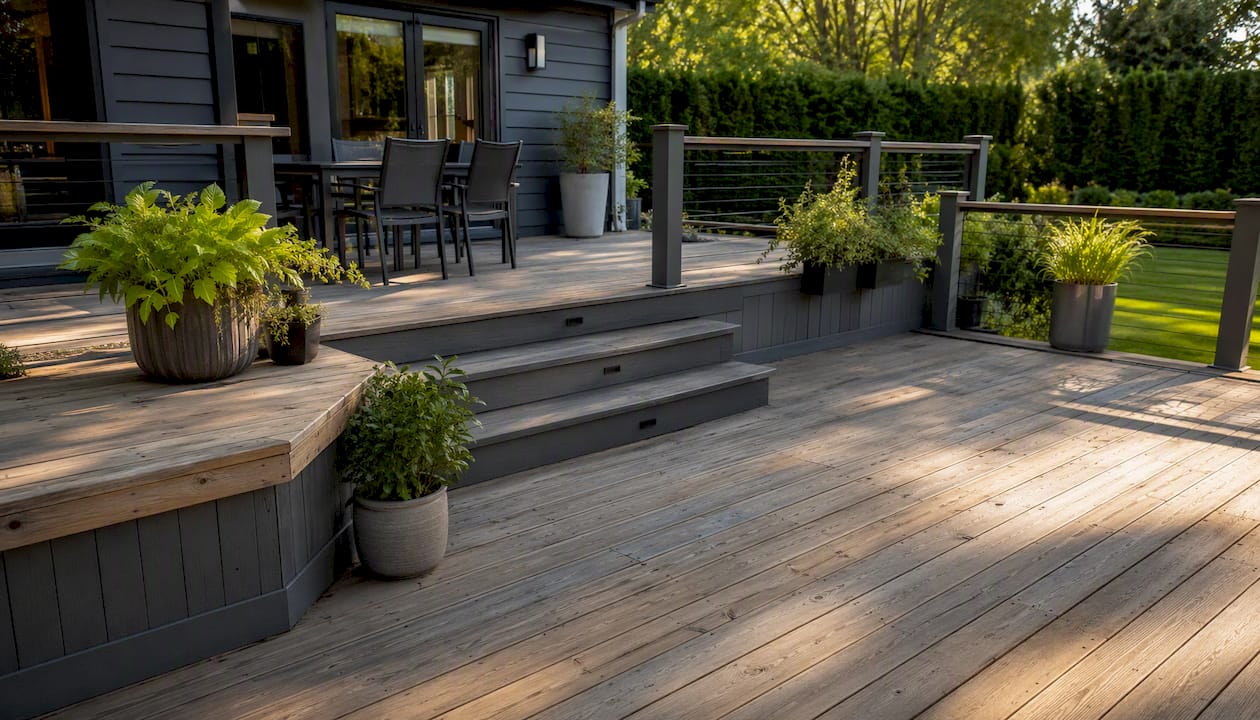


The best deck planter box depends on how much floor space you have and how long you want it to last. Railing boxes suit small decks. Freestanding planters are the easy, movable choice. Built-in planters give you the most soil and the cleanest look, but they have to be planned with the deck itself, because they add weight, hold water and sit against the framing. If you are replacing or building a deck in the Everett area, deciding on planters before the design is final saves you from retrofitting them later.
TL;DR
- Pick by space: railing planters for small decks, freestanding or corner planters for flexibility, built-in planters for a permanent, high-volume garden.
- Match depth to the plant: herbs need about 4 to 6 inches of soil, medium vegetables 8 to 12, large vegetables 12 to 16.
- Water is the enemy of any deck planter. Drainage holes, a gap between planter and rail, and a waterproof liner decide whether the wood underneath survives.
- Built-in planters are part of the deck’s structure and waterproofing, so they belong in the design stage.
- Cedar, PVC and composite all work. Which one fits depends on the look you want and how much upkeep you will accept.
Table of Contents
- The main types of deck planter boxes
- Which type fits your deck
- Choosing size and depth for what you want to grow
- Drainage, liners and keeping the wood dry
- Materials: cedar, PVC and composite
- Built-in planters in a new or replacement deck
- Our perspective
- Plan your deck planters with Cactus Decking
- FAQ
- Sources
The main types of deck planter boxes
Most planters on a deck fall into five groups: railing boxes, freestanding planters, corner planters, tiered or cascading units, and built-in benches with integrated planters. A Sustainable Garden’s style guide lists exactly those five and notes that railing boxes are the right call when floor space is precious, while built-in planters are permanent, load-bearing and need careful waterproofing.
Planters on deck railings
This is the most searched option, and it comes in two forms. HGTV’s roundup of deck rail planters separates saddle planters, which sit directly on top of the railing and need to match your railing width, from clamp-on bracket planters, which hang over the rail and fit more railings. Hanging boxes install in minutes and can be moved around. Saddle planters sit more steadily on a flat top rail.
Two checks before you buy. First, measure your top rail. Most rail planters are designed for rails roughly 1.5 to 6 inches wide, and a 2x6 cap rail is a very different fit from a slim metal tube. Second, think about weight. A wet planter is heavy, and it pulls sideways on the posts every time someone leans on the rail. A guard that has to protect people from a fall should not be asked to carry a garden it was not built for. If your railing is wobbly or aging, that is a reason to look at replacing it before you load it. Our deck railing ideas guide covers styles and safety in more detail.

Freestanding and corner planters
Freestanding planters sit on the deck surface and can be rearranged for a party, a storm or a new season. Corner planters use dead space and can soften the edges of a seating area. They are also the easiest way to protect the deck: set them on feet or a tray so water drains away from the boards instead of pooling under the pot.
If your deck is compact, a mix of one or two large planters and a rail box often looks better than a dozen small pots. For layout thinking on tight spaces, these small backyard patio ideas show how to make every square foot work, and our own small deck ideas page covers the deck-specific side.
Built-in deck planters
Built-in planters are boxes framed into the deck, often as the back of a bench, along a railing line or at a corner. Comparisons of installation styles rate built-in units as the most stable option with the most soil volume, but also the least flexible and a professional-grade installation job. That fits what we see in the design logic: the planter becomes part of the deck, so its framing, waterproof liner and drain all have to be decided together with the boards, the railing and the stairs.
Built-in planters pair naturally with seating. If you like that idea, see our guide to built-in deck seating.
Which type fits your deck
| Type | Best for | Soil volume | Flexibility | Things to plan for |
|---|---|---|---|---|
| Over-the-rail hanging box | Small decks, herbs, flowers | Low | Very high | Rail strength, rail width, water dripping down the face of the deck |
| Saddle (rail-top) planter | Flat, wide top rails | Low to medium | High | Exact fit to the cap rail, wind |
| Freestanding or corner planter | Any deck, shrubs and vegetables | Medium to high | High | Weight on the boards, feet or tray for drainage |
| Tiered or cascading unit | Narrow spots, vertical gardens | Medium | Medium | Stability, watering the lower tiers |
| Built-in bench or planter | Permanent garden, larger decks | Highest | Low | Framing, liner, drain, designed in from the start |
The ratings on rail-mounted and built-in styles come from EcoCraftyLiving’s installation comparison.
Choosing size and depth for what you want to grow
Size is where most planter purchases go wrong. A box that looks right on the rail is often too shallow for anything but herbs.
The University of Maryland Extension gives clear container sizes for vegetables:
| Plant group | Growing media | Depth |
|---|---|---|
| Large vegetables (tomatoes, for example) | 8 to 10 gallons | 12 to 16 inches |
| Medium vegetables | 4 to 6 gallons | 8 to 12 inches |
| Small vegetables and herbs | 1 to 3 gallons | 4 to 6 inches |
Flowers fall in the middle. Most flowering annuals do well at 8 to 12 inches. Small shrubs and dwarf trees want 18 inches or more, which in practice means a freestanding or built-in planter rather than a rail box.
Two more rules from university extension sources:
- A deeper container is generally better than a wider one, because roots can grow down toward water and cooler soil, according to UC Marin Master Gardeners.
- Do not oversize for a small plant. UC Cooperative Extension guidance suggests a pot about 2 inches larger than the root mass, since a pot that is too large can lead to root rot.
Plan around the weight
Soil is heavier than most people expect. Moist potting mix weighs about 40 pounds per cubic foot. A built-in planter 6 feet long, 18 inches wide and 12 inches deep holds 9 cubic feet, which is roughly 360 pounds of wet mix before you count the plants and the planter itself. Spread that along a framed line and it is manageable. Hung from a rail, it is not.
That is why the weight of planters belongs in the conversation when a deck is designed or replaced, not after the boards are down.
Drainage, liners and keeping the wood dry
Almost every failed deck planter fails the same way: water sits against wood. A few habits prevent it.
Drain it properly. University of Maryland Extension calls drainage critical and warns that adding rocks, gravel or pot shards to the bottom of a container does not improve drainage and can raise the water table in the pot. Use drainage holes and a good potting mix instead of a gravel layer.
Lift the box off the rail. For a wooden rail planter, Family Handyman recommends raising it slightly with small plastic feet, composite shims or pebbles so that neither the rail nor the planter bottom stays wet and rots. The same project calls for three 3/8-inch drainage holes and two coats of exterior polyurethane.
Line built-in planters. Fine Homebuilding’s planter project lined its deck planter boxes with an EPDM rubber roofing membrane, added a vinyl-tubing drain to prevent root rot and built the boxes freestanding so they could come off the deck for cleaning and refilling. Separately, a Fine Homebuilding guide on benches and planters cautions that petroleum-treated products and treated plywoods can leach chemicals into soil, so be careful with liners if you grow food.

Mind the height. In Fine Homebuilding’s planter guidance, a planter under 18 inches tall is a tripping hazard, and 30 inches is a comfortable maximum height for most situations. Treat that as a design guide for built-in units near walkways and stairs.
We also suggest looking under every planter at the start and end of each season. A damp, dark board is the early warning that a drain is blocked.
Materials: cedar, PVC and composite
The three materials we work with on decks each suit a planter differently.
- Cedar. Cedar is naturally resistant to decay, which is why extension horticulturists point to durable woods like redwood and cedar for wood planters. It looks warm and weathers to silver unless you stain or seal it. It is porous, so it needs a liner or sealed interior and good drainage.
- PVC. Cellular PVC does not absorb water, does not rot and needs little more than a wash. It suits a clean, modern look, and it is a natural match for a PVC deck and railing.
- Composite. Composite planter boxes do not rot, though they still need proper water drainage so soil and moisture do not sit against the deck frame.
On a Northwest deck, where rain is a fact of life for much of the year, the practical rule is to match the planter material to the deck and railing. A cedar planter on a composite deck is fine, but a planter built from the same composite or PVC as your boards keeps the look consistent and the upkeep low.
Built-in planters in a new or replacement deck
If you are already planning new decking, this is the cheapest moment to add planters. The framing can be sized for the load, the planter’s liner and drain can be tied into the deck plan, and the finished edge can match your boards and railing instead of looking like an afterthought.
What to decide up front:
- Location. Along a rail, at a corner, behind a bench or beside the stairs. Keep the planters out of main walking lines.
- Height and width. Stay above the tripping threshold and keep the planter shallow enough not to crowd furniture.
- Plants. Herbs and flowers need only a shallow box. Tomatoes, peppers or small shrubs need real depth, so the planter has to go deeper than it looks.
- Water. Where does the drain outlet go, and will it stain the boards or run onto a lower patio?
- Lighting and privacy. Planters can screen a neighbor’s view and hold low lighting. See our ideas for deck privacy and plant screens, and consider Cactus Decking service directory so the planter line glows in the evening.
On a larger yard, planters also help divide zones. Our multi-level deck ideas show how planters can mark a change in level, and the deck design ideas for 300 to 400 square foot yards show how to budget space.
A finished example of composite decking with a metal railing is in our gray composite deck project in Everett, where you can see how a clean railing line works as a backdrop for plants.
Our perspective
We think of a planter as part of the deck, not an accessory to it. The deck is a system of framing, boards, railing and drainage, and every one of those pieces has to cope with the weight and moisture a garden adds.
That is why we prefer to talk about planters during design. When our in-house crew builds a deck, we can plan the framing, the railing and the materials together, whether you choose composite, PVC or cedar, and choose options that suit the Northwest climate. A planter that is part of that plan looks intentional and is far less likely to cause trouble later.
If you are replacing an older deck, treat it as your chance to get the garden you wanted without compromising the railing or the boards. Start with how you want to use the space, then let the planters follow.
Vlad
Plan your deck planters with Cactus Decking
Cactus Decking designs and builds residential decks in Everett, Washington and nearby communities, using composite, PVC or cedar, with a clear process from consultation through construction, an in-house build crew and warranty-backed installations. If you want planters, seating and lighting designed into the deck from the first sketch, start with our Everett deck design service, or talk to us about a new deck installation service or deck replacement. If your railing is part of the project, see our deck railing systems.
FAQ
How deep should a deck planter box be for vegetables?
It depends on the crop. University of Maryland Extension recommends 12 to 16 inches of depth for large vegetables, 8 to 12 inches for medium ones and 4 to 6 inches for small vegetables and herbs. If you are unsure, go deeper rather than wider.
Can I put planters on my deck railing?
Yes, if the railing is strong and the planter is made to fit. Saddle planters sit on top of the rail and clamp-on planters hang over it, and both need the right match to your rail width. Keep loads light, because a wet planter is heavy. A deck railing that is loose or aging should be repaired or replaced first.
What is the most durable material for a deck planter?
Cedar, PVC and composite all hold up well when drained properly. Cedar resists decay naturally, while PVC and composite do not rot. The material you pick matters less than the drainage and a small gap that keeps the planter off wood surfaces.
Are built-in deck planters worth it?
They give the most soil volume and the most polished look, and they stay put. Because they are framed into the deck and need a liner and drain, they work best when planned as part of the deck design or replacement.
Sources
- Deck Planters: Choosing the Right Style for Your Space
- 11 Best Deck Rail Planters of 2026 | HGTV
- Best Planter Boxes for Deck Railing: Guide and Top Tips
- Types of Containers for Growing Vegetables | University of Maryland Extension
- Containers | UC Marin Master Gardeners
- Container Gardening | UC Cooperative Extension
- Soil Weight Calculator
- How to Build a Planter Box for Your Deck Railing | Family Handyman
- Add a Garden to the Deck With Planters | Fine Homebuilding
- Benches and Planters | Fine Homebuilding
- Building Benches and Planters | Fine Homebuilding
- How to Build a DIY Deck Planter Box | Decks.com
- Small Backyard Patio Ideas