What's the Real Return on Investment for a Deck?
Discover how much value a deck can add to your home. Learn about the real return on investment and find out what affects this figure.
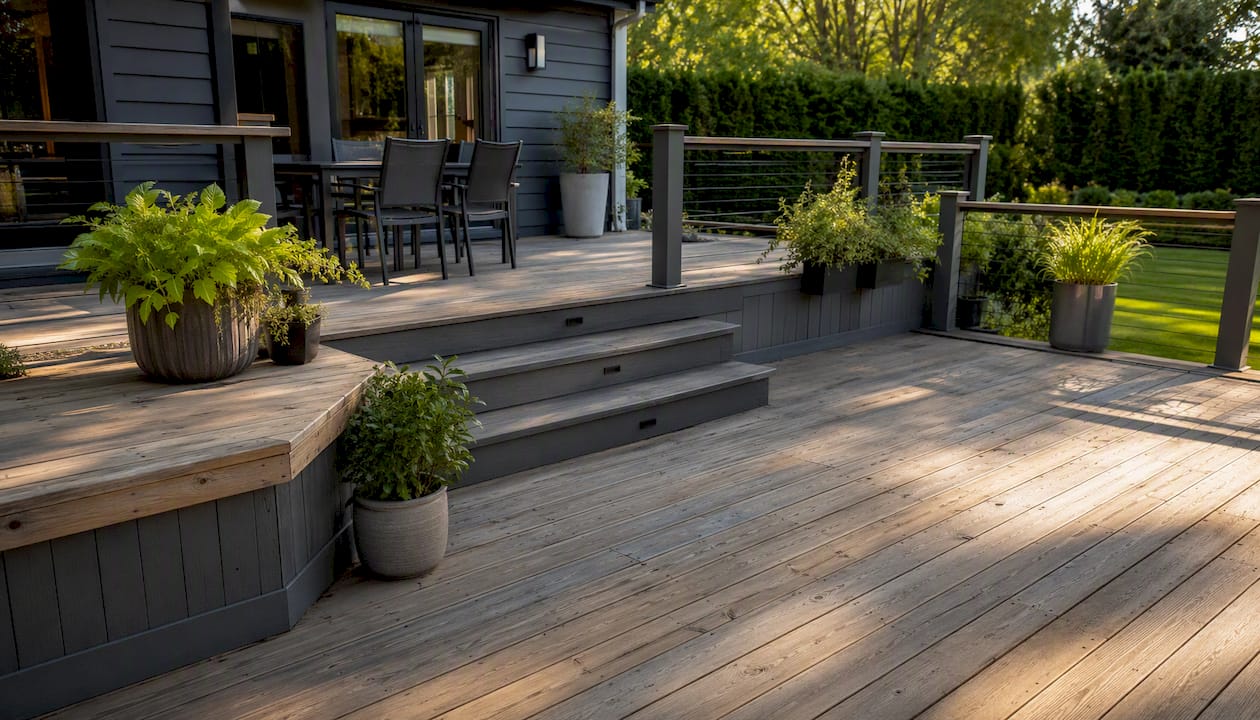
What’s the Real Return on Investment for a Deck?
A well-built deck typically returns 50–65% of its construction cost at resale, according to national Cost vs. Value benchmarks. Some scenarios push higher: Realtor from a specific 2025 Cost vs. Value case, and Angi reports recoup examples reaching into the 80% range for certain wood-deck data points. The short verdict: a deck is a solid investment for most U.S. homeowners, but the actual number depends heavily on where you live, what you build, and how well you maintain it.
Three variables move the needle most:
Region: West Coast markets pull materially higher recoup percentages than many rural or Southern markets.
Material: Pressure-treated wood, composite, and PVC each carry different upfront costs and different recoup profiles.
Condition and permits: An unpermitted or poorly maintained deck can flip from an asset to a buyer deduction at inspection.
The National Association of Realtors consistently ranks outdoor living improvements among the top projects for buyer appeal, and the Remodeling Cost vs. Value report is the industry’s annual benchmark for translating build costs into expected resale value. Cactusdecking uses both frameworks when helping Everett homeowners think through their options.
Key Takeaways
A professionally built, permitted deck in a strong local market typically returns 50–65% of its cost at resale, with condition, material choice, and regional market being the three variables that move that number most.
Point | Details |
|---|---|
National ROI baseline | Wood decks nationally recoup roughly 50–65% of construction cost; some scenarios reach 80–95% depending on market and material. |
Biggest recoup levers | Region, direct access to main living area, and condition at sale have the largest impact on your actual recoup percentage. |
Material and decay | PT wood decays at roughly 1.8%/yr; composite at 1.0%/yr; PVC at 0.7%/yr, so material choice affects long-term recoup. |
Pre-sale action | Document permits, invoices, and warranty certificates before listing to prevent buyer deductions at inspection. |
Cactusdecking | Offers permitted, warranty-backed deck builds in Everett, WA with line-item estimates tied to resale goals. |
Table of Contents
How much value does a deck actually add to your home?
What does a deck actually cost to build?
How do wood, composite, and PVC affect your recoup?
What factors move a deck’s ROI the most?
Practical steps to get the most resale value from your deck
Deck vs. patio: which one adds more value?
Should you build a deck before listing your home?
How a professional contractor affects your ROI at resale
How we define “ROI” for decks and what the numbers assume
The ROI number is only part of the story
Cactusdecking builds decks that hold their value at resale
Sources
How much value does a deck actually add to your home?
The 50–65% national baseline is a useful starting point, but it hides a wide range. A modest pressure-treated deck on a $400,000 home in a Pacific Northwest suburb can recoup closer to 65–75% once regional multipliers are applied. A high-end composite deck on a mid-range home in a flat rural market may land closer to 45%.
DeckMath’s ROI calculator, which is built on Cost vs. Value data, breaks down material-specific base recoup percentages: pressure-treated (PT) wood at roughly 50.2%, capped composite at roughly 52.0%, and PVC at roughly 56.5%. West Coast regional multipliers in the DeckMath model run approximately 1.20–1.30×, which can push a PT deck’s effective recoup into the low-to-mid 60s before accounting for age.
Three concrete examples at different project sizes:
$8,000 project (small PT deck, 200 sq ft): At a 65% recoup, you add roughly $5,200 in resale value. Net out-of-pocket cost after resale: about $2,800.
$20,000 project (mid-size composite deck, 400 sq ft): At a 52% recoup, you recover approximately $10,400. Net cost: roughly $9,600.
$35,000 project (large custom composite or PVC deck with features): At a 50% recoup, you recover about $17,500. Net cost: approximately $17,500.
The dollar gap grows with project size, which is exactly why right-sizing matters. A $35,000 deck on a $250,000 home is almost certainly over-built for the neighborhood, and the recoup percentage will reflect that.
What does a deck actually cost to build?
NerdWallet puts the national average deck build cost at roughly $8,246, with a typical contractor-installed range of $30–$60 per square foot. That range covers a basic PT wood deck at the low end and a mid-grade composite build with standard railings at the high end. Premium materials, elevated structures, or complex designs push costs above $60 per square foot.
The main cost drivers:
Size: More square footage is the single biggest lever on total cost.
Material: PT wood runs cheapest; composite and PVC cost more upfront but carry lower maintenance costs over time.
Structure and access: An elevated deck requiring footings, ledger attachment, and structural posts costs significantly more than a ground-level platform.
Features: Railings, stairs, built-in seating, lighting, and covers each add to the line-item total.
Permits and labor: Permit fees vary by municipality, but skipping them is a resale liability. Labor typically represents 40–60% of total project cost.
For financing, a home equity line of credit (HELOC) is the most common route because interest may be tax-deductible when funds are used for home improvement. Personal loans are faster to close but carry higher rates. Some contractors offer financing directly, which is convenient but worth comparing against HELOC rates before signing.
Pro Tip: Get at least three local bids and ask each contractor for a line-item estimate that separates materials, labor, permits, and any structural work. A lump-sum bid makes it nearly impossible to compare apples to apples.
How do wood, composite, and PVC affect your recoup?
Material choice is one of the clearest levers you control. Pressure-treated wood costs less upfront, which is why its recoup percentage often looks favorable on paper. But composite and PVC reduce the condition risk that erodes value over time, and they tend to appeal to buyers who want a turn-key outdoor space.

Material | Base recoup (%) | Sample recoup on $20K project | Installed cost per sq ft | Maintenance / lifespan |
|---|---|---|---|---|
Pressure-treated wood | ~50–65% | $10,400 | $30–$45 | Moderate; stain/seal every 2–3 yrs; 15–25 yr lifespan |
Capped composite | ~52–60% | ~$10,400–$12,000 | $45–$65 | Low; occasional cleaning; 25–30 yr lifespan |
PVC | ~56–65% | $10,400 | $50–$75 | Very low; hose-down maintenance; 25–30+ yr lifespan |
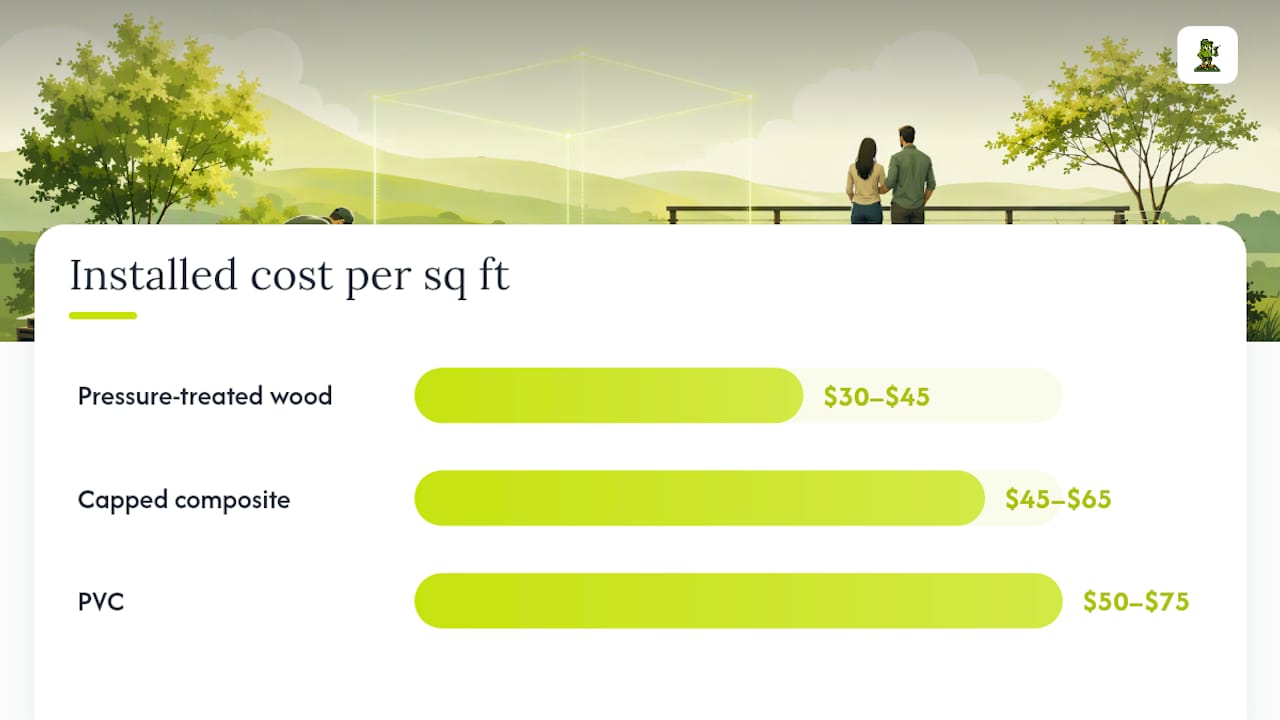
Base recoup percentages sourced from DeckMath’s material-specific model and Cost vs. Value benchmarks. Installed cost ranges from NerdWallet.
PT wood’s higher recoup percentage is partly a math artifact: a lower denominator (project cost) makes the ratio look better even when the added resale value is similar. Composite and PVC cost more to build, so the percentage looks lower, but the dollar amount recovered can be comparable. For a composite deck’s long-term lifespan, the maintenance savings over 10–15 years often close that gap.
TimberTech, a well-known capped-composite brand, offers warranties of 25–30 years on many product lines. That kind of documented warranty transfers to buyers and reduces the negotiation risk that an aging wood deck creates at inspection.
Pro Tip: Match your material to your ownership horizon. Selling within three years? PT wood’s lower cost and solid recoup percentage may make more sense. Staying 10+ years? Composite or PVC pays back through lower maintenance and stronger buyer appeal when you eventually list.
For a detailed side-by-side, composite vs. PVC decking breaks down the practical differences.
What factors move a deck’s ROI the most?
Not all variables carry equal weight. Some can shift your recoup by 15–20 percentage points; others barely register.
Ranked by impact:
Market and region. This is the biggest single variable. West Coast metros, the Northeast, and high-demand suburban markets consistently outperform rural or lower-price-tier markets. Adjust any national figure to your local agent’s comps before making decisions.
Access to the home’s main living area. A deck that flows directly from the kitchen or living room is treated as usable square footage by buyers. One tucked off a bedroom or accessible only through a side door is not.
Scale relative to home value. A deck that represents a disproportionate share of the home’s total value tends to show diminishing returns. Keep the project proportional to what the neighborhood supports.
Condition and maintenance. An aging, unpermitted, or structurally questionable deck becomes a buyer deduction, not an asset. Inspectors flag it; buyers negotiate against it. A well-maintained deck with documented permits does the opposite.
Material and finish. Higher-quality materials signal lower future maintenance costs to buyers, which translates to perceived value. Peeling paint, splintered boards, or faded stain undercut even a well-designed deck.
Permitted work. Unpermitted additions create title and insurance complications. Buyers’ agents routinely flag them. A permitted deck is cleaner to transfer and avoids last-minute renegotiation.
Age also matters mechanically. DeckMath models annual recoup decay rates: roughly 1.8% per year for PT wood, 1.0% for composite, and 0.7% for PVC. A PT deck built five years before sale has already shed about 9 percentage points of its base recoup.
Practical steps to get the most resale value from your deck
Getting the ROI right is less about spending more and more about spending smart.
Right-size the deck. A deck proportional to your home and yard reads as a natural extension of the living space. An oversized deck reads as a maintenance burden.
Connect it to the main living area. Direct access from the kitchen or great room is the single design decision with the highest buyer-appeal payoff.
Choose buyer-friendly materials. Low-maintenance composite or PVC signals “nothing to fix” to buyers. That perception has real dollar value at negotiation.
Prioritize condition and safety. A power-wash, fresh stain or sealant, and tight railings cost a few hundred dollars and can preserve thousands in perceived value.
Add practical features selectively. Lighting and built-in seating increase year-round usability and photograph well. Elaborate pergolas or outdoor kitchens can push costs past what the neighborhood supports.
Avoid overbuilding for your street. Buyers compare your home to neighbors’. A deck that costs more than the neighborhood ceiling for outdoor improvements rarely recoups proportionally.
For quick wins before listing: power-wash the deck surface, touch up any peeling stain or paint, tighten loose railings, and replace any visibly damaged boards. These tasks cost little and remove the “deferred maintenance” signal buyers use to justify lower offers.
Pro Tip: Gather your permit documentation, contractor invoices, and warranty certificates into a single folder before listing. Presenting that package to buyers removes uncertainty and reduces the chance of a last-minute price reduction tied to deck condition.
Adding deck covers or lighting can also extend the perceived usability of the space, which matters in markets where buyers want year-round outdoor living. These improvements also compare favorably to other home upgrades; for context on how targeted projects stack up, interior door upgrades follow a similar logic of proportional investment for proportional return.
Deck vs. patio: which one adds more value?
The answer depends almost entirely on your lot and local market.
Sloped or elevated lots: A deck is often the only practical solution. Patios require level ground; a deck can span grade changes and still connect to the main living area. In these cases, the deck vs. patio question answers itself.
Flat lots with good drainage: A poured concrete or paver patio can cost significantly less than a deck of comparable size, and in some markets the ROI on a well-designed patio plus landscaping matches or exceeds a basic wood deck.
Climate considerations: In the Pacific Northwest and Northeast, a covered deck with weather protection extends usable months and adds buyer appeal. In dry Southwest climates, a patio with shade structure may be equally attractive at lower cost.
When a patio wins on ROI: If your lot is flat, your budget is tight, and your neighborhood skews toward outdoor entertaining rather than elevated living spaces, a patio plus landscaping often delivers better dollar-for-dollar value than a mid-range deck.
When a deck is the clear choice: Elevated lots, homes where the main floor is above grade, and markets where outdoor living is a top buyer priority all favor a deck.
The patio ROI analysis is worth running with a local agent before committing. In many Pacific Northwest markets, a deck is simply expected; a patio reads as a lesser substitute.
Should you build a deck before listing your home?
Timing shapes both the financial math and the practical logistics.
Selling within 12 months: A new deck can add buyer appeal and reduce days on market, but the recoup percentage means you will not recover full cost at sale. Focus on condition improvements to an existing deck first. If building new, keep the project modest and use materials that photograph well and require no immediate maintenance.
Staying 5+ years: The calculus shifts. You get years of personal use, the deck becomes part of the home’s established character, and you have time to choose materials that hold up well. Composite or PVC makes more sense over a longer horizon because the maintenance savings accumulate.
Permitting and build timelines: In most U.S. municipalities, permit approval takes two to eight weeks. Contractor scheduling in peak season (spring and early summer) can add another four to eight weeks. A realistic timeline from decision to finished deck is three to five months in busy markets. Plan accordingly if you have a listing date in mind.
Seasonal demand: Contractors are busiest from April through August. Booking in late fall or winter often means faster scheduling and sometimes better pricing.
How a professional contractor affects your ROI at resale
The difference between a DIY deck and a professionally built one shows up most clearly at the inspection table, not during construction.
A permitted, warranty-backed deck built by a licensed contractor gives buyers confidence. An unpermitted DIY build raises questions about structural integrity, code compliance, and insurance coverage. Buyers’ agents know how to use those questions as negotiating leverage, and the deductions can easily exceed whatever was saved on labor.
Here is what a professional contractor delivers that directly protects resale value:
Accurate line-item estimates so you know exactly what you are paying for and can document it for buyers.
Permit handling from application through final inspection, which produces a clean paper trail.
Structural safety and inspection-ready work that passes buyer due diligence without renegotiation.
Warranty transfer to the new owner, which is a genuine selling point in a competitive market.
Professional-grade finishes that hold up to buyer scrutiny during showings.
A homeowner in Everett who built a PT deck without permits saved roughly $1,500 in permit fees. At closing, the buyer’s inspector flagged the unpermitted structure, and the buyer requested a $6,000 credit to cover potential remediation. The net result: a $4,500 loss compared to doing it right the first time.
Pro Tip: When hiring a contractor, ask specifically for: a copy of the permit application, a lien release at project completion, the warranty certificate with transfer terms, and a detailed invoice broken out by materials and labor. These four documents are your resale protection package.
Cactusdecking handles permitting, uses an in-house build crew, and backs installations with transferable warranties. For homeowners in Everett and surrounding areas, deck design consultations include a discussion of material choices, expected build timelines, and how the project aligns with resale goals. The completed project gallery shows the range of material options and finished quality across real local builds.
How we define “ROI” for decks and what the numbers assume
Recoup percent is the standard metric used across the industry:
Example: A $20,000 deck that adds $10,400 in resale value has a recoup of 52%.
This is not the same as profit. A 52% recoup means you recovered $10,400 of a $20,000 spend. The remaining $9,600 is the net cost of the improvement, offset by years of personal use.
Key assumptions behind the figures in this article:
Project scope includes materials, labor, permits, and standard features (railings, stairs). It excludes landscaping, furniture, and outdoor kitchen appliances unless stated.
Resale value added is estimated at time of sale, not at time of build. Age-related decay applies.
Condition at sale is assumed to be good (maintained, no structural defects, permitted).
National figures are drawn from the Remodeling Cost vs. Value report, DeckMath’s calculator, and Angi’s published benchmarks.
Regional variance is real and significant. The national 50–65% range is a starting point. West Coast and high-demand suburban markets regularly outperform it; rural and lower-price-tier markets often fall below it. Always cross-reference national figures against local agent comps and recent sales data before finalizing your budget.
The ROI number is only part of the story
The financial case for a deck is real, but it is also incomplete on its own. A 52% recoup on a $20,000 composite deck means you spent roughly $9,600 net after resale. That is also five to ten years of outdoor dinners, weekend mornings with coffee, and a backyard your kids actually use. The National Association of Realtors consistently finds that outdoor living improvements rank among the highest for homeowner satisfaction, not just resale performance.
Where I think homeowners go wrong is optimizing purely for recoup percentage. A modest, well-placed deck that connects to your kitchen and fits your yard will almost always outperform a larger, more expensive deck that was built to impress rather than to be used. The luxury deck that costs $50,000 and recoups 45% leaves a $27,500 net cost. A $12,000 PT deck that recoups 60% leaves a $4,800 net cost and serves the same daily function.
The smarter question is not “what is the highest recoup percentage I can get?” It is “what is the right deck for how I live and how long I plan to stay?” Match that answer to your material choice, your budget, and a contractor who can document the work properly, and the financial outcome takes care of itself.
Cactusdecking builds decks that hold their value at resale
Most homeowners leave money on the table not because they chose the wrong material, but because the build was unpermitted, underdocumented, or structurally marginal. Cactusdecking solves all three.
Cactusdecking’s in-house crew in Everett, WA handles the full process: custom deck design aligned to your resale goals, permit applications and inspections, and warranty-backed installations with transferable coverage. When you bring a budget range, site photos, and a rough timeline to a consultation, the team can walk you through expected recoup percentages for your specific lot, material options, and neighborhood price point.
The first question worth asking any contractor: “Can you give me a line-item estimate that separates materials, labor, permits, and structural costs?” If the answer is no, keep looking. Schedule a consultation with Cactusdecking to get that estimate and a clear picture of what your deck investment will return.
Sources
For the most accurate estimate of what a deck will return in your specific market, combine these national baselines with recent local sales comps from a real estate agent who knows your neighborhood. National averages are a floor and ceiling, not a guarantee.