
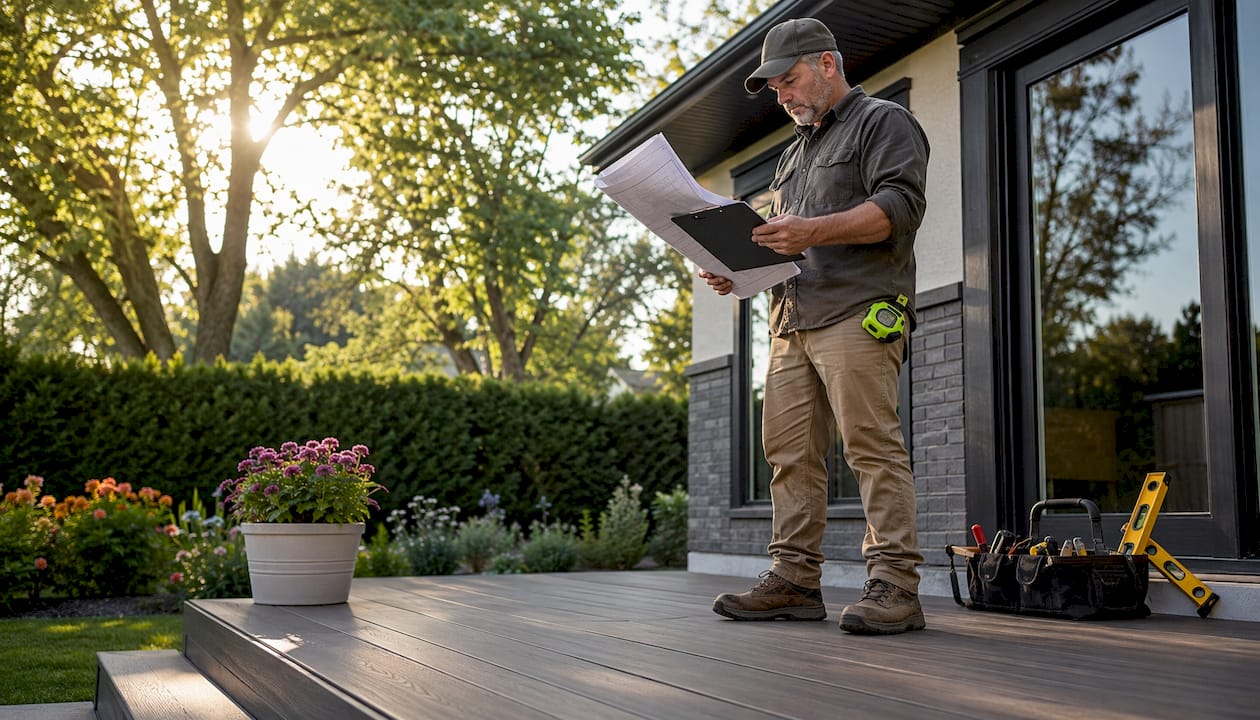
Most homeowners pay a wide range per square foot installed for composite decking, with the national mid-range landing in the $40–$50 range. Materials alone typically run a few dollars per square foot depending on board tier, before labor, railing, and substructure are added. Here is how that total breaks down across a typical project:
- Decking boards: a significant portion of total project cost
- Framing and substructure (PT lumber): a considerable share
- Railing system: often the biggest surprise line item
- Labor: a major part on straightforward builds
- Fasteners and hardware: a smaller cost component
- Permits and disposal: a minor portion
Regional labor markets shift these numbers significantly. Expect the higher end of that range in the Pacific Northwest and coastal metros, and the lower end in parts of the South and Midwest.
Table of Contents
- How much does composite decking cost per square foot?
- What drives the biggest differences between quotes?
- What types of composite decking materials affect price?
- How do Trex, TimberTech, Fiberon, and AZEK compare on price?
- Is composite decking worth the higher upfront cost?
- Should you repair boards or replace the whole deck?
- How do you get accurate contractor quotes?
- How long does a composite deck project take?
- How the cost ranges in this guide were estimated
- Key Takeaways
- Why the substructure is where experienced contractors focus first
- Get an on-site estimate from Cactusdecking in Everett, WA
- Useful sources
How much does composite decking cost per square foot?
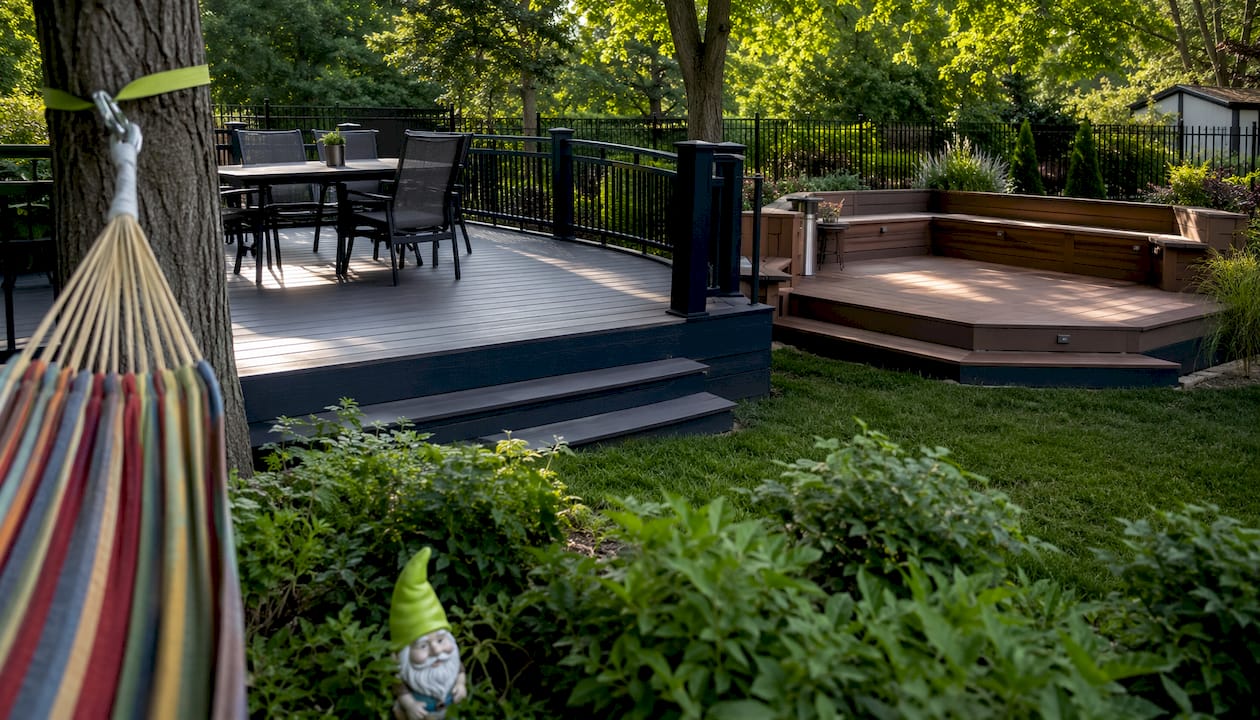
The installed cost range for composite decking spans a wide range at the high end when premium boards, complex layouts, and full railing systems are included. For straightforward builds with mid-tier boards, most contractors charge moderate rates per square foot installed. Material-only costs for the boards vary by quality tier, with premium lines costing more.

Sample project totals by deck size
| Deck size | Sq ft |
|---|---|
| 16×20 | 320 |
| 20×20 | 400 |
| These sizes are typical for estimating materials and installed costs, which vary by region and scope. |
These figures assume a ground-level or single-elevation deck with standard railing on two to three sides, hidden fasteners, and a pressure-treated substructure. Stairs, elevated framing, and premium railing systems push totals toward the upper end.
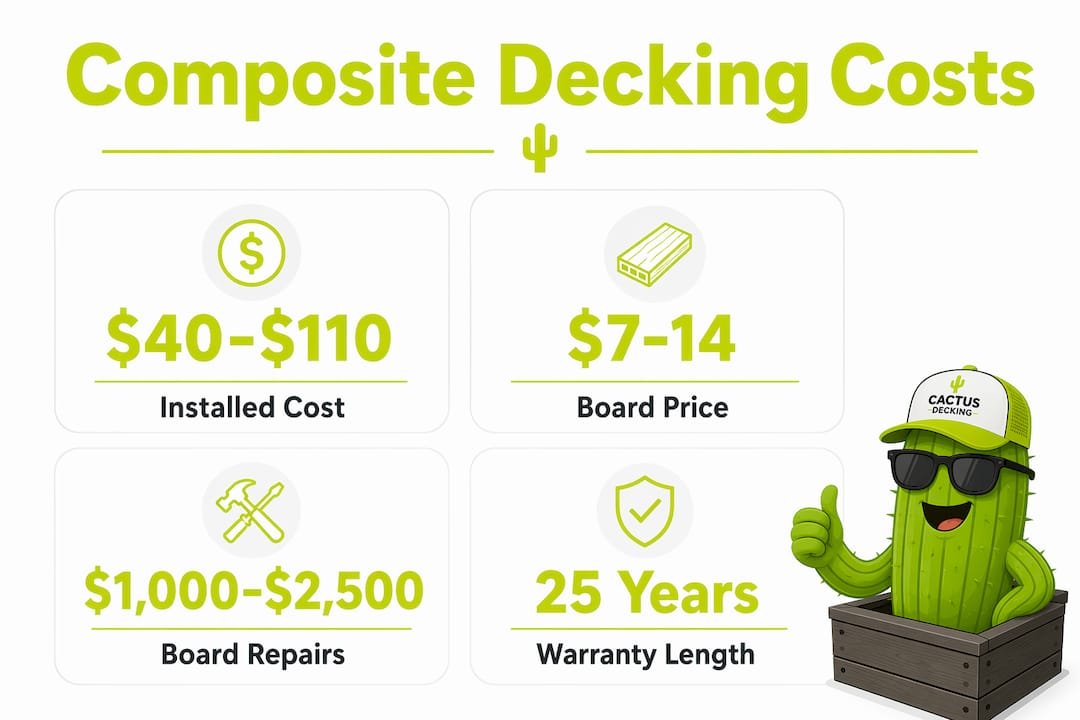
A 12×16 mid-range composite deck commonly falls into a moderate cost range depending on region and options; larger builds typically cost more. The cost-per-square-foot math gets more favorable as the deck grows because fixed costs like permit fees and mobilization spread across more surface area.
Pro Tip: Add a 10% contingency to any sample calculation. Substructure surprises, ledger repairs, and code-required blocking are common discoveries once framing begins.
What drives the biggest differences between quotes?
Two quotes for the same footprint can differ by $5,000 or more. The variables below explain most of that gap.
- Deck size and shape: Larger decks lower the per-square-foot cost; complex shapes (L-shaped, multi-level, picture-frame borders) add both material waste and labor time.
- Elevation and height: A deck raised 4+ feet above grade requires deeper footings, more structural posts, and often cross-bracing. Expect a 20–40% framing cost premium over a ground-level build.
- Stairs: Each stair run adds materials (stringers, treads, risers) and significant labor. A single straight stair run typically adds $1,000–$2,500 to a project; deck stairs with landings or multiple runs cost considerably more.
- Railing type: Composite or aluminum railing systems run $80–$150 per linear foot installed. On a 60-linear-foot perimeter, that is $4,800–$9,000 before a single board is laid.
- Board tier: Entry capped composite versus premium textured boards can differ by $8–$10 per square foot on materials alone.
- Hidden fasteners: Manufacturer-recommended clip systems add roughly $0.50–$1.50 per square foot in materials and extend install time by 25–30% compared to face-screwing wood boards.
- Framing condition: If an existing substructure needs sistering, replacement joists, or new ledger flashing, those repairs add directly to the total.
- Demolition and disposal: Tearing off an old deck typically runs $500–$2,000 depending on size and material.
- Site access: Tight side yards, steep slopes, or limited equipment access slow crews down and raise labor costs.
- Permits: Fees vary by jurisdiction but commonly fall between $150 and $750.
Pro Tip: When comparing multiple bids, ask each contractor to itemize every line separately: board cost, framing, railing, fasteners, labor, permit, and disposal. A bid that bundles everything into one number makes it impossible to spot where the price difference actually lives.
What types of composite decking materials affect price?
The term “composite decking” covers four distinct material categories, and they do not all price the same.
Capped wood-plastic composite (WPC) is the most common. A polymer shell wraps a wood-fiber core, protecting against moisture and UV. Entry-level capped WPC runs $7–$12 per square foot for boards; mid-tier versions with deeper embossing and richer color blends run $12–$16 per square foot.
PVC (cellular PVC) decking contains no wood fiber at all, making it the most moisture-resistant option. It handles high-humidity environments and pool surrounds better than WPC. The tradeoff is price: PVC boards typically run $15–$22 per square foot, and the material expands and contracts more with temperature swings, requiring careful gapping.
Mineral-enhanced composite blends stone or mineral particles into the core for added hardness and slip resistance. These boards are less common but show up in commercial and high-traffic residential applications. Pricing is similar to or slightly above premium PVC.
Entry-level capped composite (thinner cap, fewer color options) is the budget tier. It performs adequately in moderate climates but carries shorter warranties and less UV protection than mid or premium lines.
| Material type | Board cost per sq ft | Typical warranty | Best for |
|---|---|---|---|
| Entry capped WPC | $7–$12 | 10–15 years | Budget builds, low-traffic areas |
| Mid-tier capped WPC | $12–$16 | 25 years | Most residential decks |
| PVC / cellular | $15–$22 | 25–30 years | Pool surrounds, high humidity |
| Mineral-enhanced composite | $15–$22 | 25–30 years | High-traffic, slip-sensitive areas |
Warranty length is a real proxy for cap quality. A 25-year fade-and-stain warranty means the manufacturer is confident in the cap’s UV resistance. A 10-year warranty on a budget board is telling you something about what is underneath.
How do Trex, TimberTech, Fiberon, and AZEK compare on price?
Every major brand runs three tiers internally, and the tier matters more than the brand name when budgeting. Here is what to expect across the four manufacturers homeowners see most often.
| Brand | Entry tier (boards/sq ft) | Mid tier (boards/sq ft) | Premium tier (boards/sq ft) | Warranty | Maintenance |
|---|---|---|---|---|---|
| Trex | $5–$8 | $8–$12 | $12–$16 | 25 years (fade/stain) | Annual wash |
| TimberTech | $7–$10 | $10–$14 | $14–$20 | 30 years (select lines) | Annual wash |
| Fiberon | $6–$9 | $7–$12 | $12–$16 | 25–50 years (line dependent) | Annual wash |
| AZEK (PVC) | $12–$16 | $16–$20 | $20–$25+ | 30 years | Annual wash |
AZEK is a PVC product, not a wood-composite, which explains its higher floor price and longer warranty. Fiberon’s top lines carry some of the longest fade-and-stain warranties in the category. Trex’s entry line (Enhance) is widely available at big-box retailers and is often the price anchor homeowners use to sanity-check contractor quotes.
A few things worth knowing before you read a quote that names a specific brand:
- MSRP is a starting point. Distributor pricing and dealer markups mean the same board can vary 15–25% in cost between suppliers.
- Installed cost per square foot is what matters. A cheaper board paired with a complex layout can cost more than a premium board on a simple rectangle.
- Color and finish affect price within a tier. Variegated, multi-tone boards cost more than solid-color options even within the same product line.
Browse the Cactusdecking gallery to see how different board lines look in finished Pacific Northwest builds before committing to a material.
Is composite decking worth the higher upfront cost?
Pressure-treated wood starts around $3–$6 per square foot for boards, which makes it look like the obvious budget winner. Over 20–25 years, that math changes.
Wood decks need periodic staining and sealing. Hiring that work out typically runs around $3 per square foot for stain and $2 per square foot for sealer. On a 300-square-foot deck, that is roughly $1,500 every 3–5 years. Add occasional board replacements for rot or warping, and the cumulative maintenance bill climbs fast.
Composite requires an annual wash, which most homeowners handle themselves with a composite-safe cleaner and a soft brush. No staining, no sealing, no board rot.
A few additional factors that affect the long-term value calculation:
- Resale perception: Buyers recognize low-maintenance upgrades. A 16×20 composite deck addition recoups approximately 68% of its cost at resale nationally, a useful benchmark when weighing the investment.
- Lumber tariff effects: Material price increases of 5–10% in late 2025 and early 2026 narrowed the upfront cost gap between composite and pressure-treated wood, since lumber prices also rose.
- Lifespan: Quality composite boards carry 25–30 year warranties. Most pressure-treated decks need significant work or full replacement within 15–20 years.
- Regional climate: In wet climates like the Pacific Northwest, composite’s moisture resistance makes the break-even case even stronger.
Should you repair boards or replace the whole deck?
Spot repairs make sense when the substructure is sound and damage is limited to a handful of boards or a single railing section. Full replacement becomes the right call when joists are rotted, footings have shifted, or more than 30–40% of the surface needs work.
Typical repair costs:
- Replace 5–10 composite boards: $400–$1,200 (materials and labor)
- Replace a 10-foot railing section: $800–$1,500 installed
- Swap stair treads on one run: $300–$700
- Reattach or replace ledger flashing: $500–$1,500
Sample comparison on a 320 sq ft deck:
| Scenario | Estimated cost |
|---|---|
| Repair 15 boards + one railing section | $1,000–$2,500 |
The decision hinge is the substructure. If a contractor opens up the framing and finds rotted joists, compromised ledger connections, or footings that have heaved, a surface-only repair will not hold. Composite board warranties also typically require installation over a structurally sound, code-compliant frame. Skipping substructure repairs to save money today usually means a full deck replacement in 3–5 years instead of 15–20.
How do you get accurate contractor quotes?
Three bids is the minimum. One bid gives you a number; three give you a market. Here is what a complete, comparable bid should include:
- Itemized line items: boards, framing, railing, fasteners, labor, permit, and disposal listed separately
- Brand and product line name: not just “composite decking” but the specific manufacturer and line (e.g., Trex Transcend, TimberTech Azek)
- Fastener system specified: hidden clip system or face-screw, and which manufacturer’s clip
- Framing assumptions stated: new PT lumber substructure, or work with existing framing (and what happens if existing framing needs repair)
- Railing scope: linear footage, post spacing, baluster style, and whether post bases are surface-mount or through-post
- Permit and inspection responsibility: who pulls the permit, who pays the fee, who is present for inspections
- Schedule: estimated start date, duration, and what happens if materials are delayed
- Warranty: both the manufacturer’s product warranty and the contractor’s installation warranty
- Insurance proof: general liability and workers’ compensation certificates
When bids use different allowances for railing or stairs, those line items are not comparable. Ask each contractor to price the same railing linear footage and the same stair configuration so you are reading the same project across all three quotes.
Pro Tip: Book your consultation in late fall or winter. Crews are less booked, and some contractors offer off-season pricing. You also lock in your start date before the spring rush fills their calendars.
The Everett deck design service process at Cactusdecking includes material selection, layout planning, and permitting guidance before a single board is ordered.
How long does a composite deck project take?
From first conversation to final inspection, most residential composite deck projects run 6–14 weeks total. Here is where that time goes:
- Design and quote period: 1–3 weeks (site visit, drawings, bid review)
- Permit application and approval: 2–6 weeks depending on jurisdiction (some municipalities process in days; others take longer during busy seasons)
- Demolition of existing deck (if applicable): 1–2 days
- Footing excavation and concrete cure: 3–7 days (concrete needs cure time before framing begins)
- Framing and substructure: 2–5 days for a standard residential deck
- Decking board installation and railing: 3–7 days
- Final inspection: 1–3 days after completion notice is filed
Permit fees for a residential deck project commonly fall between $150 and $750. Inspectors typically check footing depth and diameter, ledger flashing and attachment, and railing height and baluster spacing. Some jurisdictions require a mid-project framing inspection before decking boards go down.
Spring is the busiest season for deck contractors. If you want a summer deck, start the quote process in January or February. Waiting until April means competing with every other homeowner who had the same idea, and bids often reflect that demand.
How the cost ranges in this guide were estimated
The figures throughout this guide draw on manufacturer MSRP data, national remodeling cost calculators, contractor-aligned pricing databases, and regional labor indices for 2026.
Core assumptions used in sample calculations:
- Substructure is new pressure-treated lumber (joists, beams, posts, and footings)
- Hidden-fastener clip systems are used throughout (manufacturer-recommended for composite)
- Railing is included on two to three sides of the deck at standard linear footage for each size
- A 10% contingency is built into installed totals to reflect common field discoveries
- Labor rates reflect national mid-range figures, not any single regional market
The composite vs. pressure-treated pricing data used for board-only material ranges reflects 2026 contractor-aligned figures. Permit fee ranges draw on national remodeling data and local jurisdiction surveys.
Key Takeaways
Composite decking costs more upfront than pressure-treated wood, but the installed range of $40–$110 per square foot and a break-even point of 10–14 years make it the stronger long-term investment for most homeowners.
| Point | Details |
|---|---|
| Installed cost range | Most homeowners pay $40–$110 per sq ft installed; mid-range projects run $40–$50 per sq ft nationally. |
| Materials vs. labor split | Board materials run $7–$22 per sq ft; labor typically accounts for 35–50% of the installed total. |
| Railing is the surprise | Composite or aluminum railing runs $80–$150 per linear foot installed, adding $4,800–$9,000 on a 60-LF perimeter. |
| Break-even vs. wood | Composite typically breaks even with pressure-treated wood between years 10 and 14 when maintenance costs are counted. |
| Cactusdecking next step | Cactusdecking provides itemized on-site estimates in Everett, WA, covering materials, permitting, and warranty-backed installation. |
Why the substructure is where experienced contractors focus first
Most homeowners think about the boards. Experienced installers think about what is underneath them.
The substructure — joists, beams, footings, and the ledger connection to the house — determines whether a deck is safe, whether it will hold its warranty, and whether the surface boards will stay flat and gap-consistent over 25 years. A composite board installed over a sagging joist will telegraph that sag within two seasons. Footings that do not reach below the frost line will heave, pulling the whole structure out of level. These are not cosmetic problems; they are structural ones.
Composite installation also has a specific labor requirement that wood does not. Manufacturer-recommended hidden-fastener clip systems are required to maintain warranty coverage on most major brands. Those clips allow the boards to expand and contract with temperature changes without buckling. Installing them correctly takes roughly 25–30% longer than face-screwing wood boards, which is why composite labor costs more even when the crew size is identical. Crews that skip the clips to save time are voiding the warranty on boards that cost two to three times more than wood.
Red flags in a contractor bid:
- No mention of permit or inspection
- Railing priced as a single lump sum with no linear footage stated
- No specification of fastener system
- Warranty limited to “workmanship” with no duration stated
- No proof of general liability insurance provided
Positive signs:
- Itemized line items with quantities
- Specific brand and product line named
- Written installation warranty (separate from manufacturer warranty)
- Permit pulled in contractor’s name
- References or portfolio of completed local projects
A bid that cannot answer “what fastener system are you using and why?” is a bid from someone who has not thought carefully about the install. That question alone tells you a lot.
Get an on-site estimate from Cactusdecking in Everett, WA
Cactusdecking builds composite, PVC, and cedar decks for homeowners across the Everett area with an in-house crew, warranty-backed installations, and a clear process from first consultation through final inspection.
Every estimate includes a site visit, itemized material and labor costs, specific product line recommendations, and permitting guidance so you know exactly what you are signing before work begins. There are no bundled mystery numbers. If the substructure needs attention, that gets flagged and priced separately before the contract is signed, not discovered mid-project.
Browse the project gallery to see finished composite and PVC builds across a range of sizes and styles. When you are ready to move forward, request a custom installation estimate and a member of the Cactusdecking team will schedule your on-site consultation.
Useful sources
The figures and ranges in this guide draw on the following primary sources. Pull a local quote and verify material costs with your distributor before finalizing any budget.
- DeckMath Composite Deck Cost Calculator: Interactive calculator with installed cost ranges by board tier and region; useful for generating a rough project estimate before contacting contractors.
- D and G Flooring Composite Deck Cost Guide: Detailed breakdown of line-item percentages, railing costs, and regional labor variance for 2026.
- RemodelCalculators Deck Cost Guide: Sample project totals by deck size and material, including composite and wood comparisons.
- CostToRenovate 2026 Deck Building Cost: Analysis of 2025–2026 material price increases and the narrowing cost gap between composite and pressure-treated wood.
- FieldRate Composite vs. Pressure-Treated Pricing Guide: Contractor-aligned board-only material cost ranges and hidden-fastener labor notes for 2026.
- ThePricer Composite Decking Cost Overview: National installed ranges, size-based examples, and maintenance cost comparisons drawing on Angi’s 2025 composite cost data.


