

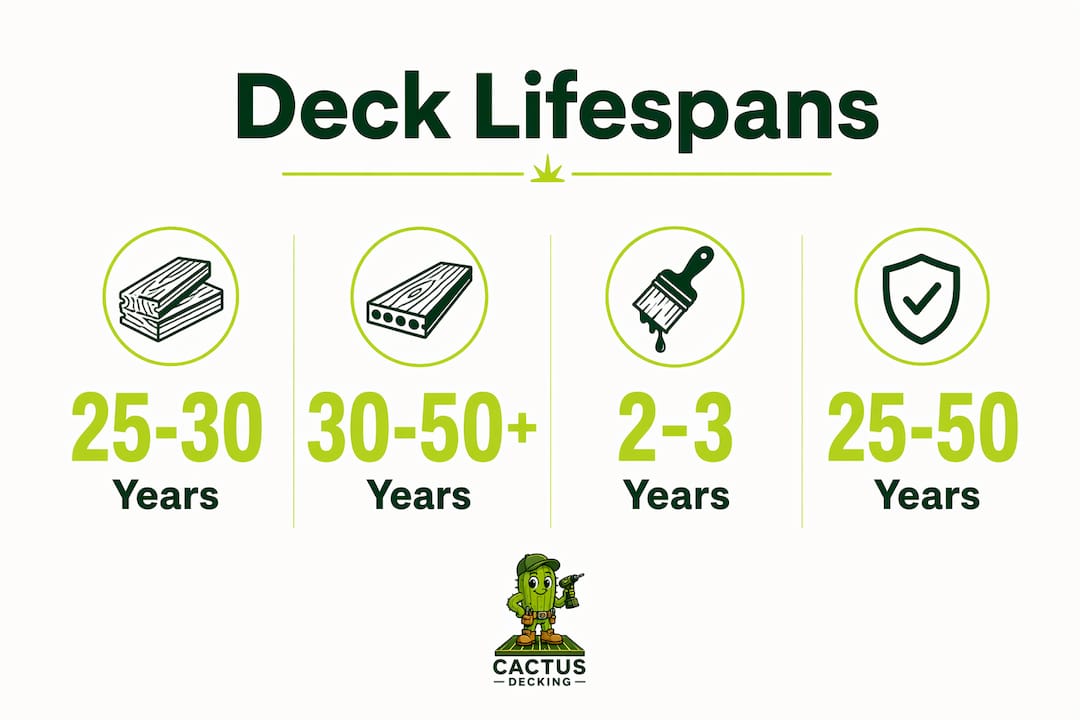
Modern capped composite boards typically last 25–30 years in real-world conditions. High-end capped PVC can last 30–50+ years. Older uncapped boards, the kind installed before polymer-shell technology became standard, often fall short at 10–20 years. Here’s the quick picture:
- Capped composite: typically 25–30 years
- Capped PVC: 30–50+ years
- Uncapped/older composite: 10–20 years
- Pressure-treated wood: shorter lifespan with regular maintenance
- Tropical hardwoods (e.g., ipe): tend to last longer than treated wood
One caveat worth knowing before you read further: the boards themselves often outlast the framing beneath them. When a composite deck fails early, the substructure is usually the reason, not the surface material.
Table of Contents
- How long does composite decking last compared to other materials?
- What actually makes a composite deck last (or fail early)?
- A practical maintenance schedule that actually protects your deck
- How to tell when repair is enough vs. when you need a replacement
- Installation choices that determine how long your deck actually lasts
- When to call a warranty-backed local contractor
- Key Takeaways
- What builders see that homeowners usually miss
- Cactusdecking builds decks designed to reach their full lifespan
- Useful sources and further reading
How long does composite decking last compared to other materials?
| Material | Typical Lifespan | Warranty Range | Maintenance Needs |
|---|---|---|---|
| Capped composite | 25–30 years | varies by product | Low (clean twice yearly) |
| Capped PVC | 30–50+ years | varies by product | Very low |
| Uncapped composite | 10–20 years | varies by product | Moderate |
| Pressure-treated wood | shorter lifespan | limited or none | High (periodic maintenance) |
| Tropical hardwood (ipe) | tends to last longer | rare | Moderate to high |
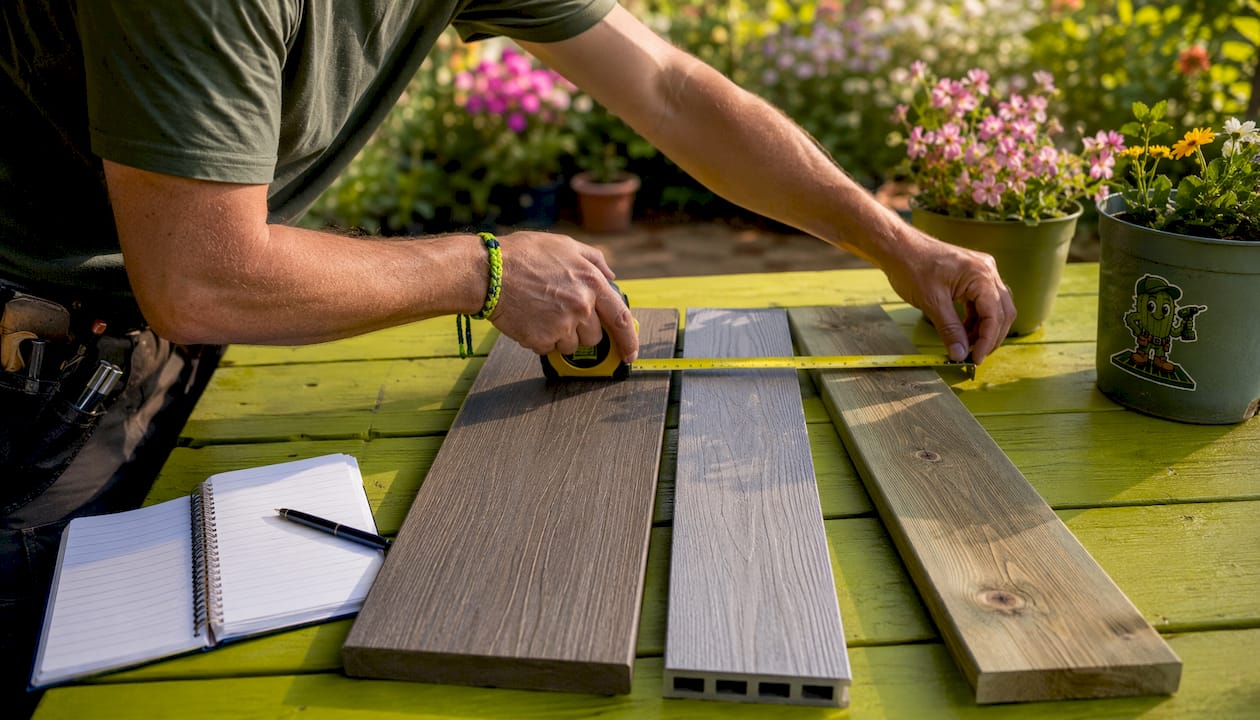
“Capped” means the wood-plastic composite core is wrapped in a continuous polymer shell. That shell is what resists UV fading, surface staining, and moisture absorption. Without it, the organic wood fibers in the core are exposed and will degrade faster. Fully capped boards reliably resist fade, stain, and moisture far better than their uncapped predecessors, and that difference compounds over decades.
Manufacturer warranties run roughly 25–50 years depending on product tier, and they’re a useful purchasing signal. A 25-year fade-and-stain warranty on a capped composite line tells you the manufacturer has enough confidence in the cap to back it financially. A 10-year warranty on an uncapped board tells you something different.
Compared to pressure-treated wood, which needs staining or sealing every two to three years, composite’s maintenance advantage is real. Consumer Reports notes that composite decking doesn’t need sealing, staining, or painting the way real wood does. Mid-tier composite decking generally provides cost savings compared to pressure-treated wood over time, depending on maintenance costs and region.
What actually makes a composite deck last (or fail early)?
Material quality matters, but it’s not the whole story. Four variables move a deck from the headline lifespan number to what actually happens on your property.
Material quality and capping. Capped composite and capped PVC are the right choices for anyone expecting 25+ years. Buying the cap is the single most cost-effective durability decision you’ll make at purchase time.
Installation quality. Flashing at the ledger board, proper fastener type, adequate drainage gaps between boards, and correct joist spacing all affect how long the deck performs. A board installed over a rotting ledger won’t reach its warranty period regardless of its chemistry.
Substructure health. The biggest lifespan threat is the framing, not the boards. Pressure-treated joists exposed to trapped moisture decay faster than capped composite above them. Joist tape and protective membranes extend framing life to match the surface boards.
Site and climate. Coastal salt air accelerates fastener corrosion. Freeze-thaw cycles stress fastener connections. Shaded, poorly ventilated decks accumulate moisture, and composites with organic cores can develop mold and surface staining without regular cleaning and adequate airflow.
The boards are rarely the weak link. Contractors consistently report that framing decay and ledger rot drive full rebuilds long before capped composite boards fail. Protect the structure and the surface takes care of itself.
Pro Tip: Before signing any installation contract, ask specifically how the contractor handles ledger flashing and joist protection. Those two details predict long-term performance better than board brand alone.
A practical maintenance schedule that actually protects your deck
Composite decking is not maintenance-free. It’s low-maintenance, which is a meaningful difference.
- Weekly or after heavy debris events: Sweep or leaf-blow the surface. Wet leaves sitting in board gaps are the primary source of organic staining and the condition that allows mold to establish.
- Twice a year (spring and fall): Deep-clean with mild soap or a manufacturer-approved cleaner. Simple Green guidance recommends at least two deep cleans annually. Work with the board grain, rinse thoroughly, and clear all gaps.
- Avoid: Pressure-washing at high settings (it can erode the cap layer), bleach-based cleaners that degrade polymer shells, and letting organic debris pack into board gaps over winter.
- Annual structural inspection: Get under the deck. Look for pooling water, check the ledger flashing for gaps or rust staining, press joists for soft spots, and inspect fasteners for corrosion. Five minutes with a flashlight can catch a $200 repair before it becomes a $10,000 rebuild.
- Budget: Annual maintenance typically requires mild cleaner, a stiff brush, and an hour or two of time. The cost is minimal; the payoff is a deck that reaches its warranty period.
How to tell when repair is enough vs. when you need a replacement
Cosmetic aging and structural failure look different, and treating them the same is expensive.
Signs that are cosmetic, not structural: Light surface fading, minor scratching, and isolated staining. These don’t require board replacement. A good cleaning or a manufacturer-approved composite cleaner handles most of them.
Signs that need a contractor’s attention:
- Boards that feel spongy or flex noticeably underfoot
- Visible sagging or concentrated deflection in a section of the deck
- Persistent pooling of water under the deck after rain
- Soft, discolored, or visibly rotted joists
- Rusted or backing-out fasteners
- Railing posts that wobble or feel loose at their base
When railing attachment or stair stability is compromised, stop using the deck. Movement in those connections is a structural safety issue, not a cosmetic one. The U.S. Consumer Product Safety Commission’s home safety checklist specifically flags loose railings and unstable stairs as priority outdoor hazards.
Many homeowners replace composite decks after 20–25 years for aesthetic reasons, not because the boards have failed. If the framing is sound, surface-board replacement only is a cost-effective option. If the framing is compromised, a full rebuild is the right call.
Installation choices that determine how long your deck actually lasts
The decisions made on installation day have a longer impact on composite deck lifespan than almost anything that happens afterward.
- Joist spacing: Composite and PVC boards are heavier than wood and flex differently. Using wood-standard joist spacing for composite can cause flex and sag over time. Always follow the manufacturer’s spacing tables, not default framing conventions.
- Ledger flashing: The ledger is where the deck meets the house. Improper flashing here is the leading cause of ledger rot and the most common reason a structurally sound deck needs a full rebuild. Flashing must be continuous, lapped correctly, and sealed at penetrations.
- Ventilation and drainage: Decks built too close to grade trap moisture and restrict airflow. A minimum clearance of 12 inches beneath the deck is a common guideline for adequate ventilation. Board gaps (typically 3/16 to 1/4 inch) must stay clear to drain water and allow airflow.
- Joist tape and membranes: Applying self-adhesive joist tape to the top of every joist before laying boards is one of the highest-value, lowest-cost steps in composite installation. It prevents water from sitting on the framing and extends joist life by years.
- Fasteners: Use stainless steel or manufacturer-specified composite fasteners. Standard galvanized fasteners corrode faster in wet climates, and backing-out fasteners create trip hazards and board movement.
Pro Tip: When reviewing contractor bids, ask to see the manufacturer’s installation guide for the specific board product. A contractor who can’t produce it or doesn’t reference it is a red flag.
Thinking through Everett deck design service before construction starts, including drainage, ventilation clearance, and material specs, is far cheaper than correcting them after the fact.
When to call a warranty-backed local contractor
Some deck work is genuinely DIY-friendly. Structural assessment, ledger repair, and full rebuilds are not.
A reputable contractor should inspect and deliver:
- A framing inspection before any surface work begins
- Proper ledger flashing installed or verified
- Joist tape or membrane on all framing members
- Manufacturer-compliant joist spacing confirmed for the specific board product
- Correct fastener type for the board and climate
- Documentation of both material and installation warranties
Warranty-backed installation is not just a sales point. new deck installation service and a contractor-backed installation warranty are what protect your investment if something goes wrong in year 8 or year 15. Without them, a material warranty may be voided by an installation defect.
Ask any contractor for their installation warranty terms, the material warranty documentation for the specific product line, and examples of local completed work. A contractor who hesitates on any of those three is worth walking away from.
When the framing is sound and only surface boards have aged, a partial replacement makes sense and costs significantly less than a full rebuild. When joists, beams, or the ledger show rot or movement, a full rebuild protects you from doing the same job twice in five years. For homeowners in the Everett area, deck replacement services that include framing inspection are the right starting point before committing to surface-only work.
Key Takeaways
Capped composite boards typically last 25–30 years, but the substructure is the real lifespan limiter: protect the framing and the surface takes care of itself.
| Point | Details |
|---|---|
| Lifespan by material | Capped composite: 25–30 years; capped PVC: 30–50+ years; uncapped boards: 10–20 years. |
| Biggest threat to lifespan | Substructure moisture and rot cut deck life short before boards fail; joist tape and flashing are the fix. |
| Most important purchase decision | Choose fully capped composite or PVC; the polymer shell is what delivers 25+ years of fade and stain resistance. |
| Maintenance commitment | Sweep regularly and deep-clean twice a year; annual under-deck inspection catches framing issues early. |
| Cactusdecking’s role | Warranty-backed installation in Everett, WA, with framing inspection, proper flashing, and manufacturer-compliant builds. |
What builders see that homeowners usually miss
The most common mistake isn’t choosing the wrong board. It’s trusting that a beautiful surface means a sound structure underneath. Joist spacing errors, skipped ledger flashing, and blocked ventilation are the three installation shortcuts that generate the most long-term complaints. None of them are visible once the boards go down.
The good news: most of these failures are preventable at low cost during construction, and even an existing deck can be improved. Clearing debris from board gaps, improving drainage at the base, and getting a professional to inspect the ledger flashing are all steps that cost far less than a rebuild. A deck that’s cleaned twice a year and inspected annually will almost always reach its warranty period. One that isn’t often doesn’t.
Cactusdecking builds decks designed to reach their full lifespan
Replacing a deck because of a flashing mistake or skipped joist tape is one of the most avoidable home repair costs there is. Cactusdecking’s in-house crew in Everett, WA, handles the details that determine whether a composite deck reaches 25 years or falls short: manufacturer-compliant joist spacing, continuous ledger flashing, joist protection, and proper fasteners for the Pacific Northwest climate. Every build comes with warranty-backed installation documentation so you know exactly what’s covered and for how long.
Whether you’re planning a new build or wondering if your existing deck’s framing is worth keeping, the right starting point is a professional assessment. Request a custom installation quote or browse completed projects in the Cactusdecking gallery to see what a properly built composite deck looks like after years of Pacific Northwest weather.
Useful sources and further reading
The claims in this article draw from manufacturer guidance, independent contractor observations, and product testing. Before purchasing or installing composite decking, consult the manufacturer’s installation instructions for your specific product line. Deviating from those instructions can void both the material and structural warranty.
A note on warranty compliance: Manufacturer installation guides specify joist spacing, fastener type, gap sizing, and flashing requirements. These are not suggestions. A contractor who follows them protects your warranty; one who doesn’t leaves you exposed.
Key sources used:
- How Long Does Composite Decking Last? — Composite Deck Direct
- How Long Does Decking Last? — TimberTech
- TimberTech Building Code & Joist Spacing Guide (PDF)
- Best Composite Decking — Consumer Reports
- How to Clean a Composite Deck — Simple Green
- Composite vs. Wood Decking — DeckMath
- Composite vs. Wood Decking — ForestSource
- How Long Does Composite Decking Last? — Kirchner Custom Decks
- Home Safe Outdoor Repairs Checklist — U.S. CPSC
- Deck Installation — Cactusdecking


