Cut Composite Decking Heat: 4 Design Moves Homeowners Must Demand
Discover why composite decking gets hot, which color, ventilation, and shade choices change peak and cooldown, and four design moves to demand from...
Cut Composite Decking Heat: 4 Design Moves Homeowners Must Demand
Yes, composite decking gets hot in direct sun, and how hot depends on board color, material formulation, and how much airflow and shade the deck gets. Dark boards in full sun can become uncomfortable to walk on barefoot by midday. You can cut peak surface temperature meaningfully by choosing lighter colors, planning shade into the design, and making sure the substructure allows air to move underneath the boards.
TL;DR:
Lighter-colored boards and reflective surfaces reduce peak temperatures, but actual heat levels depend heavily on sun angle, airflow, and shading.
Proper deck airflow underneath and correct spacing help speed up cooling and prevent heat buildup from thermal expansion.
PVC decks tend to cool faster after peak sun exposure but can reach similar high temperatures as composite boards in direct sunlight.
Asking for real full-sun exposure samples and considering integrated shading from the start are essential for managing heat in sunny climates.
Safe barefoot comfort depends on testing deck surface temperatures during peak hours, not just on color or material alone.
CactusdeckingDesign A Cooler Outdoor SpaceCactus Decking creates tailored outdoor living spaces with composite, PVC, or cedar materials and thoughtful design for lasting comfort.Explore Cactus Decking
Table of Contents
Why composite decking heats up in the sun
How hot do composite decks actually get?
Does material type and color change how hot a deck feels?
Design and installation choices that lower deck temperature
What actually cools down a hot deck
Is a hot deck safe for bare feet and pets?
What to ask a contractor before you build
Planning for comfort without giving up on durability
Build a deck that stays comfortable, not just beautiful
Sources
Why composite decking heats up in the sun
A deck board’s temperature comes down to basic physics rather than brand marketing. Dark surfaces absorb more of the sun’s energy than light ones, a property called albedo, so a charcoal-gray board will always run hotter than a sand-colored one under the same sun. Once that energy is absorbed, emissivity determines how fast the board releases heat back into the air: some capped surfaces radiate heat away quickly, others hold it longer.
Thermal mass and conductivity also matter. Denser boards can take longer to heat up but also longer to cool down once the sun moves off them, while lighter, less dense materials may spike and drop faster. The USDA Forest Products Laboratory has published equations and albedo tables specifically for estimating maximum surface temperature of exterior wood products from solar input, air temperature, and surface properties.
Solar radiation intensity and the board’s albedo set the ceiling on absorbed heat.
Emissivity controls how quickly that heat radiates back out once shade or evening arrives.
Wind and airflow around and under the deck pull heat away through convection.
Orientation and nearby structures create microclimates that shift readings board by board.
How hot do composite decks actually get?
Peak temperature varies enormously with color, exposure length, and airflow, which is why two decks in the same yard can feel completely different underfoot. Controlled radiant-heat testing at the University of Maryland measured how decking materials respond to set heat flux levels, giving a way to compare temperature rise across materials rather than relying on anecdotal touch tests.
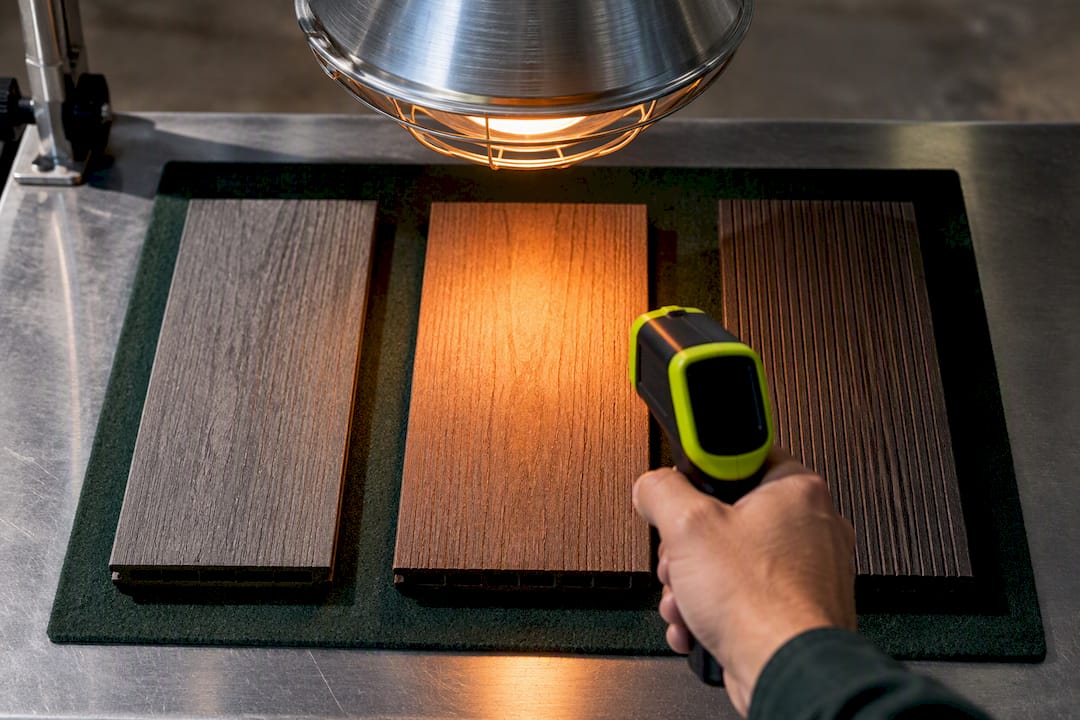
Radiant-heat testing shows decking temperature response scales directly with incident solar flux, according to the University of Maryland’s experiments, meaning the same board can read very differently depending on sun angle and cloud cover during the test.
Cooldown behavior matters as much as the peak number. A board that reaches a high temperature but sheds heat fast can feel more tolerable underfoot than one that peaks lower but stays hot longer.
Board color and formulation set the starting point for how much heat is absorbed.
Length of direct exposure changes how close a board gets to its practical peak.
Airflow above and below the board speeds up cooling once shade returns.
Ambient air temperature shifts the whole curve up or down regardless of material.
Does material type and color change how hot a deck feels?
Wood-plastic composites (WPC), PVC decking, and capped composites all handle heat differently because of what they’re made of. WPC boards blend wood fiber with plastic, and their thermal expansion and dimensional stability change with fiber content and filler type. Peer-reviewed research on WPC formulations found that higher wood-fiber content can improve dimensional stability in some ranges, while lubricants and fillers shift how the material expands and contracts as it heats and cools. PVC decking contains no wood fiber at all, which changes both its thermal mass and how it ages under repeated heat cycles, a distinction covered in more depth in our comparison of composite versus PVC decking.
WPC boards tend to have more thermal mass, which can mean slower heating but slower cooling too.
PVC boards often feel cooler to the touch sooner after peak sun, even when infrared readings are close to composite samples.
Capped composites add a protective shell that changes surface emissivity independent of the core material.
Lighter colors and grays absorb less solar energy than deep browns or charcoal tones, lowering peak readings.
Pro Tip: Ask for a sample board in your actual color choice and leave it in full sun for an hour before you commit, since color swatches indoors tell you nothing about real heat behavior.
Design and installation choices that lower deck temperature
The way a deck is built affects how hot it gets just as much as the material itself. Airflow underneath the boards helps pull heat away through convection instead of letting it radiate back up all day. Manufacturers specify spacing and fastening patterns partly to manage this airflow and partly to accommodate the thermal expansion documented in WPC thermal behavior research, which shows expansion coefficients differ across formulations.
Confirm the substructure allows real airflow underneath the boards, not just a token gap at the edges.
Follow the manufacturer’s exact spacing and fastening specifications to leave room for thermal movement.
Orient the deck and plan overhangs or shade structures at the design stage rather than as an afterthought.
Ask whether board orientation relative to the sun’s path was considered before installation began.
Retrofitting shade after a deck is finished is almost always more expensive and more visually disruptive than designing it in from the start.
What actually cools down a hot deck
Not every fix delivers the same payoff, so it helps to know what to try first. Shade is the highest-impact option available to most homeowners: a pergola, retractable awning, shade sail, or strategically placed umbrellas block direct solar radiation before it ever hits the boards, and our guide to contractor-grade shade ideas covers options that last well beyond a single season. Plantings and trellised vines offer a slower but lower-cost route to the same effect.
Outdoor rugs and removable tiles create an immediate barrier between bare feet and a hot surface.
Reflective coatings can lower absorbed heat, though homeowners should confirm compatibility with the manufacturer before applying anything to a capped board.
Misting systems and small water features cool the air above a deck but add ongoing water and maintenance costs.
Keeping boards clean preserves whatever reflectivity the surface finish was designed to provide.
Pro Tip: Skip dark stains or paints on any deck zone that sits in full sun most of the day, since you’re undoing the color benefit you’d otherwise get from a lighter board. Layering a shade sail with light-colored outdoor furniture, an approach detailed in Homable’s outdoor styling guide, can reduce both surface and perceived heat without a major structural project.
Is a hot deck safe for bare feet and pets?
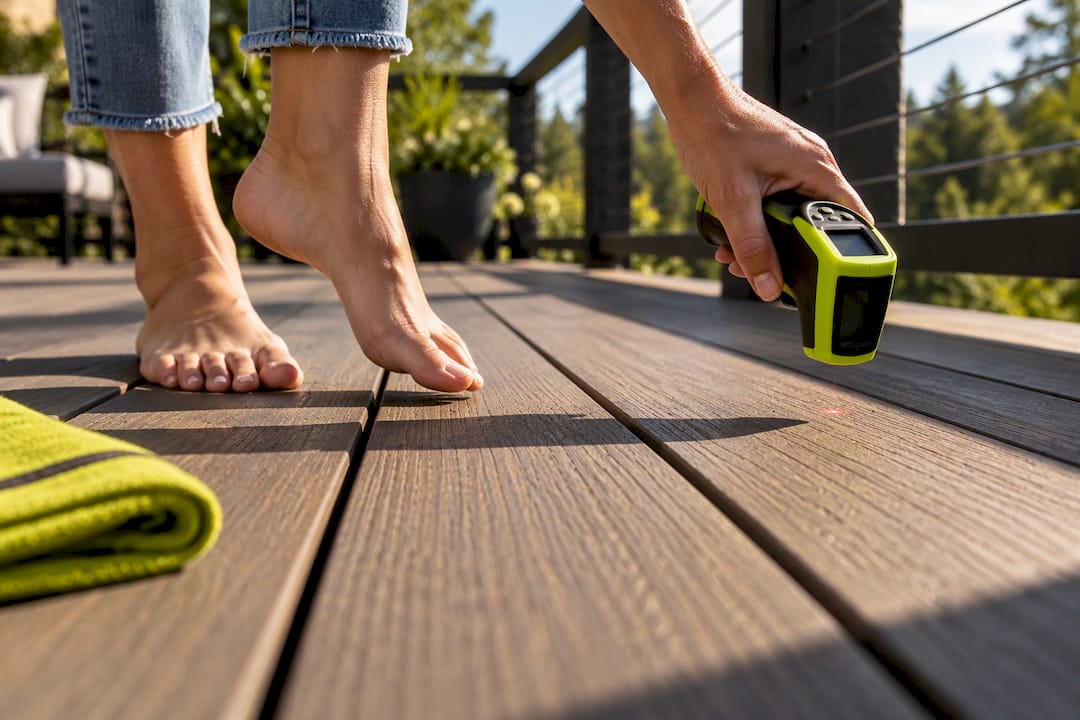
Comfort and safety are separate questions from durability, and both deserve attention before peak summer arrives. A quick way to test a deck’s real-world comfort is to walk it barefoot yourself in early afternoon sun rather than relying on the color chip or a manufacturer’s claim.
Test board temperature by hand or bare foot during peak sun hours before assuming a color choice is comfortable.
Watch for signs of cupping, warping, or gaps that have shifted beyond the manufacturer’s spec, which can signal heat-related movement.
Ask installers what gap tolerances and fastening methods they used, since these directly affect long-term resistance to thermal expansion documented in WPC composition research.
Review warranty language for what it actually covers regarding surface deformation, not just structural failure.
Our breakdown of composite deck lifespan covers how heat cycling factors into long-term wear beyond the first summer.
What to ask a contractor before you build
A short checklist at the consultation stage catches most heat problems before they’re built into the deck. Ask about board orientation relative to the sun’s path, whether the ventilation plan under the deck was actually calculated or just assumed, and what color and material options are available in your climate.
Request both peak temperature and cooldown data for any board labeled “heat-mitigating,” since that term isn’t standardized across manufacturers.
Ask whether shade structures can be integrated into the design phase rather than added later.
Confirm the crew installing your deck is in-house rather than subcontracted, which affects accountability for spacing and fastening details.
Review what the workmanship warranty actually covers if boards show heat-related deformation.
Some decking companies offer in-house build crews and warranty-backed installations that emphasize upfront planning.
Planning for comfort without giving up on durability
The homeowners who end up happiest with their deck are the ones who treat heat as a design input, not an afterthought discovered the first hot July weekend. Lighter colors and integrated shade cost less and look better when they’re part of the original plan instead of a retrofit. Durability and appearance still matter, but they’re easier to balance when comfort was on the table from day one.
— Vlad
Build a deck that stays comfortable, not just beautiful
Choosing a color, planning shade, and getting the ventilation right are easier decisions to make with a crew that designs and builds under one roof. Cactus Decking handles deck design, deck covers for integrated shade, and installation with attention to the ventilation and spacing details that affect long-term comfort and performance.

Deck design services that factor in orientation, color, and shade before construction starts.
Deck covers and shade structures built to match the deck rather than bolted on later.
Warranty-backed installation from an in-house crew, not subcontractors.
If you’re planning a new deck or replacing one that’s become unbearable in the sun, start with a deck design consultation to get heat mitigation built in from the ground up.
Sources
Thermal properties of wood–plastic composites with different compositions (PMC/MDPI)
Parameters for predicting maximum surface temperatures of wood in exterior exposures (USDA FPL)
FAQ
Do composite decks get too hot to walk on?
Dark-colored composite decking can get hot enough in direct sun to be uncomfortable barefoot, particularly in the early afternoon. Lighter colors, shade structures, and good under-deck ventilation all reduce peak surface temperature and make bare feet less of an issue.
What are the downsides of a composite deck?
Beyond heat retention in dark colors, composite decking can show thermal expansion and, over time, small deformation from repeated heat and moisture cycling, as documented in research on WPC boards after cyclic thermal exposure. Our guide to composite decking pros and cons covers cost, maintenance, and appearance trade-offs in more detail. Our guide to composite decking pros and cons covers cost, maintenance, and appearance trade-offs in more detail.
Which composite decking is best for hot, sunny yards?
Lighter-colored boards with reflective capping generally run cooler than dark, uncapped composites, since color and surface finish directly affect how much solar energy the board absorbs. Ask for both peak temperature and cooldown data on any board marketed as heat resistant, since manufacturers don’t use a standardized test for that claim.
Does PVC decking get hot in the sun the same way composite does?
PVC decking can reach similar peak surface temperatures to composite boards under the same sun exposure, but it often cools faster once shade returns because it lacks wood fiber’s thermal mass. Our comparison of PVC decking pros and cons walks through how that difference plays out in daily use.