PVC Decking Pros and Cons: A Homeowner's Guide
Discover the pros and cons of PVC decking to find the ideal option for your home. Make informed choices for beauty and low maintenance!
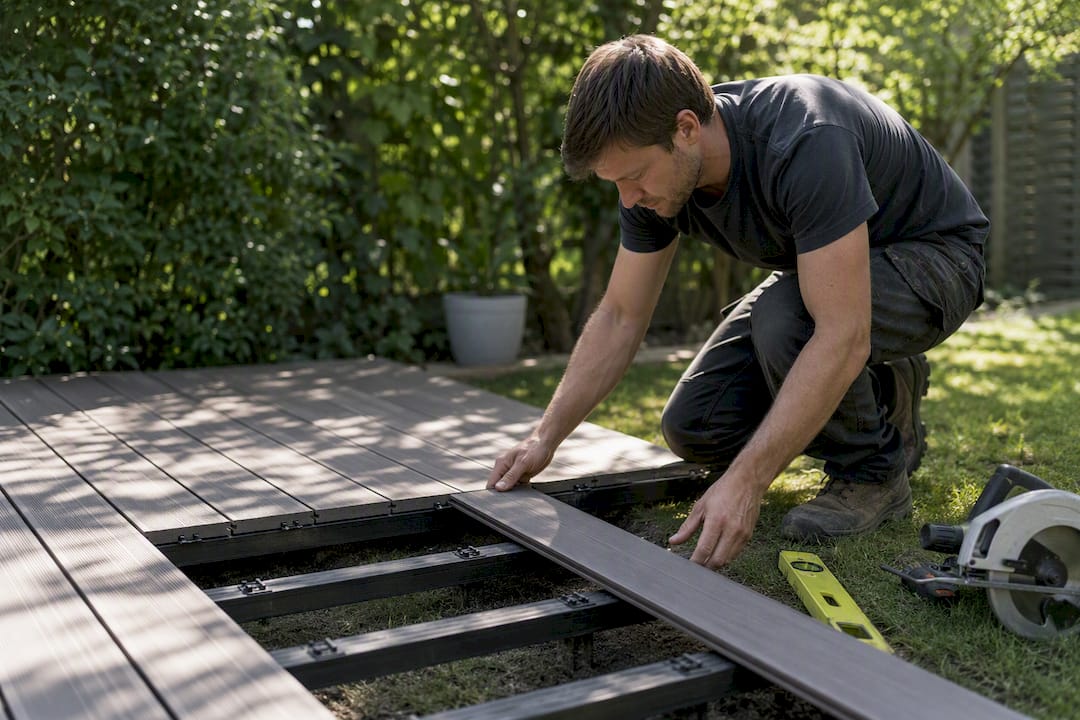
PVC Decking Pros and Cons: A Homeowner’s Guide
Choose PVC decking if you own a pool, live on the coast, or want the lowest possible maintenance over 20+ years. Choose composite if you’re working with a tighter budget or want the most realistic wood grain for the money. PVC costs more upfront but shrugs off water, rot, and mold since it’s 100% polyvinyl chloride with no wood fiber to feed decay. Composite, backed by brands like Trex and TimberTech, usually wins on price and appearance realism in dry, temperate yards.
Pick PVC for poolside decks, coastal homes, shaded areas prone to moisture, and rooftop decks where weight matters.
Pick composite for budget-conscious builds, sunny yards where wood-grain realism matters most, and typical suburban lots without heavy moisture exposure.
If cost drives your decision, jump to the pricing section below. If maintenance is your top concern, the cleaning guidance further down will settle it fast.
Key Takeaways
PVC decking wins on durability and lifetime maintenance cost while composite typically wins on upfront price and wood-grain realism.
Point | Details |
|---|---|
Best use case for PVC | Pools, coastal homes, shaded moisture-prone areas, and rooftop decks needing lighter boards. |
Best use case for composite | Budget-conscious builds in dry climates where wood-grain appearance matters most. |
Installation caveat | Skipping gapping specs or fasteners on PVC causes buckling; follow manufacturer tables exactly. |
Cost reality | PVC materials run $9 to $16/sq ft versus composite’s $5 to $12/sq ft, with installed costs varying by region. |
Where Cactus Decking fits | Cactus Decking builds warranty-backed PVC, composite, and cedar decks with an in-house crew in Everett, WA. |
Table of Contents
PVC Decking Pros and Cons vs. Composite: What’s the Real Difference?
The Benefits of PVC Decking
PVC Decking Drawbacks Homeowners Should Weigh
Composite Decking: Strengths, Limits, and the Capped vs. Uncapped Divide
PVC vs Composite Decking: Side-by-Side Comparison
What PVC Decking Actually Costs and How Long It Lasts
Which Material Fits Your Situation?
Cleaning PVC Decking and Composite: A Simple Upkeep Plan
Is PVC Decking Eco-Friendly? What to Know Before You Buy
What Installers Actually See in the Field
Sources
PVC Decking Pros and Cons vs. Composite: What’s the Real Difference?
PVC decking is solid or cellular polyvinyl chloride, extruded into boards with zero wood content. Composite decking blends wood flour with plastic resin, either left uncapped or wrapped in a protective polymer shell (capped composite). That single difference in composition explains almost everything else in this comparison: waterproofing, heat behavior, and how much upkeep a deck demands over its life.
PVC: all-plastic, immune to rot, generally lighter per board.
Composite: wood fiber plus plastic, heavier, more traditional in feel.
Decks and installers like Cactus Decking both classify these as distinct product categories, not variations of the same material, because the manufacturing process changes how each performs outdoors.
The Benefits of PVC Decking
The biggest advantage is what’s missing: wood fiber. Without it, PVC can’t rot, and mold has nothing organic to feed on, which is exactly why it dominates poolside and coastal installations.
No wood fiber means no rot, no mold, and no mildew staining, even in constant moisture.
Some flagship PVC lines carry a lifetime structural warranty plus 50 years of fade-and-stain coverage, among the longest in synthetic decking.
PVC boards run lighter than composite, a real plus for rooftop decks or multi-level builds where structural load matters.
Cleaning is typically limited to soap and water a few times a year, with no staining or sealing ever required.
Over a 20 to 30 year ownership horizon, that near-zero maintenance bill can offset the higher purchase price, especially for owners who plan to stay put. If you’re likely to sell within five years, that math changes.
PVC Decking Drawbacks Homeowners Should Weigh
PVC isn’t the automatic winner. Material costs typically run $9 to $16 per square foot versus $5 to $12 for composite, and installed pricing often lands even higher once labor is factored in.
Higher material and installed cost than most composite lines.
Greater thermal expansion and contraction, which means installers must follow gapping specs precisely or risk buckling.
Darker PVC colors can get hot underfoot in direct sun, though this depends more on color than material.
Budget PVC lines sometimes have a plastic sheen that reads as less authentic than premium composite.
Installation quality matters enormously here. Skimping on expansion gaps or using the wrong fasteners is the single most common cause of a PVC deck failing early. At end of life, PVC also faces limited recycling infrastructure compared to more established composite take-back programs.
Composite Decking: Strengths, Limits, and the Capped vs. Uncapped Divide
Composite earns its market share on value and realism. Boards from brands like Trex and TimberTech now mimic wood grain convincingly, often at a lower price than comparable PVC.
Lower typical cost than PVC, often by several dollars per square foot.
More convincing wood-grain texture and color variation in many premium lines.
Capped composite resists scratching and staining far better than older uncapped boards.
The tradeoffs show up over time. Uncapped composite still contains exposed wood fiber, so a breached cap or a scratch can let moisture in and eventually cause staining or localized mold. Composite boards also weigh more than PVC, and fade-and-stain warranties on most composite lines run shorter than PVC’s typical 50-year coverage. Capped composite narrows that maintenance gap considerably. It’s why composite works best in dry, temperate climates where moisture isn’t the primary threat.
PVC vs Composite Decking: Side-by-Side Comparison
Dimension | PVC | Composite |
|---|---|---|
Upfront cost | Higher; $9 to $16/sq ft material, often $30 to $60/sq ft installed | Lower; typically $5 to $12/sq ft material |
Expected lifespan | 25 to 30+ years, often with lifetime structural coverage | 25 to 30 years on capped premium lines |
Maintenance needs | Soap and water a few times a year, no staining | Occasional cleaning; uncapped lines need more attention |
Water and mold resistance | Excellent; no wood fiber to rot | Good on capped lines; weaker if cap is breached |
Appearance realism | Improving, but can look plastic on budget lines | Often more convincing wood grain, especially premium lines |
Heat retention | Depends heavily on color; light tones stay cooler | Similar color dependence; dark composite runs hottest |
Ease of installation | Requires precise gapping for thermal movement | More forgiving of minor installation variance |
Warranty | Often lifetime structural + 50-year fade/stain | Typically 25 to 30 year fade/stain on capped lines |
Recyclability | Limited recycling streams currently | Some lines use recycled plastic and wood content |
The dimension that trips up the most homeowners is installation tolerance. PVC’s thermal movement means gapping and fastening instructions aren’t optional guidelines. If resale value is your priority, composite’s broader buyer familiarity can help; if barefoot comfort and zero poolside maintenance matter more, PVC usually wins.
What PVC Decking Actually Costs and How Long It Lasts
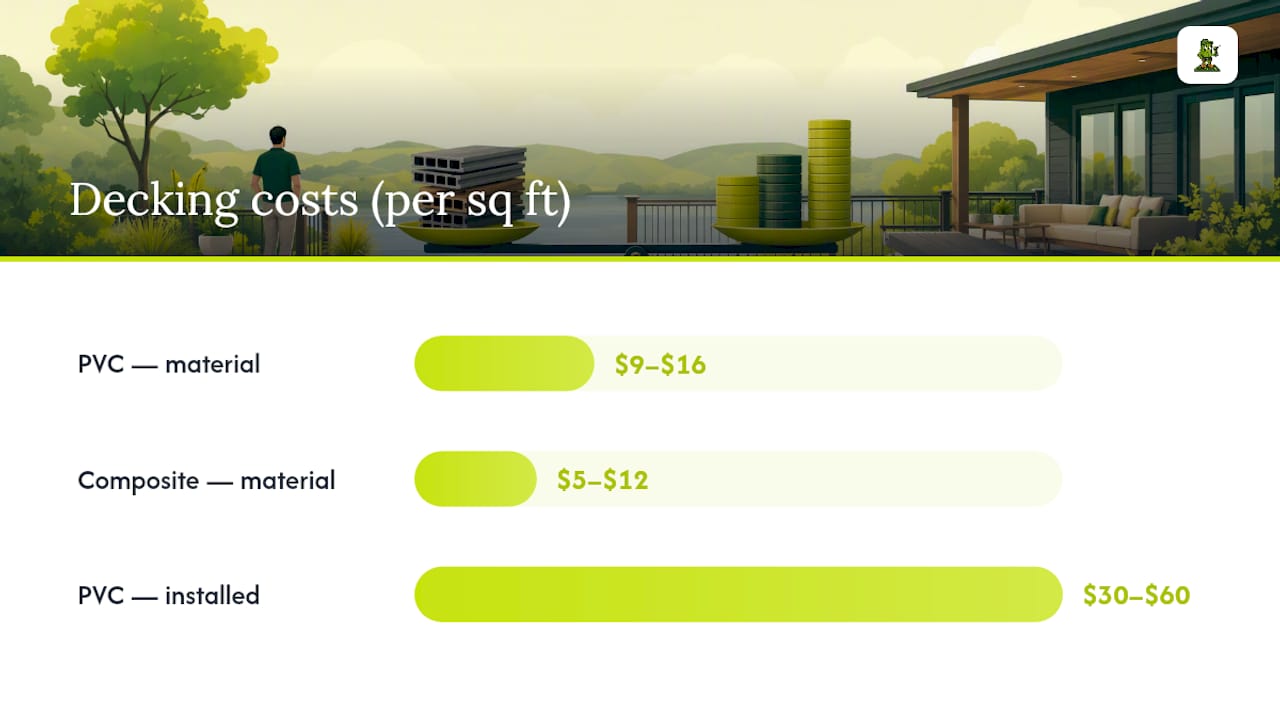
Budget realistically: PVC materials run roughly $9 to $16 per square foot, with installed pricing frequently landing between $30 and $60 per square foot once labor, footings, and railing are included. Composite typically comes in lower on materials, though installed costs vary widely by region and board tier.
Cost factor | PVC | Composite |
|---|---|---|
Material cost per sq ft | $9 to $16 | $5 to $12 |
Typical installed range | $30 to $60/sq ft | Generally lower than PVC installed |
Annual maintenance task | Soap-and-water wash, 2 to 3 times/year | Occasional wash; capped lines need less |
Follow manufacturer-specific care guides to preserve warranty coverage.
Avoid harsh solvents; stick to approved deck cleaners and soft-bristle brushes.
Power-wash only within the pressure limits your manufacturer specifies.
Lifespan estimates track closely with warranty length. A deck backed by a 50-year fade-and-stain warranty is a reasonable bet to look good for decades if you follow the cleaning schedule.
Which Material Fits Your Situation?
Poolside or waterfront property: Go with PVC. Its immunity to rot and mold makes it the safer long-term bet near standing water or salt air.
Rooftop or multi-level deck: PVC’s lighter weight can reduce structural upgrade costs on load-sensitive builds.
Tight budget, dry climate: Composite usually delivers better value per dollar, especially in regions without heavy moisture exposure.
Selling within a few years: Composite’s familiar wood-grain look often satisfies buyers without the premium price tag.
Households with kids and pets, high foot traffic: Either material works well; capped composite and PVC both resist scratching reasonably.
Order physical samples and view them outdoors in full sun before committing to a color.
Choose light-to-mid tones if your deck sits in direct afternoon sun.
Talk to a contractor before finalizing material choice if your project involves complex framing, a rooftop structure, or built-in seating and lighting.
Cleaning PVC Decking and Composite: A Simple Upkeep Plan
Do a deep clean each spring and fall, with spot cleaning as spills happen. TimberTech’s care guidance recommends specific brush types and its own DeckCleaner formula, and caps power-washing at 1,500 psi using a fan-tip nozzle held at a safe distance.
Do: use soap and water or a manufacturer-approved cleaner for routine vinyl deck upkeep.
Don’t: use harsh solvents, bleach on certain membranes, or metal scrapers that can gouge the surface.
Pro Tip: Keep your original product documentation. Most warranty claims get denied not because of a manufacturing defect, but because the homeowner used an unapproved cleaner or exceeded the power-washer’s pressure limit.
Is PVC Decking Eco-Friendly? What to Know Before You Buy
PVC is a petroleum-based plastic with limited recycling infrastructure today, though some manufacturers now offer recycled content or take-back programs worth verifying before purchase.
PVC: check for recycled-content percentages and manufacturer take-back options.
Composite: often blends recycled plastic with wood flour, giving it a head start on sustainability messaging.
Always confirm eco claims against the manufacturer’s actual warranty and certification documents, not just marketing copy.
What Installers Actually See in the Field
Contractors like the team at Cactus Decking watch three things that homeowners rarely think about: joist spacing, ventilation underneath the deck, and correct fastener selection for thermal movement.
Red flag: skipping manufacturer-specified clips or fasteners to save a few dollars.
Red flag: ignoring the gapping table, which is the leading cause of buckled PVC boards.
Proper ventilation prevents moisture buildup under composite boards, extending their service life.
The decks that come back with problems almost always have one thing in common: someone skipped the gapping spec to save time or material during installation. That single shortcut causes more callbacks than any material defect ever does.
Cactus Decking backs its installations with warranty coverage precisely because getting these details right the first time prevents almost every common failure point.
Our Recommendation on PVC vs Composite
Match the material to how long you’ll own the home and what matters most: near-zero upkeep favors PVC, tighter budgets favor composite. Order samples first.
Get a Deck Built Right the First Time
Reading about gapping tables and thermal expansion is one thing. Getting them right on your actual deck is another, and that’s where a local, warranty-backed crew earns its fee. Cactus Decking designs and builds with PVC, composite, or cedar, and its in-house crew handles the fastener selection, ventilation, and gapping details that determine whether your deck lasts 30 years or needs repairs in five.
If you’re still weighing cost against long-term upkeep, a deck design consultation walks through material options for your specific yard, sun exposure, and budget. Prefer to see finished results first? Browse the project gallery for real color and texture examples before ordering swatches. When you’re ready to move forward, request an estimate for custom deck installation and get a plan built around your specific framing, permit, and material needs.