Homeowners: Vet Recycled Composite Decking; 12 Million Pounds Diverted
Homeowners: learn what 85–95% recycled content means for composite decking, how lifespan and warranties change its real sustainability, and how to vet...

Homeowners: Vet Recycled Composite Decking; 12 Million Pounds Diverted
Recycled composite decking is generally a smart environmental choice, not a perfect one. It keeps millions of pounds of plastic film and reclaimed wood fiber out of landfills, and manufacturers like NewTechWood report recycled content in the 85% to 95% range. The catch: most of those boards still can’t go back into curbside recycling once they’re worn out, and manufacturing them uses real energy. Some contractors install plenty of it, but the honest answer is that it’s a strong option with real trade-offs worth understanding before you buy.
TL;DR:
Most recycled composite decks cannot be recycled after their lifespan ends, and end-of-life disposal often results in landfilling despite the high recycled content.
A capped composite deck offers better moisture resistance, fade protection, and durability than uncapped options, but both are more expensive upfront than wood.
Longer service life and lower maintenance needs make composite decking more environmentally friendly over time, despite manufacturing energy use and limited recycling options.
Proper installation, including adequate ventilation and correct fastener spacing, is crucial for maximizing a composite deck’s longevity and environmental benefits.
The recycled-content percentage alone is misleading; prioritizing verified construction, warranty terms, and installation quality ensures sustainability benefits.
CactusdeckingPlan A Deck Built To LastCactus Decking creates custom outdoor spaces with composite, PVC, or cedar materials, backed by quality craftsmanship and warranty-backed installation.Explore deck options
Table of Contents
What Recycled Composite Decking Is Made Of
The Real Environmental Payoff (and the Catch)
Composite vs. Wood: What It Actually Costs You to Own
How to Vet a Recycled Composite Deck Before You Buy
What a Contractor Sees That Homeowners Miss
Why the Recycled-Content Number Isn’t the Whole Story
Get a Deck That Backs Up Its Eco Claims
Sources
What Recycled Composite Decking Is Made Of
Recycled composite decking is built from reclaimed wood fiber (often sawdust or wood scrap from other industries), recycled plastic film and packaging, and a protective polymer shell called a cap. The wood fiber and plastic get blended, then extruded under heat and pressure into board shapes. Higher-end products go through a second step called co-extrusion, which fuses a durable plastic cap around that core in the same pass through the machine.
That cap matters more than most homeowners realize. It’s the part that actually touches your feet, sheds water, and resists fading. The core underneath can be almost entirely recycled material, while the cap is usually a mix of virgin and recycled plastic engineered for weathering.
Three distinct products get lumped together under “composite decking,” and they behave differently:
Capped composite wraps a wood-plastic core in a protective plastic shell, resisting moisture and fading better than older boards.
Uncapped composite skips that shell, making it cheaper but more prone to moisture absorption and surface wear over time.
PVC decking contains no wood fiber at all. It’s built from cellular PVC, which sidesteps rot entirely but isn’t part of the wood-plastic composite recycling conversation. Our comparison of composite and PVC decking breaks down which one fits which yard better.
The Real Environmental Payoff (and the Catch)
The landfill diversion numbers here are genuinely large. NewTechWood alone reports diverting more than 12 million pounds of plastic annually by turning packaging waste and film into decking material instead of letting it sit in a dump for centuries.
By the numbers: Manufacturers commonly cite recycled-content figures between 85% and 95% for their composite boards, drawing from a mix of reclaimed wood fiber and recycled plastic film.
That’s a real number worth taking seriously, but it doesn’t tell the whole story. A composite deck also tends to outlast a wood deck by a wide margin, which means fewer full replacements over the decades you own your home. Fewer replacements mean fewer manufacturing runs, less lumber harvested, and less material hauled to the curb. That longevity argument is arguably the strongest environmental case for composite, stronger than the recycled-content percentage on the label.
Where the story gets less rosy is at the end of the deck’s life. Most municipal recycling programs aren’t equipped to process wood-plastic composite, so a worn-out deck usually ends up in a landfill anyway, recycled origins or not. Some manufacturers are working against that gap. TimberTech and AZEK have referenced circular programs that reclaim old PVC decking for reprocessing, though coverage and availability vary by region.
The net picture, weighed honestly:
Large amounts of plastic waste get diverted from landfills before the deck is ever installed.
Longer service life reduces the emissions tied to repeated replacement compared with wood.
End-of-life recycling infrastructure for the boards themselves is still thin outside a handful of manufacturer programs.
Composite vs. Wood: What It Actually Costs You to Own
A composite deck almost always costs more upfront than a comparable wood deck, but the ownership math flips over time. Installed costs for composite typically run higher per square foot than pressure-treated lumber, and the total swings based on square footage, whether you choose hidden fasteners (which cost more but skip visible screw heads), and whether your substructure needs repair before installation.
The maintenance gap is where composite earns most of its keep. A capped composite deck needs an occasional soap-and-water wash. A wood deck needs sanding, staining, and sealing on a recurring cycle, sometimes every one to two years depending on climate and sun exposure, or it starts graying and splintering.
Performance differences worth knowing before you choose:
Composite resists rot and insect damage that eventually catches up to even well-maintained wood.
Modern capped composites hold their color far better than older composite generations, based on Consumer Reports testing of fade and stain resistance.
Composite runs hotter underfoot in direct sun than most wood species, a real consideration for south-facing decks.
Wood is easier to spot-repair (swap a board, sand a scratch); composite generally means replacing the whole board if it’s gouged or scorched.
On the break-even question, independent cost modeling from DeckMath suggests composite’s higher sticker price is often offset within a 25-year ownership window once you factor in wood’s recurring staining and sealing costs. That timeline isn’t fixed. Other modeling shows the break-even point shifts significantly depending on how disciplined a homeowner actually is about maintaining the wood deck. Skip a few staining cycles and wood’s real cost climbs fast. Our deck lifespan comparison walks through how those numbers play out over a typical ownership period.
How to Vet a Recycled Composite Deck Before You Buy
Getting past the marketing language on a product page takes a short checklist:
Confirm capped construction. Ask whether the board has a protective polymer cap or is uncapped composite, since that single detail drives most of the fade and moisture performance difference.
Ask what the recycled-content percentage actually measures. Get the contractor or spec sheet to clarify whether that 85% to 95% figure applies to the core, the cap, or the full board.
Read the warranty in two parts. Fade-and-stain coverage and structural coverage are usually capped separately, and one is often shorter than the other.
Request third-party test references, such as Consumer Reports data, rather than relying on manufacturer marketing alone.
Get installation specifics in writing, including clip type, joist spacing, and ventilation clearance under the deck.
For color, lighter tones stay noticeably cooler underfoot on exposed, sun-heavy decks, and good under-deck ventilation reduces moisture buildup regardless of the color you pick.
Pro Tip: Ask your contractor for a sample board and leave it in direct sun on your actual deck site for a week before committing to a full order. It’s the cheapest way to judge heat retention and true color against your house before you’re stuck with it.
What a Contractor Sees That Homeowners Miss
Some decking companies build with composite, PVC, and cedar, and the eco-conscious material sourcing that gets talked about on spec sheets only means something if the installation backs it up. A deck made from the highest recycled-content board on the market still fails early if it’s put together wrong.
The most common install mistakes we see shortening a composite deck’s usable life:
Insufficient ventilation underneath the deck, which traps moisture against the underside of boards.
Poor flashing where the deck meets the house ledger board, letting water intrude behind the siding.
Fastener spacing that’s too wide, which lets boards flex, warp, or pop loose over a few seasons.
Before signing anything, check whether the warranty separates fade-and-stain coverage from structural coverage, and whether that coverage transfers if you sell the house. A deck’s real environmental value shows up over decades of use, not just at the point of sale, and warranty language is often the clearest signal of how long a manufacturer actually expects the product to last.
Why the Recycled-Content Number Isn’t the Whole Story
Most people shopping for eco-friendly decking fixate on one number: the recycled-content percentage. It’s the easiest thing to compare, so it’s what gets repeated in every buying guide. But that number tells you almost nothing about how long the deck will actually last in your yard, and lifespan is the bigger environmental lever.
That’s a case conventional advice underplays. It’s easier to market a percentage than to explain joist spacing and ventilation clearance, but the installation details do more long-term environmental work than the label does.
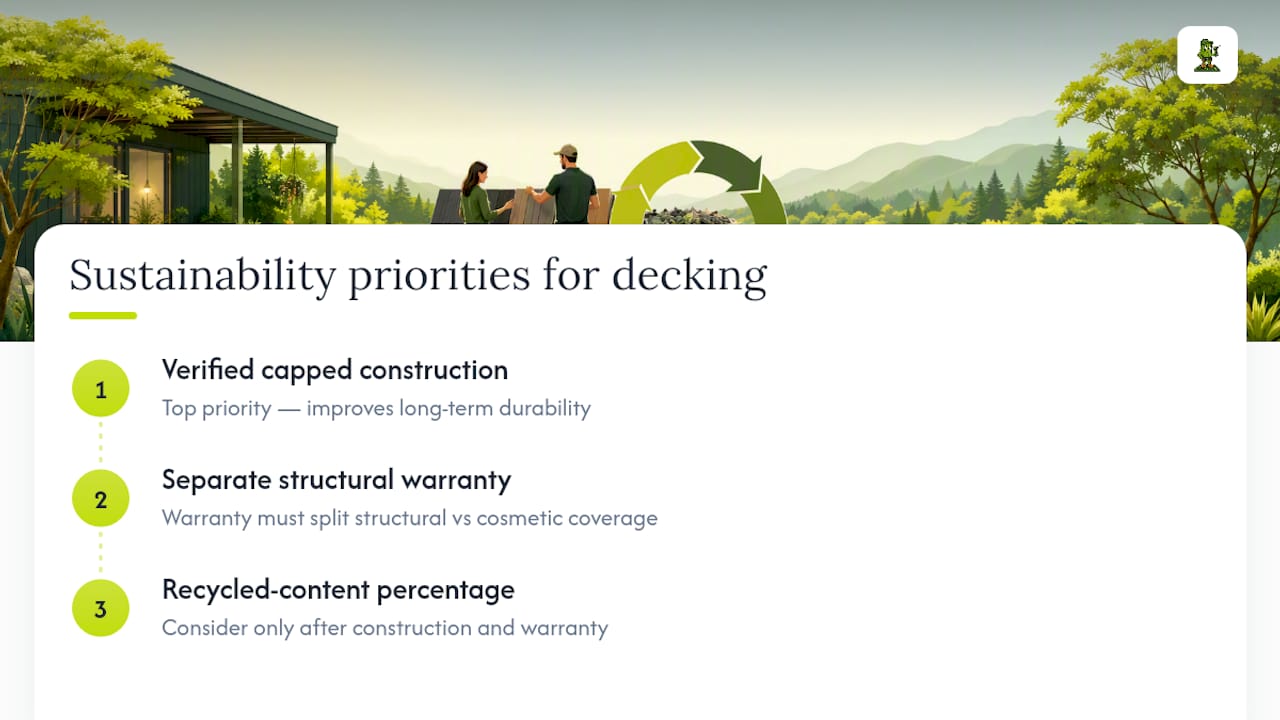
If you’re buying with sustainability in mind, prioritize in this order: verified capped construction, a warranty that actually separates structural and cosmetic coverage, and only then the recycled-content figure. Skip that order and you can end up with a “green” deck that needs replacing in twelve years anyway.
— Vlad
Get a Deck That Backs Up Its Eco Claims
A recycled-content label only means something if the deck is installed to last. An in-house build crew on every project ensures that the same team that walks your site stands behind the warranty, and eco-conscious material sourcing is part of helping clients choose between composite, PVC, and cedar.
A typical consultation starts with a site visit to check your substructure and sun exposure, followed by real sample boards you can hold and compare, then a straightforward timeline and estimate before any work begins. If you’re weighing recycled composite against other materials for your own yard, start with a deck design consultation and get a plan built around your actual site conditions, not a generic spec sheet.
Sources
FAQ
Can composite decking be recycled?
Some of it, but not through most curbside programs. A handful of manufacturers, including TimberTech and AZEK, run circular reclamation programs for their own PVC and composite products, but broad municipal recycling infrastructure for composite decking still doesn’t exist in most areas.
How much would a 20x20 composite deck cost?
Costs vary widely based on board choice, fasteners, and substructure condition, so get a site-specific quote rather than relying on a flat number. A design consultation can give you an accurate estimate based on your actual footprint and site conditions.
Is Trex decking made of recycled plastic?
Trex and similar manufacturers state high recycled-content percentages on their sustainability pages, though the exact figure and whether it covers the core, the cap, or both varies by product line, so it’s worth confirming on the specific spec sheet before you buy.
What’s the difference between capped and uncapped composite decking?
Capped composite wraps the wood-plastic core in a protective polymer shell that resists moisture and fading, while uncapped composite skips that layer and is more prone to surface wear and water absorption over time.
How long does a recycled composite deck actually last?
Well-installed capped composite decks commonly outlast wood decks by a significant margin, largely because they don’t need periodic staining and sealing to avoid rot. Our composite deck lifespan guide covers the specific factors that shorten or extend that timeline.