Composite Decking Pros and Cons: What Homeowners Should Know
Discover the pros and cons of composite decking. Learn why it's a long-term investment for homeowners and how to mitigate heat retention.

Composite Decking Pros and Cons: What Homeowners Should Know
For most homeowners planning to stay in their house eight or more years, capped composite decking is the smarter long-maintenance choice. The math is straightforward: value-tier composite typically breaks even with pressure-treated wood in about 8–10 years once you factor in recurring stain, seal, and board-replacement costs for wood. The one real comfort trade-off is heat: composite surfaces run noticeably hotter than wood in direct sun, especially darker boards. If that concerns you, lighter colors and a shade structure largely solve this. Start by getting an itemized quote that separates board cost from subframe and fasteners — that single step will tell you more than any spec sheet.
Composite typically breaks even with pressure-treated wood in 8–10 years (value tier)
Capped boards carry 25–50 year fade and stain warranties
Main trade-off: heat retention in direct sun, mitigated by lighter colors or shade
Key Takeaways
Capped composite decking is worth the higher upfront cost for most homeowners who plan to stay in their home 8 or more years, with the break-even against pressure-treated wood arriving around years 8–10 for value-tier products.
Point | Details |
|---|---|
Break-even window | Value-tier composite breaks even with pressure-treated wood in roughly 8–10 years when wood maintenance costs are included. |
Main trade-off | Composite runs hotter in direct sun; lighter colors and shade structures are the practical fix. |
Installation matters most | Incorrect joist spacing and expansion gaps cause most composite failures — verify specs before work starts. |
Full capping is the key spec | Fully-capped boards on all four sides predict long-term fade and stain performance better than most other marketing claims. |
Cactusdecking | Provides itemized composite deck quotes covering boards, subframe, and fasteners, with warranty-backed installation in Everett, WA. |
Table of Contents
What composite decking actually gets right
Common composite decking disadvantages to plan for
How to read the product types: capped, WPC, PVC, hollow, and solid
Composite vs. wood: where each material actually wins
What composite actually costs and when it pays off
What maintenance and installation really involve
When composite is the right choice for your home
What we see on real jobs
Cactusdecking builds composite decks that hold up
Sources
What composite decking actually gets right
The practical benefits of composite are real, but they’re not uniform across every product. Here’s what you can genuinely count on when you buy a quality capped board.
No refinishing. Wood decks need sanding and staining every 2–3 years. Composite needs a wash. That shift alone saves most homeowners dozens of hours and hundreds of dollars annually. DeckMath’s 25-year model shows composite maintenance runs roughly 10 times cheaper than wood on an annual basis.
Rot, insect, and splinter resistance. The plastic content in composite makes it structurally inhospitable to termites and moisture-driven rot. Splinters are essentially eliminated, which matters if you have kids or pets using the deck barefoot.
Long warranties. Fully-capped composite boards from reputable manufacturers now carry 25–50 year fade and stain warranties. That’s not marketing — it reflects a genuine improvement in cap technology over the past decade. Early uncapped products earned composite a bad reputation; current fully-capped boards are a different product.
Consistent appearance. Composite holds color far better than unfinished wood. You won’t see the gray weathering, checking, or uneven staining that wood develops over time.
Color and finish range. Premium tiers offer embossed grain patterns that read convincingly as real wood from a few feet away. Value tiers look more uniform and plastic-adjacent, but still clean up well and hold their color.
Lifestyle upside. Less weekend maintenance means more time actually using the deck. For resale, a clean, low-maintenance deck in good condition is a straightforward selling point.
Pro Tip: Ask your supplier specifically whether the boards are “fully capped” on all four sides. Some products are only capped on three sides or just the face, which leaves the cut ends and underside exposed to moisture and staining. Full four-side capping is the spec that earns the long warranties.
Composite now accounts for a significant and growing share of the U.S. residential decking market — driven largely by homeowners who’ve watched a neighbor sand and stain a wood deck for the third time and decided they’d rather not.
Common composite decking disadvantages to plan for
No material is perfect, and composite has a specific set of problems that catch homeowners off guard. Knowing these up front lets you plan around them rather than discover them after installation.
Higher upfront cost. Composite boards typically cost 2–3 times more per linear foot than pressure-treated pine. That gap widens further when you account for the subframe: composite often requires closer joist spacing and a more robust fastening system, which adds meaningfully to the installed price. Always ask for a quote that separates boards, subframe, and fasteners.
Heat retention. Composite surfaces run noticeably hotter than wood in direct sun, and dark-colored boards can become uncomfortable to walk on barefoot on a hot afternoon. This is a real issue in sun-exposed yards, less so for shaded or north-facing decks.
Fading and scratching. Capped boards resist fading well, but no composite is scratch-proof. Deep gouges from furniture or pet claws are permanent — you can’t sand them out the way you can with wood. Lighter surface scratches on capped boards are less visible, but they’re there.
Repair limitations. When a composite board fails or gets damaged, you replace it rather than refinish it. The problem: color matching is difficult, especially if the product line has been updated or discontinued. Plan for this before you buy by confirming the manufacturer’s track record on product continuity.
Thermal movement. Composite expands and contracts with temperature more than wood. Incorrect expansion gaps or poor ventilation during installation are among the most common causes of buckling and sagging in service. This is an installer problem, not a product problem — but it’s your deck that pays the price.
Slip risk and mold in shaded areas. Wet composite, especially algae-covered boards, can be slippery. Consumer Reports testing found wood often scores higher on slip resistance than many composites. Shaded, damp installations also accumulate mold faster than sunny ones if not cleaned regularly.
Pro Tip: If your deck is heavily shaded, prioritize a composite product with a textured, high-traction surface and commit to a twice-yearly cleaning schedule. Smooth-faced boards in shaded, damp conditions are where composite’s mold reputation actually comes from.
How to read the product types: capped, WPC, PVC, hollow, and solid
Composite decking is not one product. The category covers several distinct constructions, and the differences matter for performance, price, and what you’re actually getting in a quote.
Capped vs. uncapped. The cap is a polymer shell bonded to the outside of the board. Fully-capped boards (all four sides) resist fading, staining, and mold far better than uncapped or partially-capped products. ForestSource identifies full capping as the primary quality differentiator for long-term performance. If a quote doesn’t specify capping, ask.
WPC vs. cellular PVC. WPC (wood-plastic composite) blends wood fiber with plastic binders. It looks and feels closer to real wood, but the wood content makes it slightly more susceptible to moisture absorption at cut ends. Cellular PVC contains no wood fiber at all — it’s all plastic, which makes it lighter, more moisture-resistant, and better in very wet climates, but it can feel less natural underfoot and tends to run hotter. For a deeper look at how these two materials compare in practice, this breakdown of composite vs. PVC decking covers the key differences.
Hollow vs. solid profiles. Hollow boards are lighter and cheaper, but they flex more underfoot and can sound hollow when walked on. Solid boards are stiffer and quieter, but heavier and more expensive. For most residential decks, solid or composite-core boards are worth the premium.
Value vs. mid vs. premium tiers. Value-tier boards are typically uncapped or partially capped, carry shorter warranties (10–15 years), and have a more uniform, manufactured look. Mid-tier boards are usually fully capped with 25-year warranties and decent grain embossing. Premium boards add realistic multi-tonal grain patterns, enhanced scratch resistance, and 30–50 year warranties. Premium is often purchased for aesthetics and near-zero refinishing, not purely for financial return.
Composite vs. wood: where each material actually wins
The honest comparison depends on which wood you’re comparing and what you care about most.
Upfront cost: Pressure-treated pine is the cheapest option. Cedar costs more than pine but less than most composite. Value-tier composite typically costs more than cedar installed; premium composite costs significantly more. Lowe’s buying guidance puts composite’s higher upfront cost as its primary trade-off against wood.
Maintenance: Wood requires sanding, staining, and sealing on a 2–3 year cycle, plus periodic board replacement as rot or checking develops. Composite needs an annual wash and occasional spot cleaning. Over a 25-year ownership window, that maintenance gap is where composite’s financial case is built.
Lifespan: Pressure-treated pine, properly maintained, lasts 15–20 years. Cedar, which is naturally rot-resistant, can reach 20–30 years with good care. Quality capped composite is rated for 25–50 years with minimal structural degradation. For a detailed look at what drives composite longevity, this guide on composite deck lifespan breaks down the key variables.
Aesthetics: Wood still wins on texture and feel. Real cedar has a warmth and grain variation that no composite fully replicates, and it stays cooler underfoot. If authentic wood character is your priority, cedar is worth the maintenance trade-off. Is cedar good for decking? Yes — it’s naturally rot-resistant, dimensionally stable, and beautiful. The question is whether you want to maintain it.
Climate and use case: Full-sun, south-facing decks favor lighter composite or cedar (cooler surface). Poolside decks favor composite for rot and moisture resistance. Shaded yards can go either way, but composite needs more cleaning attention. If you’re planning to sell within five years, the break-even math shifts toward wood.
Consumer Reports testing found wood often outperforms many composites on stiffness and slip resistance — a useful reminder that composite’s advantages are concentrated in maintenance and longevity, not every performance category.
What composite actually costs and when it pays off
Getting the numbers right requires separating board cost from total installed cost, and total installed cost from total cost of ownership.
Material | Installed cost (per sq ft) | Typical lifespan | Maintenance intensity |
|---|---|---|---|
Pressure-treated pine | $15–$25 | 15–20 years | High (stain/seal every 2–3 yrs) |
Cedar | $25–$40 | 20–30 years | Medium (seal every 2–3 yrs) |
Value composite | $30–$40 | 25+ years | Low (annual wash) |
Premium composite | $50–$70 | 30–50 years | Very low (wash + inspect) |
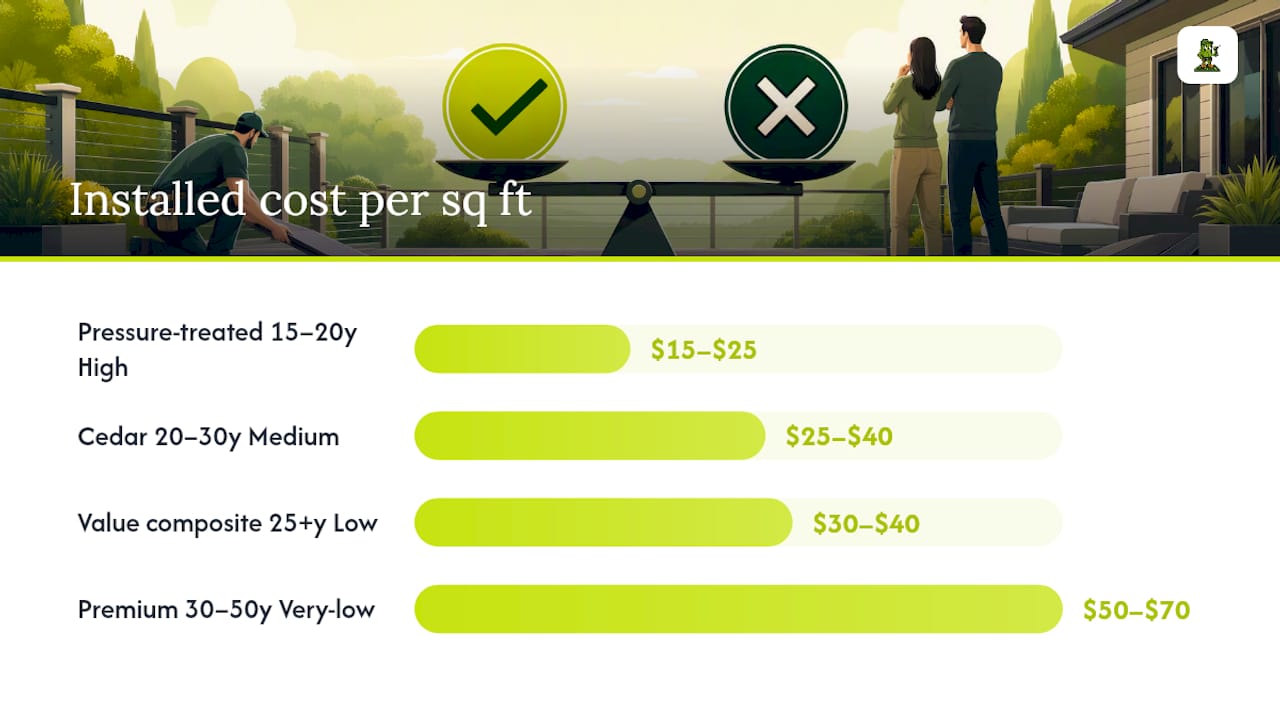
For a detailed breakdown of installed composite cost ranges and sample budgets, this cost guide walks through what homeowners in the Pacific Northwest typically pay.
DeckMath’s 25-year model puts the value-tier composite break-even with pressure-treated wood at roughly 8–10 years. Mid-tier composite ties cedar around year 25. Premium composite rarely breaks even on pure cost math — it’s purchased for the aesthetic and lifestyle payoff, not the spreadsheet.
What to check on any quote:
Does the price include the subframe (joists, beams, posts) or just the boards?
What fastening system is specified (hidden clip vs. face screw)?
Is the board fully capped on all four sides?
What does the warranty cover: fade, stain, structural, or all three?
What’s the manufacturer’s policy on discontinued colors?
Warranties worth trusting cover fade, stain, and structural integrity separately, with clear definitions of what constitutes a covered failure. A 25-year “limited” warranty that only covers manufacturing defects is not the same as a 25-year fade and stain warranty.
What maintenance and installation really involve
Routine maintenance
Composite is low-maintenance, not no-maintenance. A realistic schedule looks like this:
Twice-yearly sweep and wash. Use a garden hose or low-pressure washer with a composite-approved cleaner. Avoid harsh abrasives, undiluted bleach, or oil-based cleaners — these degrade the cap.
Spring inspection. Check for mold or algae in shaded areas, debris trapped between boards, and any boards showing movement or lift at the ends.
Furniture pad check. Rubber-backed furniture pads can stain composite surfaces. Replace with composite-safe pads annually.
Installation checklist
This is where most composite problems originate. Incorrect joist spacing, poor ventilation, and insufficient expansion gaps are the most common causes of composite failures. Before your installer starts:
Confirm joist spacing matches the manufacturer’s spec for the specific board (typically 12–16 inches on center, sometimes less for diagonal runs)
Verify expansion gaps are set per the manufacturer’s temperature-adjusted table, not a generic rule of thumb
Check that the subframe has adequate drainage and airflow underneath
Confirm hidden fasteners are the manufacturer-specified clip system, not generic alternatives
Pro Tip: Ask your contractor what temperature it was when the boards were installed. Composite set at 40°F needs different gap spacing than boards set at 85°F. An installer who can’t answer that question hasn’t thought carefully about thermal movement.
Repair reality
Surface scratches on capped boards are largely cosmetic and don’t compromise the board. Deep gouges, cracked boards, or boards that have buckled from improper installation require replacement. Order a few extra boards from the same production run when you install — color matching from a later run is never guaranteed.

For shaded or damp decks, a deck cover or pergola reduces both heat and moisture accumulation, extending cleaning intervals and improving comfort.
When composite is the right choice for your home
Run through these signals before you commit to a material.
Strong yes signals:
You plan to own the home for 8+ years
You want to eliminate sanding and staining from your maintenance calendar
You have kids, pets, or barefoot traffic where splinters are a real concern
Your deck is poolside or in a wet climate where rot is a recurring problem
Consider carefully if:
Your deck is in full sun with no shade option and you’re sensitive to surface heat
You’re planning to sell within 5 years (the break-even math doesn’t work in your favor)
You strongly prefer the look and feel of real wood grain
What to bring to a contractor meeting:
Your ownership timeline and rough budget
Photos of decks you like (color, finish, railing style)
Information about sun exposure and whether shade is an option
Whether the deck will see pool water, heavy furniture, or pet traffic
A request for 2–3 quotes that each show board cost, subframe cost, and fastener system separately
Getting itemized quotes is the single most useful step you can take before deciding. A quote that bundles everything into one number makes it impossible to compare materials or understand where the money is going.
What we see on real jobs
Most composite deck problems we encounter at Cactusdecking weren’t caused by the product. They were caused by installation shortcuts.
The most common: joist spacing set for wood (16 inches on center) on a composite product that specifies 12 inches. The deck feels bouncy, boards sag between joists, and the homeowner blames the material. The second most common: expansion gaps set by habit rather than by the manufacturer’s temperature table. Boards installed in cold weather without adequate gap buckle visibly by midsummer.
On every composite project, Cactusdecking specifies the subframe to the board manufacturer’s requirements, not to a generic residential standard. That means confirming joist spacing, drainage slope, and ventilation clearance before a single board goes down. Fasteners are always the manufacturer-specified hidden clip system for that product line — not a universal clip that “works with most brands.”
When reviewing a quote, watch for these red flags: no mention of joist spacing, a single line item for “decking materials and labor,” or a warranty offered by the contractor rather than the board manufacturer. A contractor warranty on composite performance is not the same as a manufacturer’s fade and stain warranty.

Cactusdecking builds composite decks that hold up
Cactusdecking handles the full scope of a composite deck project: design, permitting, subframe construction, board installation, railing systems, and lighting, all with an in-house crew and warranty-backed workmanship. Every quote separates board cost from subframe cost from fasteners, so you can see exactly what you’re paying for and compare materials honestly.
During a consult, the team walks through color and finish options, sun exposure and heat mitigation (including deck cover options that work with composite), and the subframe spec that fits your site. You leave with a clear picture of installed cost, not just board price. Browse finished projects in the Cactusdecking gallery to see how different composite colors and finishes look in real Pacific Northwest conditions, then request a custom installation quote to get started.
Sources
Ultimate Decking Buying Guide: Wood vs. Composite, and More - Consumer Reports
7 Disadvantages Of Composite Decking And How To Avoid Them | Konzept Garden