The Best Low Maintenance Decking Materials for 2026
Discover the best low maintenance decking materials for 2026 that save time and costs while enhancing your outdoor space. Learn more!
The Best Low Maintenance Decking Materials for 2026
For most homeowners, capped composite or PVC decking delivers the lowest long-term maintenance with the fewest annual chores. No sanding, no staining, no refinishing cycles. Composites don’t require annual sanding or staining the way wood does, and premium PVC products need nothing more than soap and water to stay clean. That’s the short answer. What follows covers every major material side by side, realistic cost ranges, climate-specific guidance, and the installation details that actually determine whether “low maintenance” holds up over a decade.
Key Takeaways
Capped composite and PVC are the most defensible low-maintenance decking choices for most homeowners, requiring only periodic cleaning and backed by multi-decade warranties that reduce long-term ownership risk.
Point | Details |
|---|---|
Best overall material | Capped composite or PVC requires only 1–3 cleanings per year with no sealing or staining. |
Warranty scope matters | Look for 25–50 year stain/fade warranties with defined color-change standards, not vague language. |
Installation drives maintenance | Hidden fasteners, correct joist spacing, and proper ventilation prevent most long-term problems. |
Climate changes the ranking | Coastal and high-shade sites favor PVC or aluminum; full-sun sites need UV-rated cap technology. |
Cactusdecking local option | Cactusdecking builds warranty-backed composite and PVC decks in Everett, WA with an in-house crew. |
Table of Contents
What makes low maintenance decking worth the upfront cost?
What “low maintenance” actually means for each material
How installed cost and lifespan shape total ownership
How does your climate affect which material holds up?
Installation choices that affect how much maintenance you’ll do
Why builders prefer capped composite and PVC for low-maintenance projects
What the conventional advice on low-maintenance decking gets wrong
Cactusdecking builds low-maintenance decks that hold up in the Pacific Northwest
Sources
What makes low maintenance decking worth the upfront cost?
Capped composites, PVC, and aluminum require only periodic cleaning and skip the sealing, staining, and refinishing cycles that consume weekends and budgets on wood decks. The trade-off is a higher upfront material cost, but that cost shifts recurring service expenses into a one-time investment. Over ten or fifteen years, the math usually favors the premium material.
The six materials worth comparing: capped composite, PVC, aluminum, tropical hardwoods, cedar, and pressure-treated wood. Each sits at a different point on the cost-versus-effort curve.
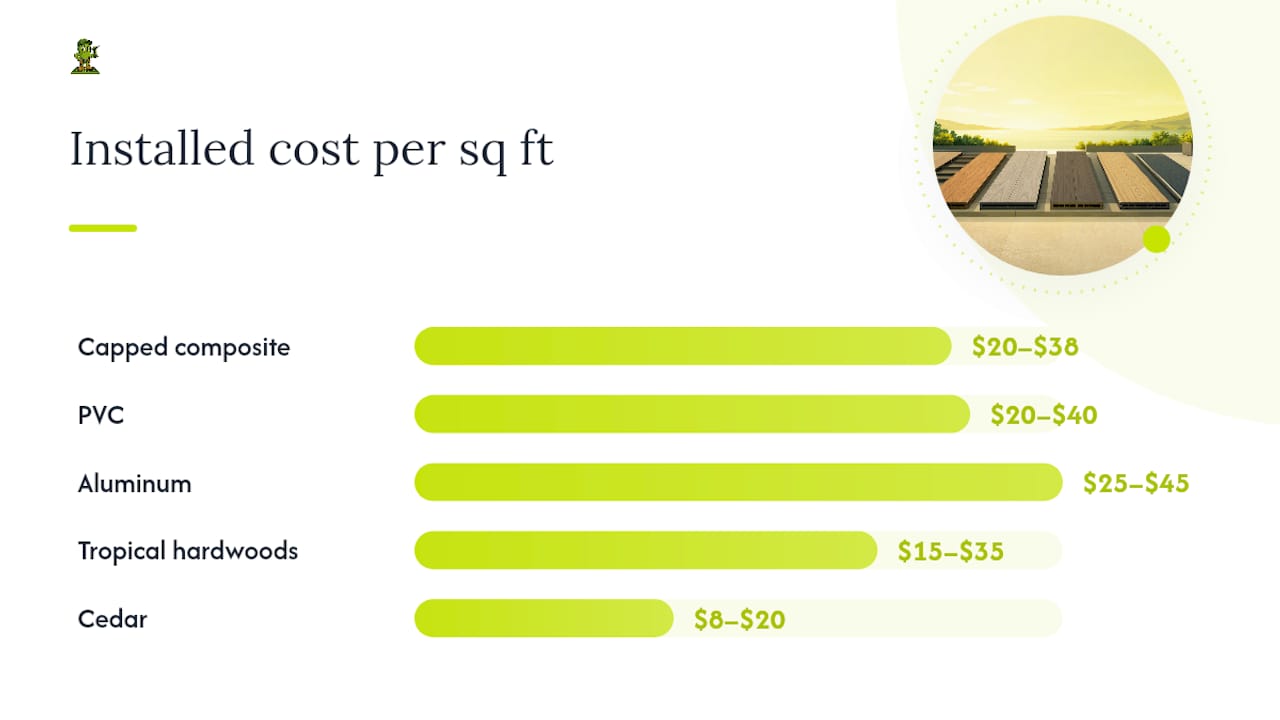
Material | Annual maintenance tasks | Installed cost (per sq ft) | Typical lifespan | Rot/mold/fade resistance | Appearance realism | Install complexity | Warranty |
|---|---|---|---|---|---|---|---|
Capped composite | Clean 1–3x/year | $20–$38 | 25 years | Excellent | High (wood grain textures) | Moderate (hidden fasteners recommended) | 25–50 years (stain/fade) |
PVC | Clean 1–2x/year | $20–$40 | 25 years | Excellent (non-porous) | Good to high | Moderate | Lifetime to 50 years |
Aluminum | Rinse occasionally | $25–$45 | 40–50 years | Excellent | Industrial/modern | Moderate to high | 20 years |
Tropical hardwood | Optional oiling every 1–2 years | $15–$35 | 25–40 years | Very good (dense grain) | Excellent (natural wood) | Moderate | Limited/none |
Cedar | Seal/stain every 2–3 years | $8–$20 | 15–20 years | Moderate | Excellent (natural wood) | Low to moderate | None |
Pressure-treated wood | Seal/stain every 1–2 years | $8–$20 | 15–25 years | Moderate (chemical treatment) | Basic | Low | None |
Brand callouts by category:
Capped composite options worth knowing: Trex (Transcend and Select lines), TimberTech (AZEK Harvest Collection), Fiberon (Sanctuary line with PermaTech cap), and Deckorators (Voyage with Surestone mineral-based technology). PVC options: AZEK PVC, Fiberon Paramount, and TimberTech’s solid-core PVC boards. These brands are illustrative of the category’s performance range, not an exhaustive list.
Warranty depth matters. Fiberon’s Sanctuary capped composite carries a 40-year stain-and-fade warranty. Fiberon Paramount PVC extends that to 50 years. Deckorators Voyage covers ground- and water-contact installations, which most composites explicitly exclude. Warranty scope, not just length, is what separates a marketing claim from a real performance guarantee.
Cedar and pressure-treated wood are the lowest-cost entry points, but neither qualifies as truly low maintenance. Both need sealing or staining on a regular cycle, and pressure-treated wood requires an initial drying period before any finish can be applied. Tropical hardwoods like ipe and cumaru sit in an interesting middle ground: their density and natural oils resist rot and insects far better than domestic softwoods, and oiling is optional rather than mandatory. You can let them silver naturally or oil every year or two to preserve the warm color.
What “low maintenance” actually means for each material
The phrase gets used loosely. Here’s what it translates to in practice.
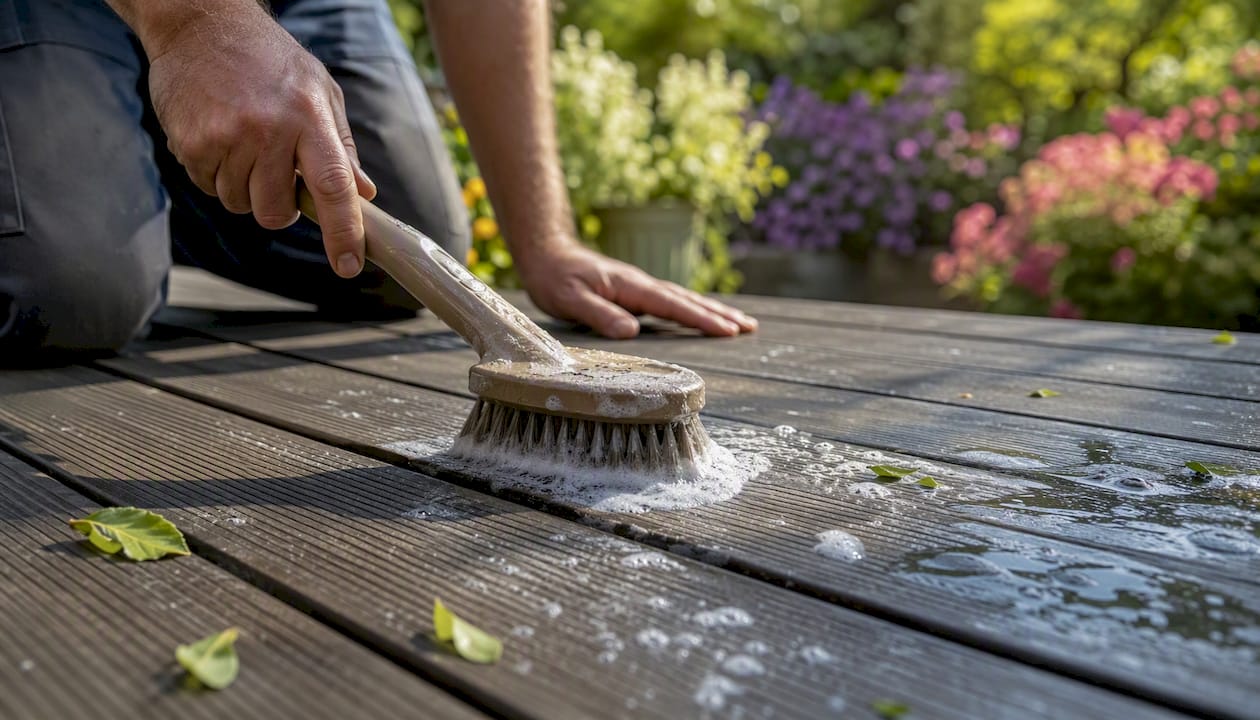
Capped composite and PVC are genuinely close to zero routine maintenance. Clean the surface with a deck brush, mild soap, and water one to three times per year. Remove leaves and debris from between boards promptly, since organic material sitting in gaps feeds mold. Inspect fasteners and end cuts annually. That’s the full list for most installations.
Aluminum is even simpler in one sense: it won’t rot, warp, or absorb moisture. An occasional rinse handles most dirt. The catch is that aluminum scratches more visibly than composite, and the industrial aesthetic limits design flexibility. It’s the right call for coastal or marine environments where salt air would degrade almost anything else.
Tropical hardwoods require more attention than composite but far less than cedar. Their density and natural oils make them resistant to moisture, rot, and insects. Oiling every one to two years preserves color; skipping it lets the wood silver to a gray patina, which many homeowners actually prefer. Structural repairs are rare compared to softwoods.
Cedar and pressure-treated wood are the honest high-maintenance options. Cedar needs sealing or staining every two to three years to prevent cracking and graying. Pressure-treated wood needs the same, plus an initial waiting period of six months to a year after installation before any finish adheres properly. Skip the maintenance cycle and you’re looking at surface checks, splinters, and eventual rot at fastener points.
Common failure modes by material:
Capped composite: mold in shaded, low-ventilation areas; surface scratches from dragging furniture; fading on uncapped or entry-level boards
PVC: expansion and contraction in extreme temperature swings; color variation between production batches
Aluminum: surface scratching; galvanic corrosion where aluminum contacts steel fasteners
Tropical hardwood: checking (surface cracks) if allowed to dry out completely; tannin staining on concrete below
Cedar: checking, splitting, and rot at fastener points; gray discoloration without regular finishing
Pressure-treated wood: warping during the drying period; rot at cut ends if not sealed; chemical leaching concerns near garden beds
Seasonal maintenance checklist:
Spring: Full deck wash with soap and water; inspect for loose fasteners, soft spots, or lifted boards; clear all debris from between boards and around posts
Summer: Spot-clean spills promptly; check for mold in shaded areas; inspect railing connections
Fall: Remove leaves before they decompose on the surface; check flashing and ledger connection for water intrusion
Winter (where applicable): Use plastic shovels on composite/PVC to avoid gouging; avoid rock salt (use sand or calcium chloride instead)
Pro Tip: In high-shade or low-ventilation areas, a diluted oxygen bleach solution (like OxiClean) applied once per year prevents mold from establishing. Don’t use chlorine bleach on composite or PVC, it degrades the cap layer over time. Rinse thoroughly after any cleaning product.
How installed cost and lifespan shape total ownership
Upfront price is only part of the story. A $10/sq ft pressure-treated deck that needs $2–$3/sq ft in stain and labor every two years costs more over a decade than a $28/sq ft composite that needs a $40 bottle of deck cleaner.
Ballpark installed cost bands (materials plus labor, U.S. average):
Budget wood (pressure-treated, cedar): $8–$20/sq ft installed
Mid-range composite (uncapped or entry capped): $15–$25/sq ft installed
Premium capped composite: $20–$38/sq ft installed
PVC: $20–$40/sq ft installed
Aluminum: $25–$45/sq ft installed
Tropical hardwood: $15–$35/sq ft installed (varies widely by species and sourcing)
For detailed regional cost breakdowns, the composite decking cost guide from Cactusdecking covers what homeowners in the Pacific Northwest actually pay, including framing and permit costs that national averages often omit. A deck cost per square foot resource from Trew Landscape offers useful regional comparison data for other markets.
10-year ownership comparison (400 sq ft deck, illustrative):
The composite still costs more over ten years in this example. Extend the horizon to 20–25 years, factor in a full wood deck replacement around year 15–20, and the composite pulls ahead. Warranty coverage matters here too: a 25-year limited warranty on a composite product reduces the risk of unexpected replacement costs that would close that gap faster.
For homeowners weighing whether to repair or replace an aging wood deck, the deck replacement service page from Cactusdecking walks through the decision criteria a contractor uses.
What drives installed cost up beyond materials: replacing deteriorated joists or ledger boards during a deck rebuild, switching from face-fastening to hidden fastener systems, adding framing upgrades for composite’s recommended joist spacing, and permit costs in jurisdictions with strict structural review requirements.
How does your climate affect which material holds up?
The “lowest maintenance” ranking shifts depending on where you live and how your deck is sited.
Full sun and high UV: Fade is the primary enemy. Premium capped composites and PVC with long fade warranties outperform entry-level composites and unfinished wood here. Look specifically for products with a four-sided cap (all faces covered, not just the top) and a warranty that covers fade to a defined color standard, not just “significant” color change. Deckorators Voyage’s mineral-based Surestone cap is specifically engineered for UV resistance.
Coastal and salt-air environments: Salt accelerates corrosion in fasteners and degrades wood finishes faster than inland conditions. In coastal and high-moisture installations, non-porous solids like PVC and corrosion-resistant metals like aluminum are the most defensible choices. If you use composite in a coastal setting, pair it with stainless steel or hot-dipped galvanized fasteners, never standard zinc-plated hardware.
Snow and freeze/thaw climates: Water absorption is the key variable. Low-absorption materials (PVC, capped composite) handle freeze/thaw cycles better than wood because they don’t swell and contract as dramatically. Proper joist ventilation matters more in cold climates: trapped moisture under a deck that freezes and thaws repeatedly accelerates rot in the substructure even when the decking itself is fine.
High-shade sites:
Mold and mildew are the primary maintenance driver, not UV or moisture absorption
Capped composite and PVC resist mold better than wood, but no material is immune in perpetual shade
Increase cleaning frequency to twice per year minimum
Consider adding a deck cover to manage moisture and reduce debris accumulation, which feeds mold growth
Aluminum is worth considering in extreme shade/moisture situations because it provides zero organic material for mold to feed on
Pro Tip: In the Pacific Northwest specifically, where Cactusdecking operates, shade and rainfall combine to create ideal mold conditions. Boards with a four-sided cap and a tight, smooth surface texture are significantly easier to clean than open-grain or embossed textures that trap spores.
Installation choices that affect how much maintenance you’ll do
The material is only half the equation. How a deck is built determines whether “low maintenance” holds up or becomes a problem in year three.
Fastener choice: Hidden fastener systems keep the board surface free of exposed screw heads, which eliminates the entry points where water infiltrates and causes rot or staining on wood. On composite and PVC, face-screwed boards can develop surface discoloration around fastener points over time. Hidden fasteners also make individual board replacement cleaner. The trade-off is slightly higher installation cost and the need for grooved-edge boards.
Joist spacing: Most composite and PVC manufacturers specify 16-inch on-center joist spacing for standard installations and 12-inch for diagonal or picture-frame patterns. Exceeding the specified spacing causes flex and, over time, permanent sag. This is one of the most common installation shortcuts that creates long-term maintenance headaches. Check the manufacturer’s installation guide before framing, not after.
Ventilation: Composite and PVC decks need airflow beneath the boards to prevent moisture buildup. A minimum 12-inch clearance between the ground and the bottom of the joists is a common guideline, though specific requirements vary by product and local code. Blocking airflow with skirting panels without providing ventilation gaps is a frequent mistake that leads to mold in the substructure.
Flashing and ledger attachment: The ledger board connection to the house is the highest-risk point for water intrusion on any deck. Proper flashing here protects both the deck framing and the house structure. This detail is also where most jurisdictions require a permit and inspection. Consult your local building department or a licensed contractor before modifying or building a ledger connection.
Red flags to watch for:
No ventilation gap specified or planned beneath the deck
Joist spacing set to 24 inches for composite without manufacturer approval
Standard zinc-plated screws used in a coastal or high-moisture environment
No slope (at least 1/8 inch per foot) built into the deck surface for drainage
Composite boards installed with no gap between ends, preventing thermal expansion
For a full picture of what professional installation looks like, the deck installation service page from Cactusdecking details the framing and fastening practices their crew uses on every build.
Why builders prefer capped composite and PVC for low-maintenance projects
Contractors who build decks professionally evaluate materials differently than homeowners do. The homeowner asks, “Will I like this in five years?” The contractor also asks, “Will I get a callback in two years because something went wrong?”
That second question is why experienced builders consistently steer clients toward capped composite and PVC when low maintenance is the goal. The maintenance tasks are predictable and simple: clean it. There’s no ambiguity about whether the homeowner sealed it correctly, used the right product, or waited long enough after installation. With wood, every one of those variables is a potential callback.
Warranty documentation also matters from an installer’s perspective. A product with a clearly written, transferable stain-and-fade warranty gives the homeowner something concrete to rely on and gives the contractor confidence that the product is backed by the manufacturer. Products like Fiberon Sanctuary and Paramount, Trex Transcend, TimberTech AZEK, and Deckorators Voyage all carry multi-decade warranties with defined performance standards.
When a homeowner asks me what they’ll actually have to do to maintain their deck, I want to be able to say “wash it twice a year and you’re done.” That’s only possible with a capped composite or PVC product from a manufacturer who backs that claim with a real warranty. Document your installation date, keep your receipt, and photograph the deck at install. Warranty claims are much smoother when you have that paper trail.
Pro Tip: Ask your installer for the manufacturer’s installation guide and keep a copy with your home records. Many warranty claims are denied not because the product failed, but because the installation deviated from the spec. Knowing what was installed and how protects you.
Cactusdecking’s in-house build crew in Everett, WA uses warranty-backed materials and follows manufacturer installation specs on every project. That consistency is what makes the low-maintenance promise realistic rather than aspirational. You can review completed deck projects to see material and design outcomes across different site conditions.
What the conventional advice on low-maintenance decking gets wrong
Most buying guides treat “low maintenance” as a binary: composite good, wood bad. That framing sells products but doesn’t actually help you make a decision.
The real question isn’t which material requires the least work in a vacuum. It’s which material requires the least work given your specific site, climate, and how you use the space. A capped composite deck in a shaded, north-facing yard in the Pacific Northwest will grow mold faster than a well-oiled ipe deck in a dry Arizona climate. The composite is still easier to clean, but “low maintenance” doesn’t mean “no maintenance,” and pretending otherwise sets homeowners up for disappointment.
The second thing most guides understate is installation quality. A premium composite product installed on undersized joists with inadequate ventilation will fail in ways that look like a material problem but are actually a construction problem. The warranty won’t cover it. You’ll spend money on repairs that a properly built deck would never have needed. This is where hiring a contractor who follows manufacturer specs, not just general carpentry practice, makes a genuine difference.
The third overlooked point: warranty language is not standardized. Two products both advertised as having a “25-year fade warranty” can mean very different things. One might cover fading beyond a defined Delta E color measurement; the other might only cover “significant” fading, which is subjective enough to deny most claims. Read the actual warranty document before you buy, not just the marketing summary.
My honest take: for most homeowners, capped composite from a major manufacturer with a clearly written, transferable warranty is the right call. PVC is worth the premium in coastal or high-moisture environments. Tropical hardwoods are underrated for homeowners who want natural wood aesthetics and are willing to do optional oiling every couple of years. Cedar and pressure-treated wood are fine budget choices only if you’re genuinely committed to the maintenance cycle, and most people aren’t.
Cactusdecking builds low-maintenance decks that hold up in the Pacific Northwest
If you’ve read this far, you know what material you want. The harder part is getting it installed correctly, with the right framing, fasteners, and ventilation details that make the low-maintenance promise actually true over time.
Cactusdecking is a local deck builder in Everett, WA with an in-house crew that specializes in composite, PVC, and cedar installations. Every build is warranty-backed, built to manufacturer specs, and designed around your specific site conditions, whether that’s a shaded backyard prone to mold, a sun-exposed rooftop deck, or a coastal property that needs corrosion-resistant hardware throughout.
The process starts with a design consultation where the crew reviews your site, discusses material options, and walks through the realistic maintenance expectations for each. No guesswork, no upselling materials that don’t fit your situation.
Get a custom deck design quote or view completed projects to see how different materials look in real installations before you decide. For homeowners ready to move forward, the custom deck installation page covers the full build process and what to expect from start to finish.