

Most homeowners installing a PVC deck in 2026 pay between $40 and $75 per square foot all-in, which puts a 12x12 deck at range reflective of average per-square-foot installed costs and a 20x20 deck at proportionally larger scale. Those ranges are wide because five variables move the number significantly: material tier, railing type, stairs, substructure condition, and regional labor rates.
Quick reference:
- Typical installed range: $40–$75/sq ft (boards, substructure, railing, labor, permits)
- 12x12 deck (144 sq ft): $5,800–$10,800 installed
- 20x20 deck (400 sq ft): $16,000–$30,000 installed
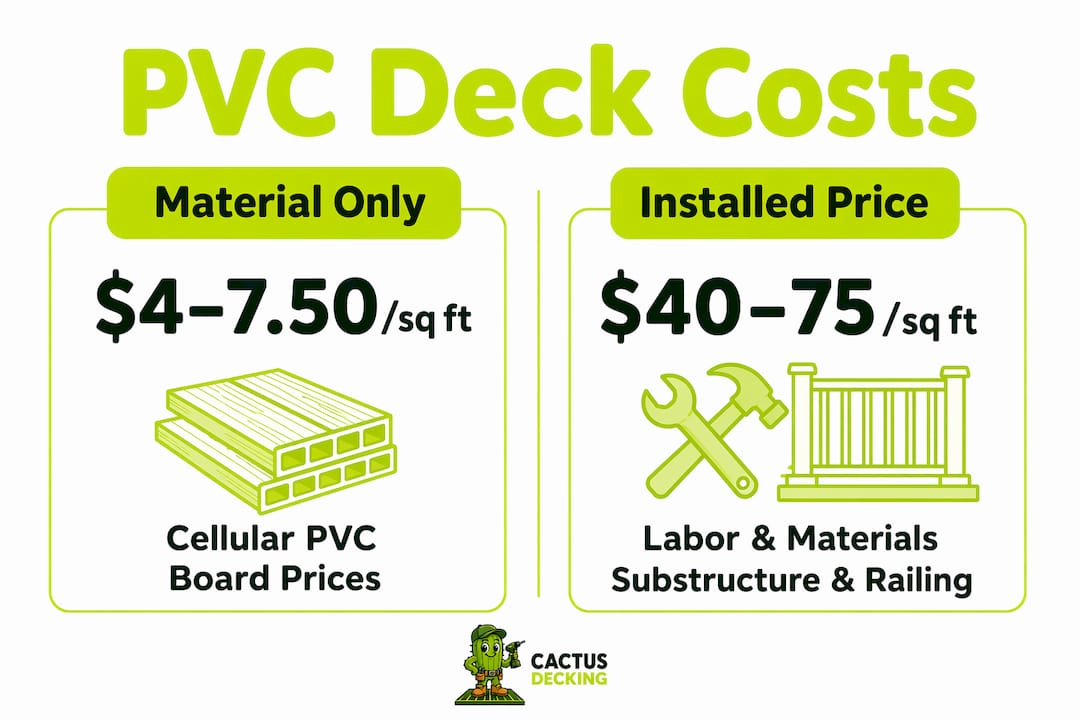
- Material-only boards: $4.00–$7.50/sq ft before labor or framing
The sections below break out exactly where each dollar goes, show line-item sample budgets, and explain how to read a contractor quote so you’re not comparing apples to oranges.
Table of Contents
- How much does PVC decking cost per square foot?
- What drives PVC deck pricing up or down?
- How does PVC compare to composite and wood on cost?
- What should you expect from labor and installation?
- Sample line-item budgets for 12x12 and 20x20 decks
- Is PVC decking worth the premium?
- How to get accurate contractor quotes
- Key Takeaways
- The budget surprises nobody warns you about
- Ready to build your PVC deck in Everett?
- Useful sources
How much does PVC decking cost per square foot?
PVC board pricing and installed project costs are two very different numbers, and conflating them is the most common budgeting mistake homeowners make.
Material-only board costs
Cellular PVC boards run $4.00–$7.50 per square foot for the boards alone, before any labor, framing, or fasteners. Entry-level lines like Wolf Serenity price around $7.50 per linear foot; mid-tier lines like AZEK Vintage land near $9.50/lf; premium lines like Advanced PVC Vintage reach $13.50/lf. Those per-linear-foot figures translate to per-square-foot costs that vary by board width, so always ask your supplier for a square-foot equivalent when comparing quotes.
Installed price ranges
The full installed price, covering boards, hidden fasteners, pressure-treated substructure, railing, labor, and permits, typically lands between $40 and $75 per square foot. Premium configurations with custom railings, multiple stair flights, and high-end board lines can push to $74–$92/sq ft on some projects. The national installed range across all deck materials runs $35–$80/sq ft, which confirms PVC sits at the upper end of that spectrum.
Worked examples for common deck sizes
| Deck size | Square footage | Low estimate | Typical estimate | High estimate |
|---|---|---|---|---|
| 12x12 | 144 sq ft | $5,800 | — | $10,800 |
| 20x20 | 400 sq ft | $16,000 | — | $30,000 |
The 12x12 low estimate assumes basic PVC boards, standard railing on two sides, no stairs, and a straightforward substructure. The high end adds a premium board line, matching PVC railing on three sides, and one stair flight. The 20x20 range reflects the same logic scaled up, with some economy of scale on labor per square foot as the project grows.
A note on regional labor: Labor rates in metro areas like Seattle or coastal markets run 10–20% above national averages. If you’re budgeting for a new deck installation service, factor in Pacific Northwest labor rates when using national calculator figures.
Railing is the single biggest wildcard in per-square-foot math. Brand-matched PVC railing adds roughly ninety-five dollars per linear foot installed. A 12x12 deck with 36 linear feet of railing adds $3,420 to the project before a single board is laid.
What drives PVC deck pricing up or down?
Understanding the cost levers lets you prioritize features and anticipate every line item before a contractor hands you a proposal.
Primary cost drivers:
- Deck size and shape: Square footage is the base multiplier. L-shapes, angles, and multi-level layouts add cutting time and waste.
- Substructure condition: Replacing rotted joists or posts on an existing deck adds $1,000–$3,000 before new boards go down. New builds start fresh, but footings and post depth vary by local code.
- Railing type and length: Standard aluminum rail costs less than brand-matched PVC rail. Glass panel rail can double railing costs.
- Stairs: Each step adds material and labor. A single 4-step stair flight typically adds $800–$1,500 depending on width and material.
- Site access and demolition: Tight side yards, second-story decks, or hauling away an old deck all add cost. Haul-away runs $100–$400 depending on debris volume.
- Permits and inspections: Municipal fees range from $50 to $600 depending on your jurisdiction. Never skip this line item on a quote.
Material choices that shift board price:
- Board profile (grooved vs. square edge) affects fastener type and cost
- Darker colors absorb more heat and may require specific expansion gaps
- Embossed or photo-cap finishes add $1–$2/sq ft over standard lines
- Thicker boards handle foot traffic better but cost more per linear foot
- Hidden fastener systems add $0.50–$1.50/sq ft but eliminate visible screws
Labor-related variables:
- Regional wage rates (Pacific Northwest runs higher than national average)
- Installer experience with PVC specifically, not just composite or wood
- Crew size and scheduling window (shoulder-season builds sometimes cost less)
Add-ons that meaningfully change the total:
- Integrated deck lighting: $500–$2,000 depending on fixture count and wiring complexity
- Under-deck drainage systems: $1,500–$4,000 for a mid-size deck
- Built-in benches or planters: $300–$800 each
- Specialty fascia boards: $2–$4/lf additional
Pro Tip: Color choice is a hidden cost driver most homeowners miss. Darker PVC boards expand more in direct sun, which requires wider expansion gaps and sometimes specialty fasteners. An installer who doesn’t account for this will see boards buckle within a season, and the fix comes out of your pocket, not theirs.
How does PVC compare to composite and wood on cost?
PVC sits at the top of the upfront price ladder, but the comparison looks different when you factor in 25–30 years of ownership.
| Dimension | Pressure-treated wood | Capped composite | Cellular PVC |
|---|---|---|---|
| Material only ($/sq ft) | $2–$5 | $4–$10 | $4–$7.50 |
| Installed ($/sq ft) | $15–$35 | $35–$60 | $45–$75 |
| Expected lifespan | 15–25 years | 25–30 years | 30+ years |
| Maintenance frequency | Annual sealing/staining | Biennial cleaning | Biennial cleaning |
| Maintenance cost (30 yr) | $1,000–$3,000 | $500–$1,000 | ~$90–$150 |
| Best use case | Budget builds, shaded sites | Versatile, most climates | Coastal, poolside, high-moisture |
| Warranty/fade resistance | Limited, varies | 25–30 yr fade/stain | 25–30 yr, strong stain resistance |
Capped composite installs at $35–$60/sq ft while cellular PVC runs $45–$70/sq ft, and the ranges overlap in the mid-tier. The real separation shows up in maintenance. PVC requires essentially zero structural upkeep; a biennial deep clean costs about a small cost per square foot in DIY cleaning materials, which works out to roughly $90–$150 over 30 years on a 192 sq ft deck. Wood decks need annual sealing or staining, and partial board replacement is common after 10–15 years.
The total-cost-of-ownership crossover where PVC becomes cost-competitive with capped composite typically arrives around year 28–32, depending on maintenance assumptions and local labor rates for refinishing work.
When composite or pressure-treated wood is the better call:
- You’re planning to sell the home within 5–10 years and want to minimize upfront spend
- Your budget is firm and PVC’s installed price exceeds it
- You want a more natural wood grain appearance that current composite lines deliver better
- The deck is in a shaded, low-moisture environment where PVC’s moisture immunity is less valuable
PVC’s strongest case is a poolside deck, a coastal property, or any site with consistent moisture exposure. It’s 100% synthetic, so it won’t absorb water the way wood-fiber composites can under prolonged wet conditions.
What should you expect from labor and installation?
Labor typically accounts for $3–$8 per square foot of the installed price, depending on complexity and region. That range covers board installation, but framing tune-ups, railing installation, and stair work are usually billed separately.
Common labor line items on a PVC deck quote:
- Board installation: $3–$8/sq ft
- Framing and substructure: $2–$4.50/sq ft (or included in a per-sq-ft all-in rate)
- Railing installation: $15–$40 per linear foot (labor only)
- Stair installation: $25/sq ft or per-step pricing
- Demolition and haul-away: $100–$400
Installation timeline
A 144 sq ft ground-level deck with standard railing typically takes 3–4 days for a two-person crew. A 400 sq ft elevated deck with stairs and railing can run 7–10 days. Weather, permit inspection scheduling, and material delivery delays all shift that window.
PVC-specific installation considerations
PVC boards are lighter than composite or wood, which speeds handling. The tradeoff is thermal movement. PVC expands and contracts more than most alternatives, and installers who don’t account for this create problems. Proper installation requires precise expansion gaps at board ends, fasteners rated for PVC’s movement, and correct joist spacing (typically 12 inches on center for PVC versus 16 inches for some composites). These requirements add installation time compared to a basic wood deck.
DIY versus hiring a pro
Homeowners comfortable with framing and finish carpentry can handle a ground-level PVC deck, but the thermal expansion requirements and hidden fastener systems have a learning curve. One wrong fastener pattern across 400 square feet means pulling boards and starting over. More importantly, most PVC manufacturer warranties require professional installation to remain valid. For a custom deck installation with premium boards, that warranty protection is worth the labor cost.
Red flags on contractor bids:
- No mention of fastener type or brand
- No thermal expansion allowance in the spec
- A single line item labeled “materials and labor” with no breakdown
- No permit line item (skipping permits voids warranties and creates resale problems)
- Warranty language that says “workmanship” but doesn’t specify duration
Sample line-item budgets for 12x12 and 20x20 decks
These estimates use mid-tier PVC boards, pressure-treated substructure at $7.50/sq ft, brand-matched PVC railing at $95/lf installed, and Pacific Northwest labor rates. Adjust downward 10–15% for lower-cost regions.
12x12 deck (144 sq ft) sample budget
| Cost line | Low | Typical | High |
|---|---|---|---|
| Hidden fasteners | — | $144 | — |
| Railing (36 lf @ $95/lf) | — | $3,420 | — |
| Permits and inspection | $150 | $300 | $500 |
| Delivery/haul-away | $100 | $150 | $300 |
Note: No stairs included. Adding one 4-step stair flight adds $800–$1,500.
20x20 deck (400 sq ft) sample budget
| Cost line | Low | Typical | High |
|---|---|---|---|
| PVC boards (material) | — | — | $3,000 |
| Substructure (PT framing) | — | $3,000 | — |
| Hidden fasteners | $200 | $400 | $600 |
| Labor (board install) | — | $2,000 | $3,200 |
| Stairs (one flight, 4 steps) | $800 | — | $1,500 |
| Permits and inspection | $250 | $400 | $600 |
| Delivery/haul-away | $150 | $200 | $350 |
| Project total | $10,400 | $15,300 | $20,450 |

Economy of scale shows up on larger decks: the per-square-foot labor rate drops slightly as crew efficiency improves across a bigger footprint. The substructure cost is a near-constant baseline regardless of which decking material you choose, which is why comparing board prices alone tells you almost nothing about total project cost.
Cactusdecking builds these estimates from actual project experience in Everett and the surrounding area, where permit requirements and labor rates reflect Pacific Northwest market conditions. For a Everett deck design service that produces a site-specific line-item estimate, the numbers above give you a solid baseline to compare against.
Is PVC decking worth the premium?
For the right property and ownership timeline, yes. For others, the math doesn’t close.
Core advantages:
- Moisture immunity: no rot, no swelling, no mold growth
- Low maintenance: biennial cleaning is all it needs structurally
- Long structural life: 30+ years with proper installation
- Strong stain resistance: most lines resist common food, beverage, and mildew stains
- Warranty strength: leading brands offer 25–30 year fade and stain warranties
Common downsides:
- Higher upfront installed cost versus pressure-treated wood or entry-level composite
- Surface discoloration risk from prolonged contact with rubber or vinyl goods (welcome mats, furniture feet with rubber tips). Manufacturers specifically warn against this and recommend lifting furniture periodically.
- Thermal expansion: boards move more than wood, and incorrect installation causes buckling
- Environmental considerations: PVC is petroleum-based and not biodegradable
- Heat retention: dark-colored PVC boards can get hot underfoot in direct sun
Ownership-horizon math:
If you’re staying in the home for 15+ years, PVC’s maintenance savings start to add up meaningfully. The total-cost-of-ownership crossover versus capped composite arrives around year 28–32. Against pressure-treated wood, which needs regular sealing and partial replacement, the gap closes faster.
Is PVC decking worth the money? For poolside decks, coastal properties, or any site with consistent moisture exposure, PVC is the strongest long-term value. If you’re planning to sell within 5–7 years or working with a tight budget, capped composite or pressure-treated wood delivers more value per upfront dollar. The decision comes down to how long you’ll own the home and how much you value a maintenance-free outdoor space.
How to get accurate contractor quotes
Getting three quotes is standard advice. Getting three comparable quotes takes more work, and that work is what protects your budget.
Must-have line items on every written quote:
- Board brand and product line (or “equivalent” with a named substitute)
- Board cost per square foot (material only)
- Fastener type and brand (hidden vs. face-screw, PVC-rated or not)
- Substructure allowance (per sq ft or lump sum, with framing species noted)
- Railing type and cost per linear foot (installed)
- Stair cost per step or per flight
- Permit allowance (even an estimate)
- Demolition and haul-away (included or excluded, clearly stated)
- Labor rate or all-in installed price per square foot
Questions to ask every contractor:
- What fastener system do you use for PVC, and how do you handle thermal expansion gaps?
- What is your warranty on workmanship, and does it align with the board manufacturer’s installation requirements?
- Have you installed this specific board line before? How many projects?
- Who pulls the permit, and is that cost included in this quote?
- What happens if you find rot in the substructure during demolition?
Red flags that signal an inexperienced or incomplete bid:
- No fastener specification anywhere in the quote
- Thermal expansion not mentioned in the scope of work
- A single line item for “materials and labor” with no breakdown
- No permit line item or a note that “permits are the homeowner’s responsibility”
- Warranty language limited to “one year” with no reference to manufacturer warranty support
A simple script for the phone call:
“Before I schedule a site visit, can you tell me which PVC board lines you’ve installed, how you handle thermal expansion on PVC, and whether your quotes break out materials and labor separately?” Any contractor worth hiring answers those three questions without hesitation.
For deck replacement projects where an existing structure may have hidden rot, add one more question: ask how the contractor prices substructure repairs discovered after demolition begins, and get that answer in writing before signing anything.
Key Takeaways
Installed PVC deck cost runs $40–$75 per square foot, with substructure, railing, and regional labor rates doing most of the work in moving that number up or down.
| Point | Details |
|---|---|
| Installed price range | Expect $40–$75/sq ft all-in; premium configurations can reach $74–$92/sq ft. |
| Board cost is a minority | Substructure alone runs ~$7.50/sq ft and is similar across all material types. |
| Railing changes everything | Brand-matched PVC railing adds ~$95/lf installed; always include it in total comparisons. |
| Lifecycle crossover | PVC’s total-cost-of-ownership advantage over capped composite typically arrives around year 28–32. |
| Cactusdecking | Cactusdecking builds warranty-backed PVC decks in Everett with line-item estimates and permit handling included. |
The budget surprises nobody warns you about
Most homeowners walk into a PVC deck project focused on the board price. That’s the wrong number to anchor on.
The substructure is where budgets quietly expand. On a replacement project, you don’t know what’s underneath until demolition starts. Rotted ledger boards, undersized footings, or joists spaced for a different material can add $1,500–$3,000 before a single new board goes down. Cactusdecking builds a contingency allowance into every replacement estimate specifically for this reason, and we walk homeowners through what we find before any additional work begins.
The second surprise is permits. Some homeowners skip them to save $200–$600 in fees. That decision can cost far more at resale when a buyer’s inspector flags unpermitted work, or when a warranty claim gets denied because the installation wasn’t code-inspected. Every Cactusdecking project includes permit handling as a standard part of the process.
Thermal expansion is the third one. PVC moves. An installer who doesn’t leave proper gaps will produce a deck that buckles in the first summer. We’ve seen it on projects where homeowners went with the lowest bid. The fix requires pulling boards and reinstalling them, which costs more than the original labor savings.
The practical advice: build a 10–15% contingency into your budget before you sign anything, and make sure your contractor has a written process for handling substructure surprises.
Ready to build your PVC deck in Everett?
Cactusdecking gives Everett homeowners a straightforward path from budget questions to a finished deck: a free on-site estimate, a line-item proposal that breaks out boards, substructure, railing, stairs, and permits separately, and an in-house crew that handles the full build from permit application to final inspection.
Every installation is backed by a workmanship warranty, and the team works exclusively with PVC, composite, and cedar materials chosen for Pacific Northwest conditions. If you’re comparing quotes, bring your existing proposals to the consultation and Cactusdecking will walk through them line by line so you know exactly what each bid includes and what it doesn’t.
Schedule your free estimate through the custom deck installation page, or browse finished projects in the deck gallery to see how different board lines and railing styles look on real Everett homes before you decide.
Useful sources
These are the primary calculators and cost guides used to build the figures in this article. Run your own numbers through the calculators before your first contractor call.
- DeckMath PVC Deck Cost Calculator: Component-level calculator covering board lines (AZEK, Wolf, Zuri), substructure, railing, and regional multipliers. The most granular free tool available for PVC-specific estimates.
- DeckMath PVC vs. Composite Guide: Side-by-side installed cost ranges, maintenance cost comparisons, and lifecycle analysis for homeowners deciding between material types.
- Current Cost PVC Decking Cost Guide: Detailed per-square-foot breakdowns for boards, substructure, labor, and soft costs with regional variation notes.
- Current Cost Cellular PVC Pricing: Material-only pricing ranges for cellular PVC boards with notes on finish and profile variables.
- Project Cost Pro Deck Calculator: Cross-material installed cost benchmarks useful for confirming that your PVC quote falls within a reasonable national range.
- BuildX PVC Vinyl Decking Cost: National average cost breakdown by component (materials, labor, supplies, disposal) with ZIP-code adjustment for location-specific estimates.
When saving quotes from contractors, ask for the board manufacturer’s warranty document and installation guide at the same time. Those two documents tell you exactly what the installer is required to do to keep the warranty valid, and they’re the fastest way to spot a bid that cuts corners on fasteners or expansion gaps.


