
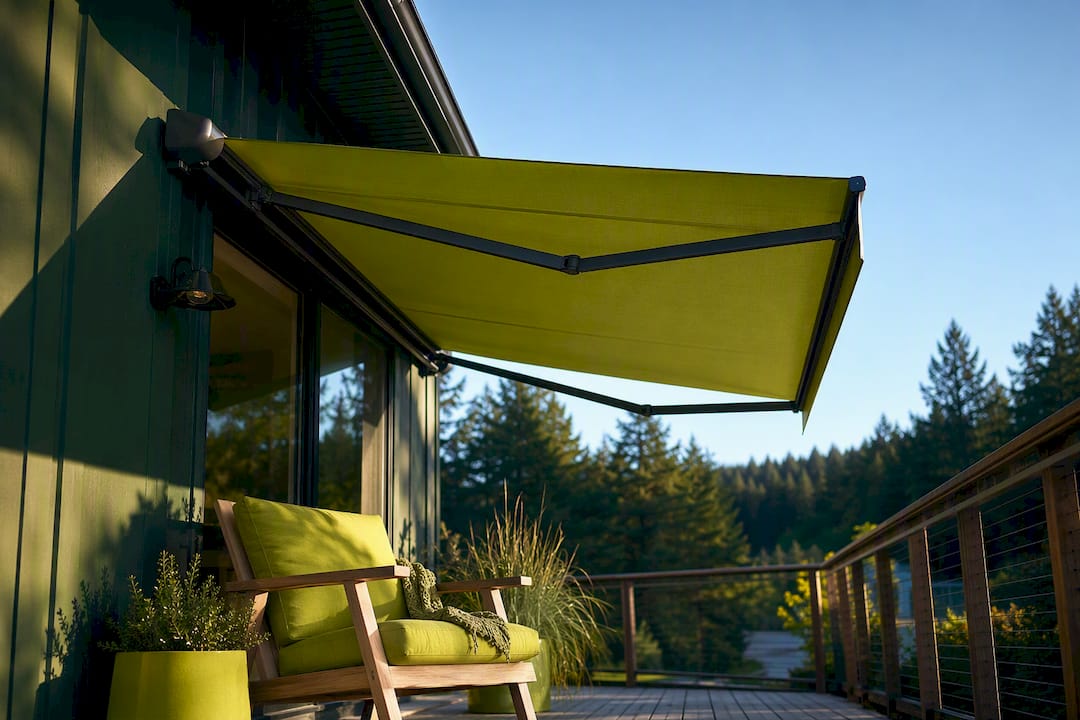
For full, reliable coverage, choose a louvered pergola or a fixed roof extension. For flexibility on a tighter budget, a retractable awning or a shade sail wins. For zero commitment, an umbrella still does the job. The right pick always comes down to your sun path, your wind exposure, and whether you’re renting or own the place long-term.
TL;DR:
- Retractable awnings can block a high percentage of UV and are suitable for flexible shading, but they tend to be expensive and require professional installation.
- Shade sails are budget-friendly and modern but perform poorly in high wind and heavy rain unless professionally anchored, making them less suitable for exposed locations.
- Structural options like roof extensions and pavilions provide comprehensive weather protection but involve higher costs, permits, and load considerations.
- Proper planning, including sun and wind tracking and structural capacity checks, is essential to avoid common mistakes such as under-anchoring or choosing inappropriate materials.
Table of Contents
- Shade for Deck Ideas That Actually Work
- How to Choose the Right Deck Shade System
- DIY vs Hiring a Pro for Deck Shade
- Costs, Lifespan, and Keeping Your Shade Structure Working
- Cactus Decking’s Contractor Checklist for Shade Projects
- Common Mistakes Homeowners Make With Deck Shade
- Get Professionally Designed Deck Shade From Cactus Decking
- Sources
Shade for Deck Ideas That Actually Work
Every deck shade option trades off coverage, flexibility, and cost differently, and the trade-off you’re willing to accept says more about the right choice than any style photo ever will.
Retractable awnings sit at the top of most homeowners’ lists because they don’t force a permanent decision. Smart pool shade and awning solutions offer practical, affordable options to keep your backyard comfortable and protected. Roll it out when the sun’s brutal, roll it back when you want open sky. Retractable awnings can block a high percentage of UV and many newer models come with wind sensors that retract automatically before a gust does damage. The catch: quality units run into real money, and professional installation is recommended to get the cassette mounted correctly and the motor wired safely.
Louvered pergolas are the premium answer. Aluminum louvers that tilt open or closed give you actual weather control, not just shade. Close them fully in a downpour, angle them for filtered afternoon light, or open them flat for stargazing. They cost more upfront but shrug off decades of Pacific Northwest weather with barely any upkeep.
Traditional and kit pergolas with fabric panels or lattice tops split the difference between style and function. Pergolas offer partial shade and take well to add-ons like retractable canopy inserts, climbing vines, or simple shade cloth stretched across the beams. A kit pergola from a home improvement store can look sharp, but the ones that last twenty years are usually custom-built to match the deck’s actual structure.
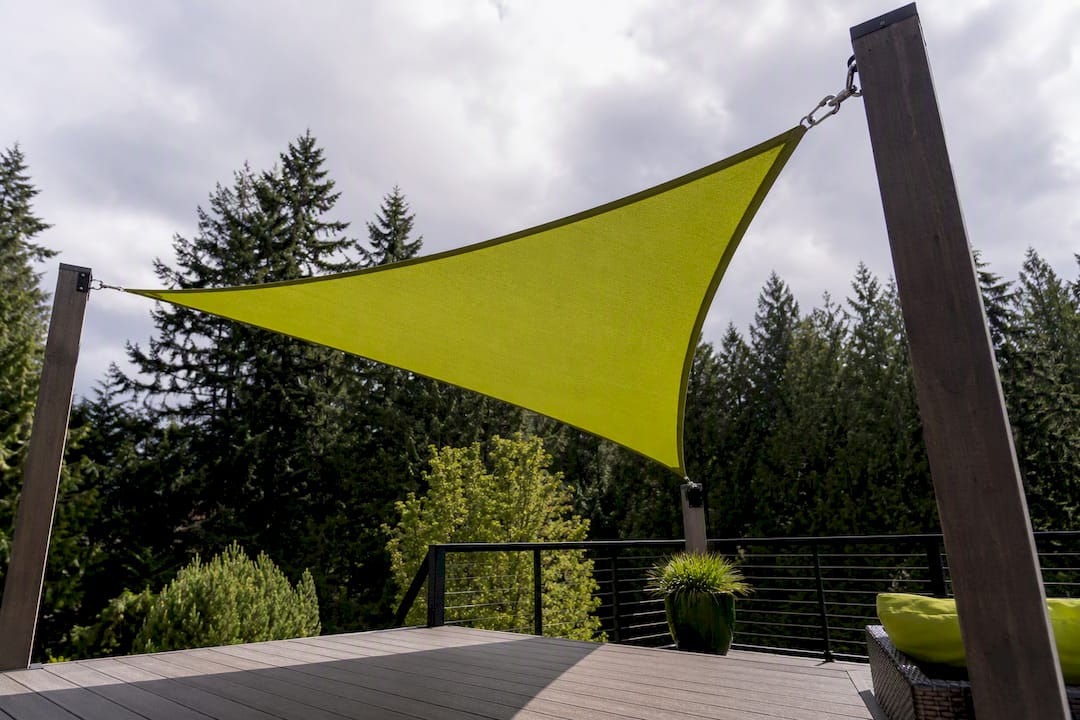
Shade sails have become the go-to for anyone chasing a modern look on a real budget. Stretched taut between three or four anchor points, they throw striking angular shadows and cost far less than a roof. The tradeoff: shade sails perform poorly in high wind and heavy rain unless anchored by a professional, so skip the DIY hardware-store kit if your deck catches gusts off open water or a hill.
Gazebos, pavilions, and roof extensions deliver the most complete weather protection of any option on this list, rain or shine. They also carry the most structural weight, meaning footings, load calculations, and usually a permit. This is the category where cutting corners costs the most later.
Umbrellas (market-style or cantilever) remain the lowest-commitment option and the easiest for renters. Move them, store them, replace them for under $200 in many cases. They just can’t cover a whole deck the way a fixed structure can.
Rounding out the list:
- Pop-up canopies work well for parties and cookouts but aren’t built for daily, season-long use.
- Outdoor curtains and drop screens add side shade and privacy without blocking airflow the way a solid wall would.
- Trellises, trees, and vines offer the slowest but cheapest shade, and they cool the air around them as a bonus.
Pro Tip: Before falling in love with a shade sail because of a photo you saw online, check what direction your deck faces. A sail angled for a south-facing deck often looks completely wrong, and shades the wrong half of the space, on a west-facing one.
How to Choose the Right Deck Shade System
Picking a shade structure without checking your own deck first is how homeowners end up with a beautiful pergola shading the wrong corner. Work through this before calling a contractor:
- Track your sun path. Stand on your deck at 10 a.m., 1 p.m., and 4 p.m. for a few days and note where the shadows fall. A deck facing due south needs different coverage than one facing west, where low afternoon sun sneaks under awnings.
- Check your wind exposure. Coastal lots, hilltops, and open backyards without windbreaks are bad candidates for unanchored sails or lightweight umbrellas.
- Confirm structural capacity. Older decks may not support the added weight of a pergola or roof extension without reinforced posts or footings.
- Set a budget band and decide if you’re optimizing for lowest upfront cost or lowest cost over ten years.
- Check permit and HOA rules before you commit to anything attached to the house or requiring footings.
- Ask your contractor about wind load ratings, warranty terms, and whether the crew is in-house or subcontracted.
Pro Tip: Take photos of your deck at the same three times of day noted above and bring them to your consultation. It saves the contractor a return visit just to check sun angles.
DIY vs Hiring a Pro for Deck Shade
Shade sails, umbrellas, and pop-up canopies are generally fair game for a confident DIYer with a drill and a weekend. Roof extensions, anchored pergolas, and motorized awnings are a different story: engineered systems like these perform best with professional installation, and getting the anchoring wrong on a pergola isn’t the kind of mistake you notice until it’s too late.
Before you call anyone, or grab your own tools, take three measurements:
- Footprint: the exact square footage you want shaded.
- Sun path: the three-time-of-day check from the section above.
- Anchor points: where a sail, awning, or post could physically attach, and whether that structure (house wall, existing post, deck frame) can bear the load.
Proper anchoring is what separates a durable shade sail from one that tears loose in the first windstorm. If you’re not confident rating your own hardware for wind load, that’s the line where DIY should stop.
Costs, Lifespan, and Keeping Your Shade Structure Working
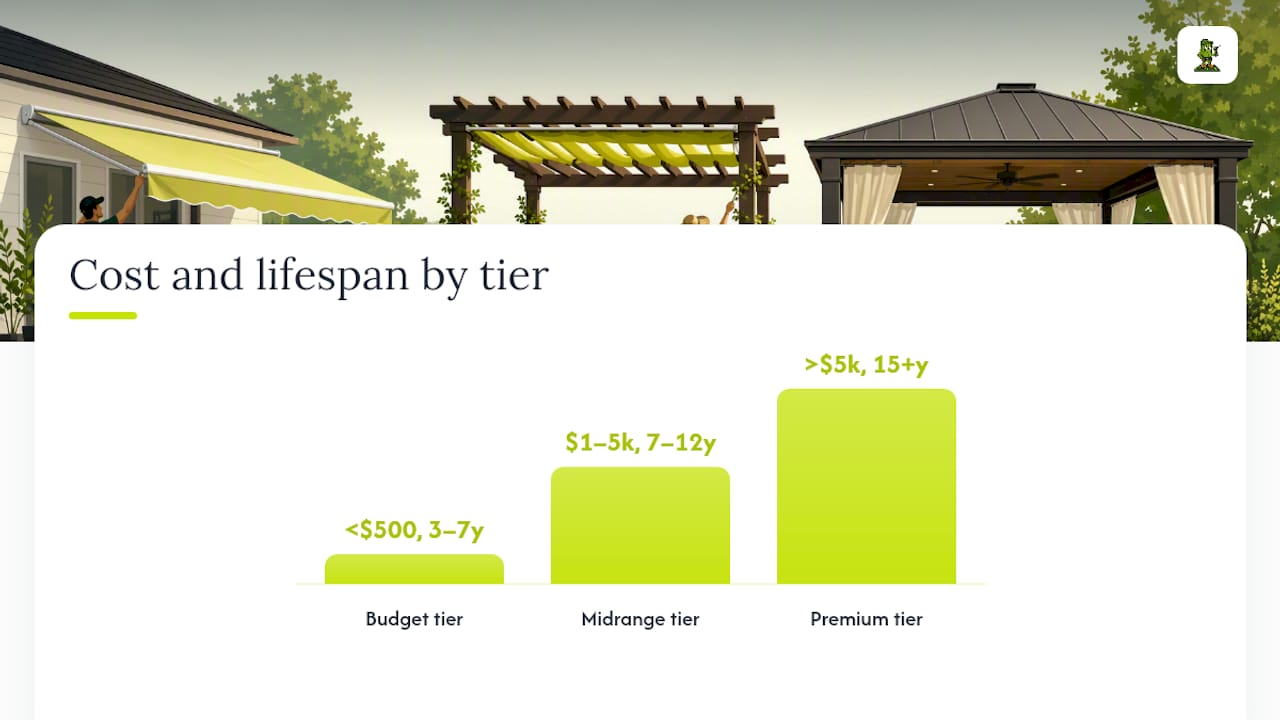
Budget-tier shade (umbrellas, basic pop-ups) usually runs under $500 and lasts three to seven years before fabric fades or frames rust. Midrange options like fabric awnings, mid-size sails, and kit pergolas land between $1,000 and $5,000, with fabric awnings typically holding up seven to twelve years. Premium builds, louvered pergolas, roof extensions, and custom pavilions, run past $5,000 but can last fifteen years or more with basic upkeep.
A well-chosen shade strategy also protects what’s underneath it: less direct sun means less fading on your decking boards and less UV breakdown on outdoor furniture cushions.
Simple seasonal maintenance keeps any of these running longer:
- Clean fabric panels and sails at least once a season to prevent mildew buildup.
- Fully retract awnings before storms, even with a wind sensor installed.
- Check hardware, bolts, and anchor points twice a year for corrosion or loosening.
- Inspect pergola beams for water damage where they meet the house.
Cactus Decking’s Contractor Checklist for Shade Projects
Cactus Decking builds every shade project the same way it builds decks: consultation first, design second, then in-house construction with a warranty backing the finished work. That order matters because a shade structure sized wrong at the design stage is expensive to fix after installation.
Material choice depends on the structure. Aluminum frames and composite decking hold up with minimal upkeep for louvered pergolas and roof extensions, while cedar still wins on classic pergola style for homeowners who don’t mind periodic staining. PVC decking underneath a shaded area resists moisture buildup particularly well since it dries slower without direct sun.
Before your consultation, prepare:
- Photos of your deck at three different times of day
- Notes on your sun path and prevailing wind direction
- A target shade percentage (50%, 75%, or 90% coverage)
- A rough budget range
| What to bring | Why it matters |
|---|---|
| Sun path photos | Lets the Everett deck design service size the structure to your actual light, not a guess |
| Wind notes | Determines anchor strength for sails or awning cassettes |
| Coverage target | Sizes purlins and posts correctly before materials are ordered |
| Budget range | Filters options before you fall for something outside it |
Common Mistakes Homeowners Make With Deck Shade
Wind gets underestimated more than any other factor. Homeowners fall for a shade sail’s clean look, skip the professional anchoring, and lose it in the season’s first real storm. Under-anchoring is the second big one, treating a fabric structure like it just needs to look secure instead of actually rated for local wind loads. Fabric choice trips people up too: budget polyester fades and sags within a couple of years where a UPF-rated marine fabric would have lasted a decade.
The clearest trend right now is a shift toward low-maintenance composite structures and motorized shade systems that homeowners can control without climbing a ladder. One recent project involved a homeowner replacing a sagging fabric pergola cover with a fully louvered aluminum system. The difference in how often they actually used the deck afterward was immediate.
— Vlad
Get Professionally Designed Deck Shade From Cactus Decking
Cactus Decking is the alternative to piecing together shade from a big-box kit and hoping the anchors hold. As an in-house crew based in Everett, Washington, the team designs, builds, and warranties deck cover installation service, pergolas, and custom shade structures without subcontracting the work out to strangers.
Homeowners choose Cactus Decking because the crew that shows up for the consultation is the same crew that builds the project, backed by a warranty and a preference for eco-conscious materials like composite and PVC decking that hold up to Pacific Northwest weather. Before your consultation, gather your sun path photos, note your wind exposure, and set a rough budget so the design conversation moves fast. Ready to see what’s possible for your own deck? Browse the deck gallery or reach out to schedule a consultation and get a shade plan built around how you actually use your outdoor space.
Sources
For sun exposure risks tied to inadequate shade, the American Cancer Society’s overview of UV and skin cancer risk is worth a read. For side-by-side shade comparisons, see Decks.com’s shade and privacy guide. For pergola sizing specifics like purlin strength and anchor spacing, Sunset Pergola Kits’ spec sheet breaks down the numbers.
- Best Ways to Shade a Deck: Top 10 Options Compared
- 20 Shade Solutions and Ideas for Decks, Porches, and Patios
- Roof Deck Sun Shade Solutions for Outdoor Comfort – New England Metal Roof


