
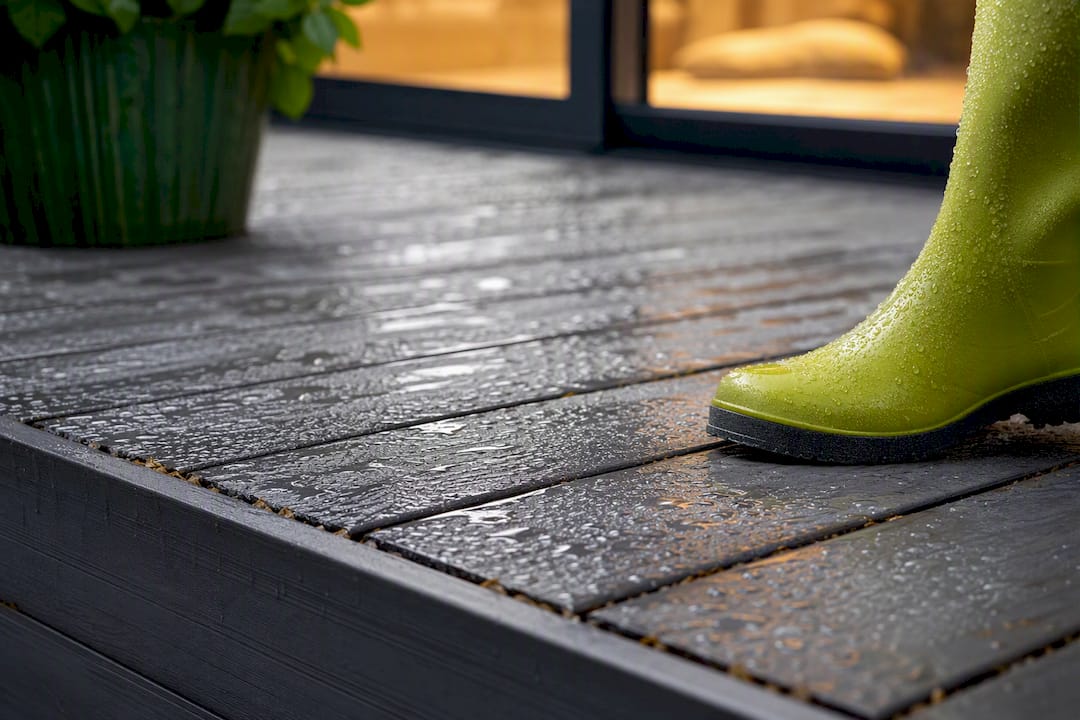
Short answer: modern textured composite decking is not inherently dangerous to walk on, wet or dry, but it is not slip-proof either. Real-world traction depends on the board’s texture, whether algae or debris has built up on the surface, and how well the deck was installed. Pick a capped, textured board, keep it clean, and you’re dealing with a manageable risk rather than a hazard.
TL;DR:
- The primary cause of slipperiness on composite decking is surface contamination from algae, pollen, and debris, not the material itself.
- Textured, capped composite boards with grooved or embossed finishes maintain better wet traction over time than smooth or aged boards.
- Proper deck slope, adequate drainage, and good airflow beneath the structure are critical to prevent persistent dampness and algae buildup.
- Regular cleaning, careful power washing, and adding anti-slip treatments or coatings significantly reduce slip risk.
- Selecting boards with a wet coefficient of friction of 0.55 to 0.65 or a PTV of 36 or higher helps ensure low slip hazards in wet conditions.
Table of Contents
- Why composite decking can feel slippery: factors that reduce traction
- How composite compares with wood, PVC, and stone for wet traction
- Which composite board surfaces give the best grip
- Practical ways to stop composite decking from being slippery
- Installation and design choices that reduce long-term slip risk
- Cactus Decking’s field practices and homeowner resources
- The bottom line on composite decking safety
- What installers get wrong, and what to fix first
- Get a deck built right from the ground down
- Where to go for deeper testing data
- Sources
Why composite decking can feel slippery: factors that reduce traction
Most complaints about slippery composite decking trace back to what’s sitting on the surface, not the material underneath. A thin biofilm from algae, pollen, or leaf residue fills in the microtexture that gives a board its grip, and once that layer forms, even a well-designed surface can feel like glass underfoot. GripDeck’s analysis points to this contamination, rather than the composite itself, as the main driver of slip complaints.
Weathering plays a role too. Composite boards degrade at different rates depending on their polymer base. Research on wood plastic composites found that HDPE based formulations resist surface degradation better than PP based ones, which affects how much texture a board retains after years in the sun and rain, according to a ScienceDirect weathering study. A board that’s lost its cap integrity absorbs more moisture and grows algae faster.
A few other conditions stack the odds against you:
- Standing water that pools instead of draining
- Shaded, low-airflow spots where moisture never fully evaporates
- Ice, which defeats almost any texture regardless of material
- Installation errors like flat slope, blocked drainage gaps, or boards laid too tight
How composite compares with wood, PVC, and stone for wet traction
Textured composite generally holds up better than aged wood decking, which grays, splinters, and grows slick with mildew as its surface fibers break down. New, rough-sawn wood can offer decent grip, but that grip fades fast once the wood weathers unevenly.
PVC decking and smooth stone tile tell a similar story: performance depends more on finish than category.
- Smooth PVC often scores lower on wet traction than textured composite unless it has embossing
- Polished stone tile can be genuinely hazardous when wet, since it lacks any mechanical texture
- Aged wood loses consistency across the deck as some boards weather faster than others
- Textured, capped composite tends to hold its grip more evenly over time
The real takeaway: don’t shop by material label alone. A smooth board in any category underperforms a textured one, and maintenance matters more long term than what the product is made from.
Which composite board surfaces give the best grip
Look for grooved, embossed, or wood-grain brushed finishes over anything with a flat, glossy face. Grooves in particular do double duty: they channel water off the surface and give your foot something to mechanically catch onto, which is why UltraDecking’s guide notes grooved finishes consistently outperform smooth ones in wet-condition testing.
Capped composite boards resist moisture absorption, which keeps algae from taking hold as fast as it does on uncapped or older-generation composite.
Pro Tip: Ask any supplier for their Pendulum Test Value (PTV) or wet coefficient of friction before you buy, not after installation.
Here’s what to check for:
- PTV of 36 or higher — classed as low slip risk in independent wet-condition testing
- Wet SCF in the 0.55 to 0.65 range for textured or grooved boards, versus 0.40 to 0.50 for smooth composite
- Test documentation specific to your exact board and finish, not a generic product line rating
A board that scores well in dry conditions but has never been tested wet tells you almost nothing useful.
Practical ways to stop composite decking from being slippery
Cleaning solves more slip problems than any product retrofit. Sweep debris regularly, and wash the deck every few months (more often near trees or in shaded, damp climates) with warm water, a mild dish soap or composite-safe cleaner, and a soft-bristle brush worked into the grooves where grime collects.
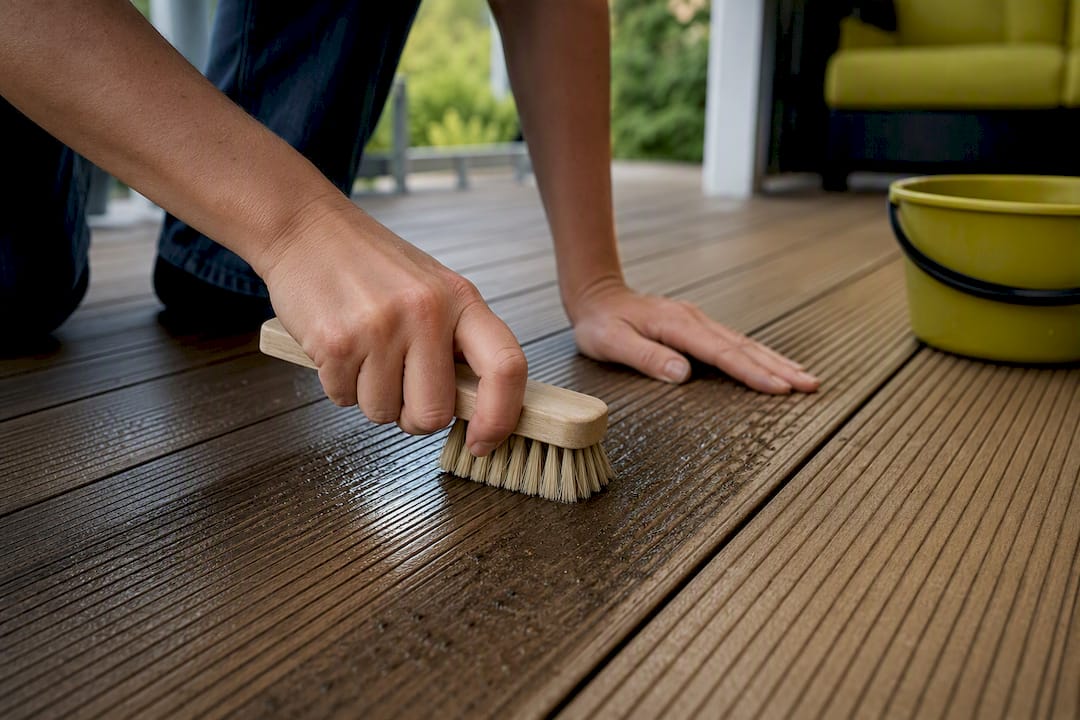
Power washing works, but keep the pressure below 3,100 PSI or so, and hold the nozzle at a wide angle. Blasting straight down at high pressure can strip the cap and roughen the surface in ways that trap even more dirt afterward.
When cleaning alone isn’t enough, a few retrofits fill the gap:
- Anti-slip tape on stair treads and high-traffic edges, though it wears and needs replacing
- Non-slip coatings for broader coverage, with some trade-off in the board’s natural look
- Grit additives mixed into paint or sealant for maximum traction on ramps or pool steps
Suppliers like SlipDoctors offer these as targeted fixes for stairs and pool-adjacent areas rather than whole-deck solutions.
For winter, use a plastic shovel, never metal, and stick to calcium chloride or CMA-based de-icers. Rock salt and cheap sodium chloride products can pit or discolor composite caps over repeated seasons.
Installation and design choices that reduce long-term slip risk
A lot of chronic slipperiness gets built into the deck before anyone ever walks on it. Boards need roughly a quarter-inch gap for drainage and airflow, and the substructure should slope slightly (about a quarter-inch per foot) away from the house so water sheets off instead of pooling.
Ventilation underneath the deck matters just as much as the slope on top. A deck built low to the ground with no airflow stays damp for hours after rain, giving algae exactly the environment it needs.
A few design details worth flagging to your contractor:
- Trim back overhanging branches that drop leaves and shade the deck year-round
- Add contrast nosing or grooved treads on stairs, where slips cause the worst injuries
- Install step lighting so wet or icy spots are visible at night
Cactus Decking’s field practices and homeowner resources
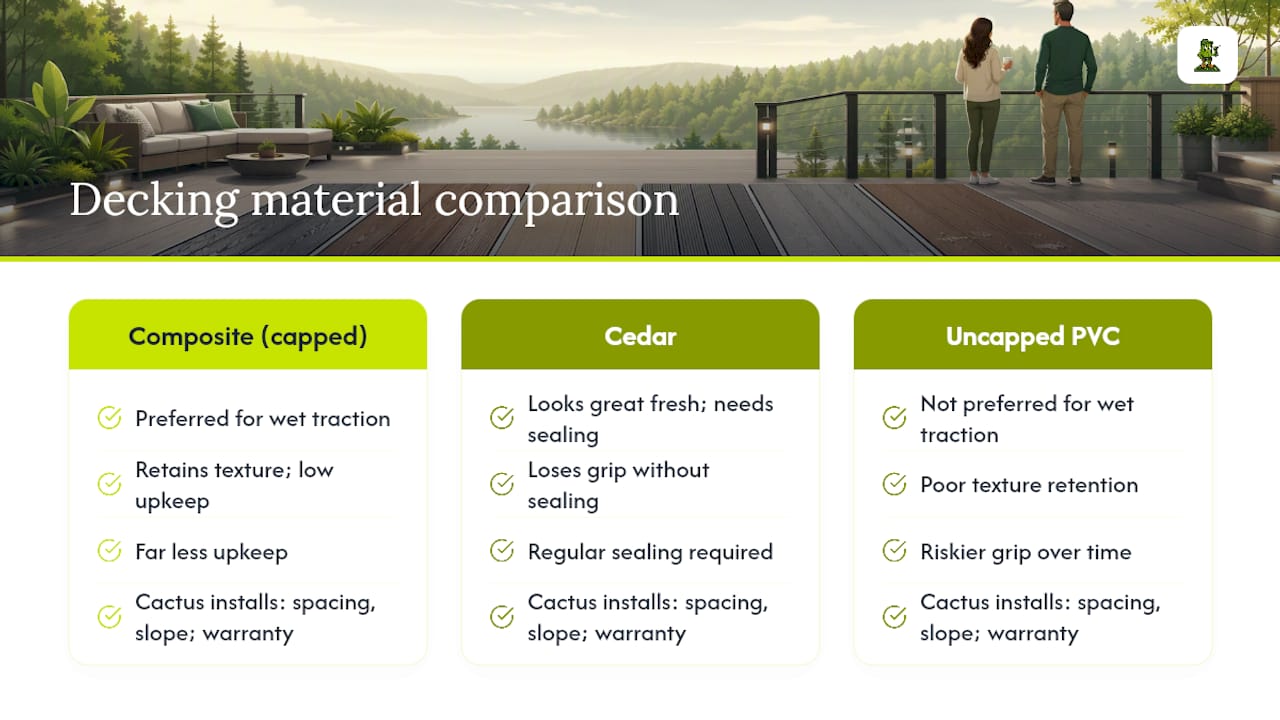
On most projects where wet traction is a real concern, poolside decks, shaded lots, coastal humidity, we steer clients toward capped, textured composite over cedar or uncapped PVC. Cedar looks great fresh but needs regular sealing to keep its grip; composite holds texture with far less upkeep.
Our in-house crews build in proper board spacing and slope from the start, and every installation carries a warranty, so drainage problems get fixed rather than argued over later. If you want the maintenance side of the picture, our guides on cleaning composite decking and composite deck lifespan cover the day-to-day and long-term details. If your current deck feels riskier than it should, an in-person assessment usually spots the cause fast.
The bottom line on composite decking safety
Composite decking is safe for most households when you choose a textured, capped board and keep it clean. Before you commit to a product or a contractor, run through this:
- Choose textured or grooved, capped boards over smooth finishes
- Ask for wet-condition PTV or coefficient of friction data
- Confirm proper slope, spacing, and under-deck airflow
- Set a cleaning schedule based on your shade and tree cover
Call a professional if water pools anywhere on the surface or a section never fully dries.
What installers get wrong, and what to fix first
The most common mistake isn’t the board choice, it’s the substructure. Installers rush the slope calculation or skip the airflow gap to save a few boards, and no amount of texture fixes a deck that never drains.
If you’re triaging an existing deck, work in this order: fix drainage first, since standing water defeats any surface. Clean second, since biofilm is usually the actual culprit behind a “slippery material.” Retrofit last, once you know the first two aren’t the real issue.
— Vlad
Get a deck built right from the ground down
There are DIY fixes for a slippery deck, tape, coatings, a good scrub, but none of them fix a substructure that was sloped wrong or never got the airflow it needed. Cactus Decking builds that groundwork correctly the first time, with in-house crews who set slope and spacing before a single board goes down, and every installation is warranty-backed so drainage issues get resolved rather than debated.
If your current deck stays damp too long or you’re planning a new one for a pool, shaded yard, or high-traffic entryway, our Everett deck design service team can assess the site and recommend the board texture and layout that fits it. Browse finished projects in our deck gallery, or reach out to start a custom deck installation built around drainage and traction from day one.
Where to go for deeper testing data
For the technical side of weathering and cap performance, the ScienceDirect study on wood plastic composites breaks down how polymer base affects long-term surface change. UltraDecking’s wet-traction guide explains PTV scoring in more depth, and GripDeck covers contamination-driven slip risk. For hands-on cleaning help near pools, Goleta Pressure Washing’s pool deck guide is a solid practical reference.
Sources
- The effects of weathering on wood plastic composites (ScienceDirect)
- Is Composite Decking Slippery? (GripDeck)
- Is composite decking slippery when wet? (UltraDecking)
- Composite and Conglomerate Decking (SlipDoctors)


