Cedar Deck vs Composite: What Homeowners Need to Know
Discover the key differences between a cedar deck vs composite. Learn which option offers better lifespan, cost, and maintenance for your home.

Cedar Deck vs Composite: What Homeowners Need to Know
For most homeowners who want a deck that holds up for decades without constant upkeep, capped composite wins. It lasts over two decades with minimal maintenance, often supported by long product warranties, and eliminates the annual staining cycle that cedar demands. Cedar is the right call when you want genuine wood character, a cooler surface underfoot, and you’re willing to commit to yearly finishing work to protect it.
The core trade-offs come down to four things:
Lifespan: Capped composite typically lasts 25–30 years, while cedar runs 15–20 years when maintained annually.
Upfront cost: Cedar can be competitive with entry-level composite, but mid-range and premium composite costs more upfront.
Maintenance: Cedar needs annual staining and sealing; composite needs a soap-and-water wash once or twice a year.
Heat comfort: Composite boards, especially darker ones, get significantly hotter in direct sun than cedar.
Cactusdecking installs both materials in Everett, WA and the surrounding area, and the recommendation almost always comes down to lifestyle, not just budget.
Table of Contents
How does cedar deck vs composite actually compare?
What do cedar and composite actually look like on a finished deck?
How long does each material actually last?
What does each material actually cost over 25 years?
What maintenance does each material actually require?
How hot does composite get, and is it safe barefoot?
Which material is better for the environment?
What installation differences should you ask your contractor about?
Quick pros and cons for cedar and composite
How do you choose the right material for your home?
What Cactusdecking recommends from the field
Which material fits your situation? Scenario-based recommendations
Key Takeaways
What the job site actually teaches you about this choice
Ready to build? Cactusdecking handles the whole project
Useful sources and further reading
How does cedar deck vs composite actually compare?
Dimension | Cedar | Capped Composite |
|---|---|---|
Typical lifespan | 15–20 years with annual maintenance | 25–30 years |
Upfront cost per sq ft (installed) | Moderate | Higher |
Maintenance tasks | Annual stain/seal, periodic board inspection | Soap-and-water wash 1–2x/year, debris removal |
25-year TCO (400 sq ft example) | Higher | Comparable or lower |
Appearance/finishes | Natural grain, stainable, weathers to gray | 50+ color options, embossed wood-grain textures |
Heat retention | Moderate; stays cooler barefoot | High in direct sun (140–170°F for dark boards) |
Warranty | Lumber grade only; no finish warranty | 25–50 years (cap technology dependent) |
Installation notes | Standard 16" OC framing, screws or hidden clips | 16" OC straight, 12" OC diagonal; expansion gaps required |
Key clarifications on the table above:
The cedar TCO assumes annual staining at roughly $0.55 per sq ft per year in labor and materials, plus periodic board replacement.
Composite TCO assumes a capped product (Trex, TimberTech, or equivalent) with no annual finishing costs.
RealCedar sets the industry benchmark for Western Red Cedar quality grading; not all cedar sold at lumber yards meets that standard.
“Capped composite” refers to boards with a co-extruded polymer shell. Uncapped composites lack that protection and perform significantly worse over time.
What do cedar and composite actually look like on a finished deck?
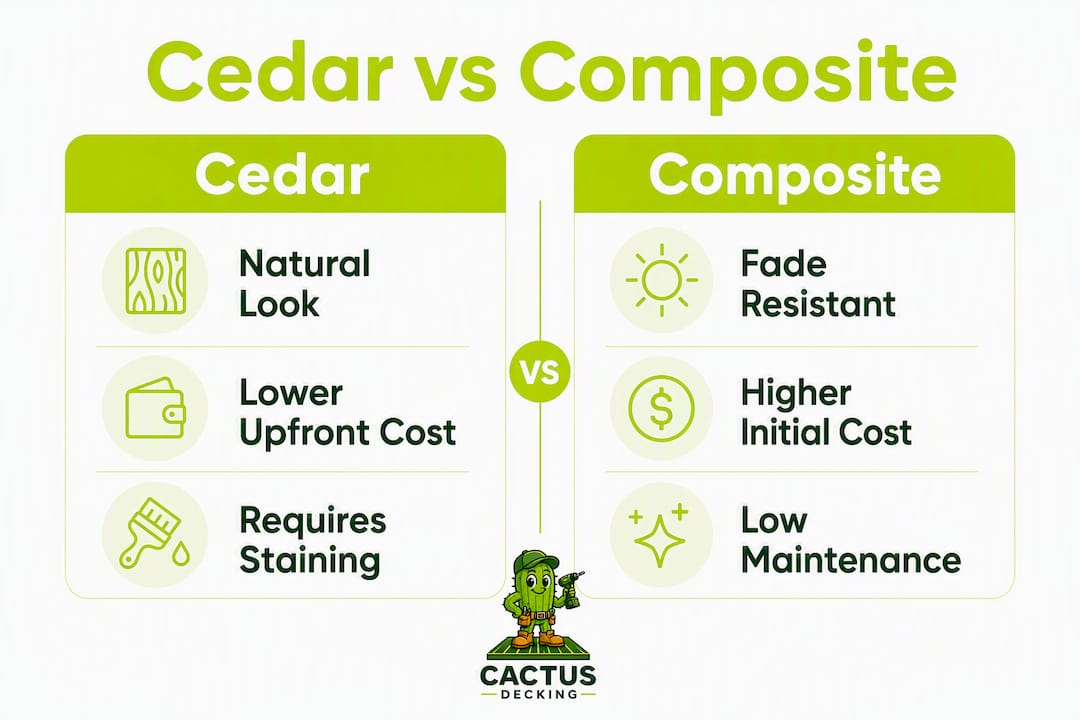
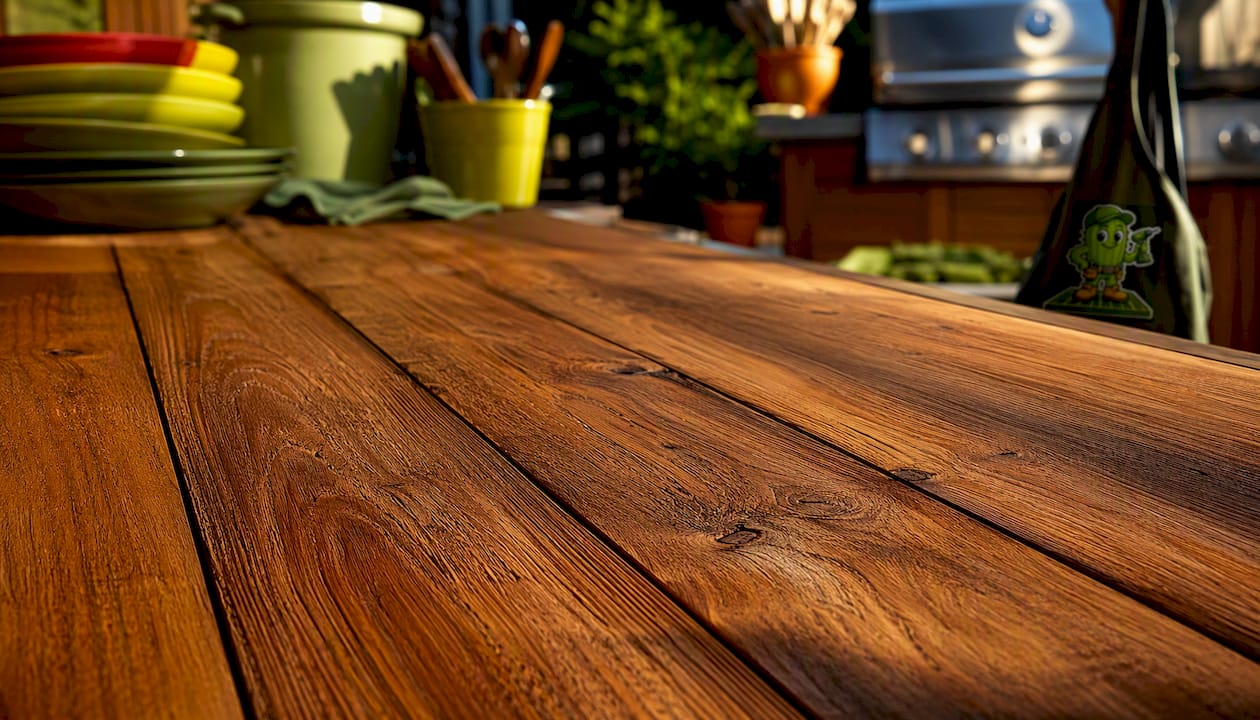
Cedar’s appeal is hard to fake. The grain varies board to board, the color shifts from warm amber to silver-gray if left unfinished, and it takes stain in ways that let you match almost any exterior palette. Routed edges, curved boards, and custom trim profiles are straightforward because cedar cuts and shapes like any dimensional lumber.
Composite has closed the visual gap considerably. Brands like Trex and TimberTech now produce boards with deep embossed grain patterns, variegated color streaks, and matte finishes that read as wood from a few feet away. You get 50-plus color options across most product lines, and the cap technology stabilizes color so the board you install looks close to the board you see in the showroom five years later.
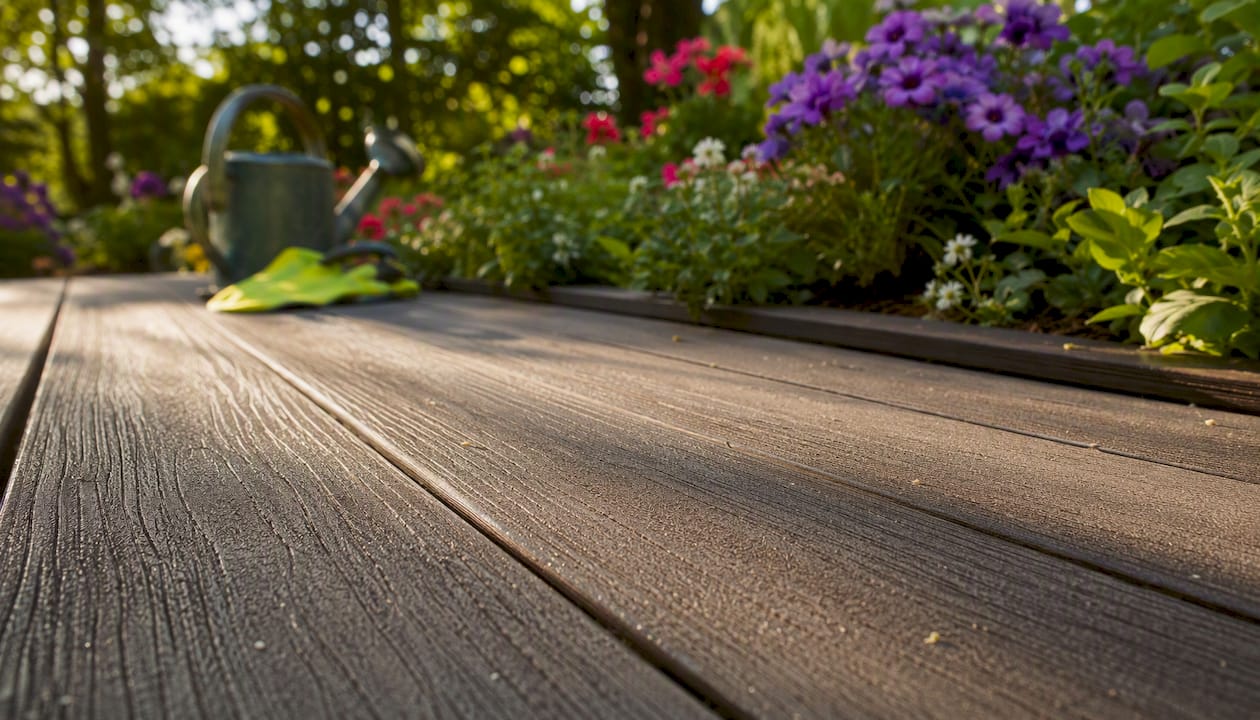
Where composite still falls short aesthetically: the repeating grain pattern. Because boards are extruded from molds, you’ll see the same texture repeat every few feet unless you mix board orientations or choose a premium line with randomized patterns. Cedar never has that problem.
Design practicality by material:
Cedar accepts hidden fastener clips, traditional screws, and face-screwing with plugs; routing and custom profiles are easy.
Composite requires manufacturer-specific hidden fastener systems to maintain warranty; cutting and routing is possible but limits finishing options at cut ends.
Both materials work with cable railings, aluminum post systems, and deck lighting without major compatibility issues.
Pro Tip: On sun-exposed south-facing decks, choose a composite color two shades lighter than your instinct. The board will look darker once installed against a light house exterior, and lighter colors run 20–30°F cooler underfoot in peak summer.
How long does each material actually last?
Capped composite typically lasts 25–30 years; cedar runs 15–20 years when you stay on top of annual staining and sealing. Skip a couple of maintenance cycles and cedar’s service life drops fast, especially in the Pacific Northwest where moisture is relentless.
The failure modes are different, and that matters for how you plan.
Cedar fails from the outside in: moisture penetrates the grain, rot sets in at board ends and low spots, and insects find their way into compromised wood. Checking (surface cracks along the grain) and splintering follow. The good news is that early-stage damage is visible and repairable. You can sand a cedar board, restain it, and add years to its life.
Composite fails differently. The cap is the whole game. Deep scratches or gouges go through the polymer shell and expose the wood-fiber core underneath, where moisture and mold can take hold. Unlike cedar, you cannot sand and refinish a composite board. The damaged board typically needs full replacement. Structural sag can also develop if joist spacing specs aren’t followed during installation.
Trex and TimberTech both offer 25-year fade and stain warranties on their capped lines, with some premium tiers extending to 50 years. Those warranties cover the cap’s performance, not structural failure from improper installation. Read the fine print.
What does each material actually cost over 25 years?
Cedar’s lower sticker price is real but temporary. Mid-tier composite typically breaks even with cedar somewhere between years 8 and 14 once you account for recurring staining costs, and composite pulls ahead after that.
Installed cost ranges (per sq ft):
Cedar: $15–$30 installed (material + labor)
Entry-level composite: $25–$35 installed
Mid-range composite (Trex Select, TimberTech Azek): $35–$45 installed
Premium composite: $45–$55+ installed
For a detailed breakdown of cedar material and labor costs, the drivers include board grade, local lumber prices, and framing complexity.
25-year TCO example (400 sq ft deck, mid-range assumptions):
Cost Item | Cedar | Mid-Range Composite |
|---|---|---|
Initial installation | $8,000 | $14,000 |
Annual stain/seal (25 yrs) | $8,000 | $0 |
Board replacements (est.) | $6,000 | $220 |
Assumptions: 400 sq ft deck, $20/sq ft cedar installed, $35/sq ft composite installed, $0.55/sq ft/yr stain labor and materials, moderate climate, no full deck replacement within 25 years for composite.
Break-even calculation (simplified):
Composite premium over cedar upfront: $14,000 minus $8,000 = $6,000
Annual cedar maintenance savings from composite: ~$220/year (stain/seal on 400 sq ft)
Break-even: $6,000 ÷ $220 = approximately year 27
That math shifts significantly if you hire out staining (labor pushes annual costs higher) or if cedar board replacement runs above average. Climate matters too: wet climates accelerate cedar degradation and push the break-even earlier. For current composite installed-cost ranges in the Everett area, Cactusdecking can provide a project-specific estimate.
What maintenance does each material actually require?
Cedar maintenance is a real annual commitment, not a suggestion.
Cedar year-by-year tasks:
Year 1: Clean with a deck wash, let dry fully, apply penetrating stain or sealer.
Years 2–5: Inspect boards for checking, soft spots, and end-grain moisture damage; re-stain annually.
Years 5–10: Begin replacing boards showing rot or deep checking; re-examine fastener areas for corrosion.
Years 10+: Consider a full sanding and refinish; assess whether substructure needs attention.
Finishing options for cedar include penetrating oil stains (best long-term protection), semi-transparent stains (color plus protection), solid stains (maximum coverage, hides grain), and clear sealers (shortest recoat interval, typically 1–2 years). Paint is an option but traps moisture if the surface isn’t perfectly prepared.
Composite maintenance is genuinely low: sweep off debris regularly, wash with mild soap and a soft brush once or twice a year, and address mold or mildew spots with a composite-approved cleaner before they spread. No staining, no sealing, no sanding.
Composite maintenance limits:
Never use a metal shovel or wire brush; scratches through the cap are permanent.
Avoid pressure washing at high PSI; it can lift the cap on some products.
Composite-specific cleaners (Defy, Corte-Clean) work better than generic deck washes on mold stains.
Pro Tip: Schedule cedar staining in late spring after the wood has dried from winter moisture. Staining wet or damp cedar traps moisture under the finish and causes peeling within a season.
How hot does composite get, and is it safe barefoot?
This is the question composite manufacturers don’t lead with. Darker composite boards in direct sun commonly reach 140–170°F, which is hot enough to cause discomfort or a burn within seconds of barefoot contact. Cedar under the same conditions runs noticeably cooler because wood conducts heat more slowly than the polymer cap.
Factors that make composite hotter: dark board color, south or west-facing orientation, no overhead shade, and low air circulation under the deck. Factors that help: light gray or tan board colors, deck covers or pergola structures, outdoor rugs in high-traffic areas, and composite products with heat-reflective cap technology (some premium lines advertise this).
Cedar stays cooler by nature. If you have young children or pets who spend time on the deck barefoot, that’s a real practical advantage worth weighing against cedar’s maintenance demands.
Which material is better for the environment?
Neither material is a clean win here, and anyone telling you otherwise is selling something.
Cedar is renewable, biodegradable, and stores carbon during its service life. The sustainability question is sourcing. FSC-certified cedar confirms the lumber came from responsibly managed forests; uncertified cedar may not. The finishing chemicals (stains, sealers) add a disposal consideration at end of life, and cedar boards going to landfill biodegrade relatively quickly.
Composite’s sustainability pitch centers on recycled content: most composite boards use post-consumer recycled plastic (grocery bags, film wrap) and reclaimed wood fiber. The manufacturing process is energy-intensive, and the finished board is a plastic-wood hybrid that most municipal recycling programs won’t accept. Some manufacturers (Trex, for example) run take-back programs, but availability varies by region.
Sustainability checklist for homeowners:
For cedar: look for FSC certification on the lumber, choose water-based low-VOC stains, and confirm the supplier’s chain-of-custody documentation.
For composite: ask the manufacturer for post-consumer recycled (PCR) content percentage, check whether a take-back or recycling program exists in your area, and request a product environmental declaration if available.
For both: a longer-lasting deck is inherently more sustainable than one replaced every 12 years.
What installation differences should you ask your contractor about?
The framing under your deck matters as much as the boards on top of it, and composite and cedar have different structural requirements.
Joist spacing: Standard composite installations require 16" on-center for straight board runs and 12" on-center for diagonal patterns. Cedar is more forgiving and typically installs on standard 16" framing regardless of pattern. If you’re replacing cedar boards with composite on an existing frame, the framing may need to be upgraded before installation begins.
Weight: Composite boards are heavier than cedar. Retrofitting an older cedar deck with composite requires a framing load assessment. Posts, beams, and joists that were sized for cedar may need reinforcement.
Fasteners and expansion: Composite expands and contracts with temperature changes more than cedar does. Most manufacturers require hidden fastener systems with built-in spacing clips to allow for that movement. Installing composite boards tight against each other (as you might with cedar) can cause buckling in summer heat and voids the warranty.
Cedar installation: Traditional face-screwing with stainless steel screws works fine, or hidden clip systems are available for a cleaner look. Cedar’s dimensional stability is better than composite in temperature extremes, though it still needs end-gap spacing.
Pro Tip: Ask your contractor to show you the manufacturer’s installation guide for the specific composite product being used. If they can’t produce it, that’s a red flag. Joist spacing and fastener specs are product-specific, and deviating from them is the most common warranty-voiding mistake.
Quick pros and cons for cedar and composite
Cedar pros:
Authentic wood grain and natural beauty that composite can’t fully replicate
Cooler surface temperature in direct sun
Repairable: sand, restain, and extend board life
Lower upfront cost, especially for smaller decks
Biodegradable and renewable when FSC-certified
Cedar cons:
Annual staining and sealing required to maintain appearance and prevent rot
Shorter lifespan (15–20 years) compared to capped composite
Susceptible to rot, insects, and moisture damage if maintenance lapses
Resale impact: buyers increasingly expect low-maintenance materials; cedar may require disclosure of maintenance history
Composite pros:
25–30 year lifespan with minimal upkeep
No staining, sealing, or sanding required
Wide color and texture selection; color-stable with capped technology
Strong resale appeal; low-maintenance decks are a selling point in most markets
Composite cons:
Higher upfront cost, especially for mid-range and premium products
Gets significantly hotter in direct sun than wood
Deep scratches require board replacement, not refinishing
Uncapped composite (older or budget products) performs poorly; cap quality varies widely
Climate note: In wet, shaded climates like the Pacific Northwest, composite’s rot and mold resistance is a significant advantage. In dry, sunny climates, heat retention becomes the dominant comfort concern.
How do you choose the right material for your home?
Work through these five questions before you call a contractor:
What’s your time horizon? If you’re staying in the home 20+ years, composite’s lower lifetime cost and longer service life make a strong case. If you’re selling within 10 years, cedar’s lower upfront cost may pencil out better.
How much maintenance will you actually do? Be honest. If annual staining sounds like a weekend project you’ll enjoy, cedar works. If it sounds like something you’ll defer every year, composite is the right answer.
What’s your aesthetic priority? If authentic wood grain and the ability to change stain color over time matter to you, cedar wins. If you want a consistent, low-effort appearance, composite delivers.
What’s your climate exposure? Shaded, north-facing, or high-humidity decks favor composite. Hot, sunny, south-facing decks where barefoot comfort matters may favor cedar or a lighter composite color.
What’s your budget structure? Lower upfront cost points to cedar; lower lifetime cost points to mid-range composite.
Questions to ask any deck contractor:
What joist spacing do you use for this composite product, and does it meet the manufacturer’s spec?
Is this a capped or uncapped composite? What’s the cap technology?
What warranty does the manufacturer provide, and what does it cover specifically?
Can you show me the installation guide for this product?
Do you have local references for decks built with this material in the last three years?
Red flags during quotes:
Contractor quotes “composite” without specifying capped vs. uncapped or naming the product line.
No mention of joist spacing upgrades when replacing cedar with composite.
Warranty described vaguely as “lifetime” without written documentation.
No proof of insurance or local permit experience.
What Cactusdecking recommends from the field
Cactusdecking’s crew in Everett has built both cedar and composite decks across a range of project types, and the pattern in recommendations is consistent.
When cedar makes sense on a project:
Historic or craftsman-style homes where the wood aesthetic is part of the architecture.
Lightweight existing framing that would require significant reinforcement to handle composite’s added weight.
Homeowners who genuinely want to refinish and customize the deck’s appearance over time.
Smaller decks where the lower upfront cost is the deciding factor and the homeowner understands the maintenance commitment.
When composite is the recommendation:
Clients who explicitly say they don’t want to think about the deck for 10 years.
Lakefront, poolside, or high-humidity installations where moisture exposure is constant.
Decks with north-facing or shaded orientations where wood rot risk is elevated.
Homeowners planning to sell within 5–10 years who want the low-maintenance selling point.
Cactusdecking backs every installation with warranty documentation, uses an in-house crew (no subcontracting), and pulls permits for all projects. For composite builds, the team specifies capped products and provides the manufacturer’s installation guide as part of the project file.
Which material fits your situation? Scenario-based recommendations
“I want low maintenance for 25+ years.” Choose capped composite. The service life, warranty coverage, and near-zero annual upkeep cost justify the higher upfront price over that horizon.
“I want authentic wood look and I’ll maintain it.” Cedar. No composite fully replicates the grain variation and warmth of real wood, and if you’ll stay on top of annual staining, cedar holds up well.
“My deck is near a pool or lake.” Composite. Constant moisture exposure accelerates cedar’s rot timeline dramatically; composite’s cap resists water intrusion far better.
“I want the lowest upfront cost and plan to replace within 10 years.” Cedar. The upfront savings are real, and within a 10-year window, composite’s TCO advantage hasn’t fully materialized.
“I have young kids or pets who use the deck barefoot all summer.” Cedar or a light-colored composite with a shade structure. Dark composite in full sun is a genuine burn risk for small children.
“I’m selling the house in the next few years.” Mid-range composite. Buyers in most markets respond positively to low-maintenance decking, and a new composite deck photographs well for listings.
Next step: get at least two contractor quotes, ask each one to specify the exact product and cap technology, and request written warranty documentation before signing anything.
Key Takeaways
Composite wins on lifetime value for most homeowners; cedar wins on natural aesthetics and upfront cost when annual maintenance is not a barrier.
Point | Details |
|---|---|
Lifespan gap | Capped composite lasts 25–30 years; cedar typically lasts 15–20 years with consistent annual maintenance. |
TCO reality | Mid-range composite often breaks even with cedar between years 8–14 once staining costs accumulate. |
Maintenance difference | Cedar requires annual staining and sealing; composite needs only a soap-and-water wash once or twice a year. |
Heat comfort | Dark composite boards can reach high temperatures in direct sun; cedar generally stays cooler and is safer barefoot. |
Cactusdecking | Installs both materials in Everett, WA with in-house crews, permit handling, and warranty-backed work. |
What the job site actually teaches you about this choice
Most homeowners come into the conversation focused on the material cost per square foot. That’s the wrong number to anchor on. The decks that generate callbacks and regret are almost always cedar builds where the homeowner underestimated the maintenance commitment, or composite builds where the contractor skipped the joist spacing upgrade and the boards started sagging by year three.
The choice between cedar and composite is genuinely a lifestyle question, not a technical one. A cedar deck maintained well is a beautiful thing. A composite deck installed correctly is nearly invisible in the best way: you use it, you enjoy it, and you don’t think about it again until you’re ready to sell the house. Neither answer is wrong. The wrong answer is choosing one without understanding what it actually asks of you.
Ready to build? Cactusdecking handles the whole project
Cactusdecking builds custom cedar and composite decks in Everett, WA and the surrounding area, from initial design through permitted installation. The in-house crew handles framing assessments, joist upgrades, material selection, and warranty documentation so you’re not managing subcontractors or chasing paperwork. Every composite build uses capped products with written manufacturer warranties; every cedar build includes a maintenance schedule so you know exactly what the deck needs and when.
To get started, schedule a deck design consultation or request a quote for installation. Bring your deck dimensions, a photo of your home’s exterior, and a rough sense of your budget range. The estimate covers materials, framing, permits, and a 25-year cost comparison so you can make the decision with real numbers in hand.
Useful sources and further reading
Source | What it covers |
|---|---|
Cedar vs Composite Decks — Longevity | Lifespan comparisons and maintenance assumptions for cedar and composite |
Composite vs Wood Decking — DeckMath | 25-year TCO models and stain/seal cost estimates |
How hot does composite decking get? | Surface temperature data for composite in direct sun |
Cedar vs Composite Decking — BTN Decks | Cap technology and warranty scope explanation |
Proper joist spacing for composite decking | Structural requirements and spacing specs by installation pattern |
Cedar vs Composite — Deck & Drive Solutions | Repairability differences and cap damage considerations |
Composite Decking Pros and Cons — D and G Flooring | Market share data and composite cost ranges |
Composite Decking Cost — Cactusdecking | Current installed-cost ranges for composite tiers in the Everett area |
Cedar Deck Cost — Cactusdecking | Cedar material and labor cost drivers |
Real-world durability and warranty details for composite |