A typical cedar deck costs a moderate to high range per square foot installed, with materials alone costing less than half that amount. Most homeowners building a mid-size deck spend several thousand dollars once labor, framing, and permit fees are included. Cedar is worth it when you want a natural wood look, plan to refinish over time, and prefer lower upfront cost compared to premium composites. Size, species, labor rates, and whether you’re replacing an existing deck are the variables that move the number most.
Table of Contents
- How much does a cedar deck cost by size?
- What drives the price of a cedar deck?
- Which cedar species should you choose?
- DIY vs. hiring a contractor: what’s the real difference?
- What does cedar deck maintenance actually cost?
- Permits, timeline, and site-prep costs
- A sample contractor-style cost breakdown
- How to get quotes you can actually compare
- Key Takeaways
- The numbers are only half the story
- Cactusdecking builds cedar decks in Everett, WA
- Useful sources and tools
How much does a cedar deck cost by size?
The fastest way to sanity-check a quote is to run the math yourself. Installed costs vary significantly by size and features, with materials costing a fraction of the total. Larger decks tend to push totals higher due to framing and railing complexity.
To scale for your own size, multiply your square footage by $14 for a bare-bones estimate or $35 for a fully featured build with upgraded species and railings. Add 10% contingency on top.
Coastal markets often have higher labor and material costs than inland areas. Everett, WA represents a mid-to-high labor cost market, so budgeting accordingly for installed deck costs is recommended.
Common add-on costs to budget separately:
- Railings: $150–$600 per linear foot depending on material (wood vs. cable vs. aluminum)
- Stairs: $1,000–$2,500 per staircase for a standard deck stairs run
- Deck lighting: $200–$800 for basic low-voltage deck and step lighting
- Demolition of old deck: $5–$15 per sq ft
- Permit fees: up to $500 in most jurisdictions
Pro Tip: Order 10%–15% extra material to account for end cuts, waste, and any boards that arrive with defects. On a 320-sq-ft deck, that’s roughly 32–48 extra square feet of decking — budget it in from the start rather than scrambling mid-build.
What drives the price of a cedar deck?
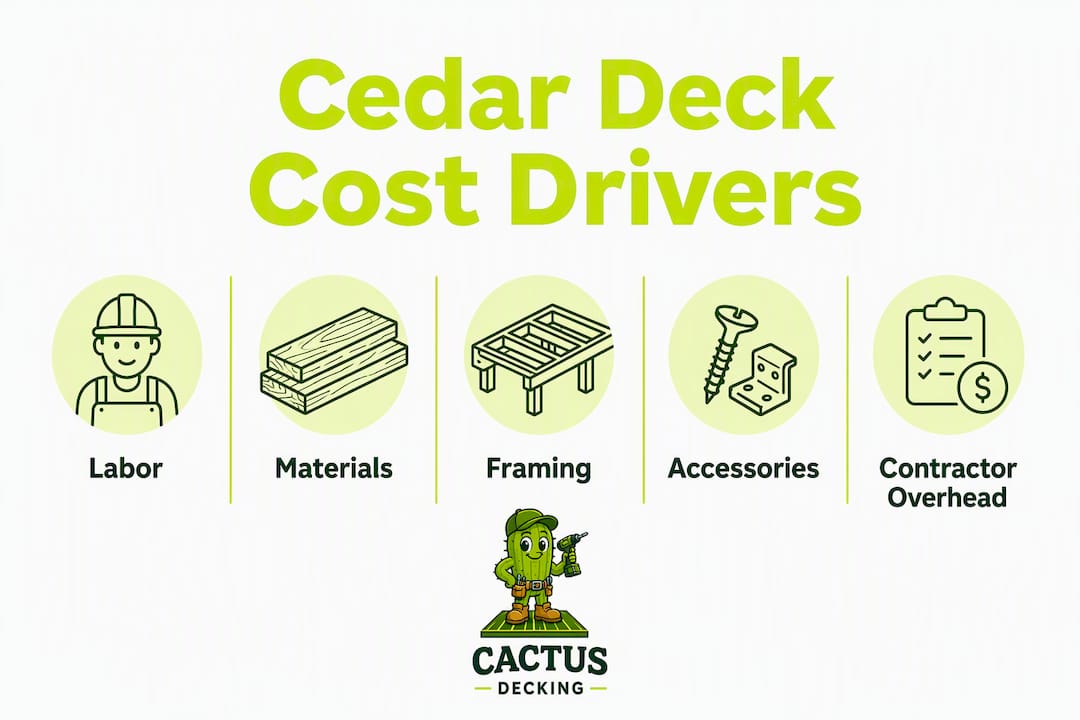
Labor is the largest portion of a cedar deck’s installed cost, often representing the majority of total expenses, varying by region and project complexity. That means on a $10,000 deck, roughly $6,000–$7,000 goes to the crew, not the wood.
Framing and foundation
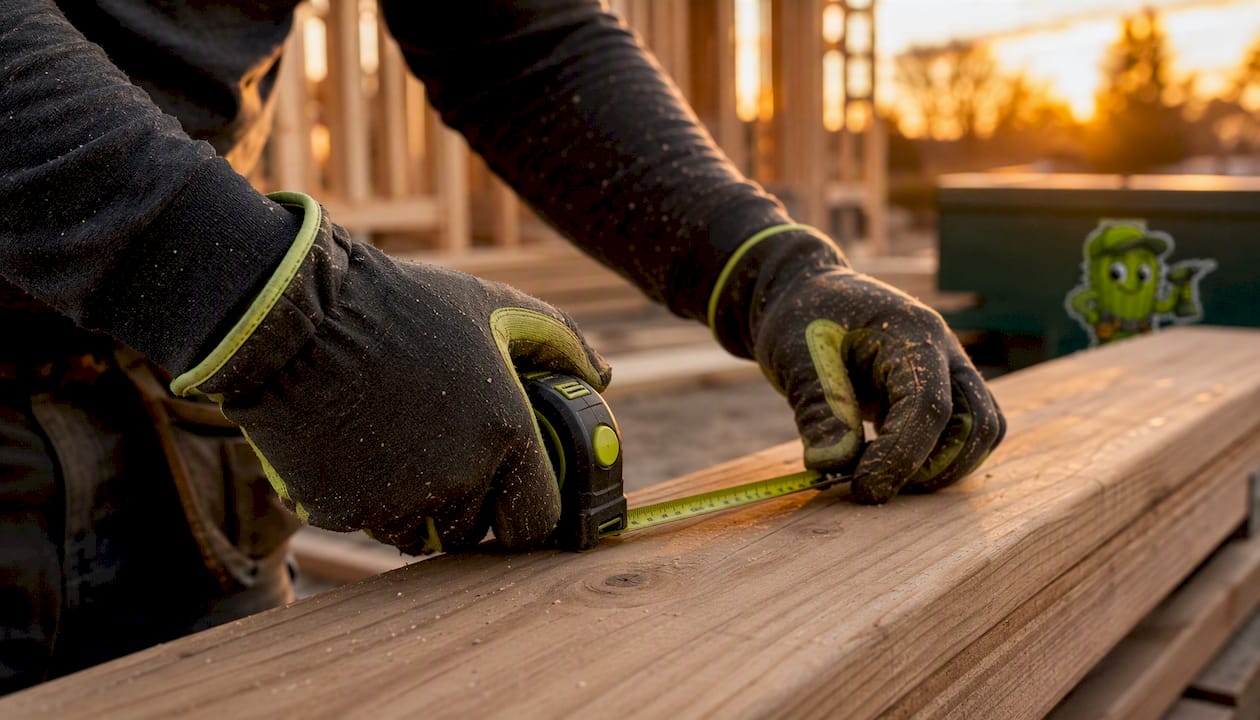
The substructure under the decking boards often costs as much as the surface itself. Joist spacing (12" vs. 16" on center), beam sizing, post depth, and whether you need a ledger attachment to the house all affect both material and labor costs. A freestanding deck costs more to frame than a ledger-attached one because it needs its own beam system. Concrete footings in frost-prone areas add a notable additional cost per footing, depending on depth.
Decking boards and grade
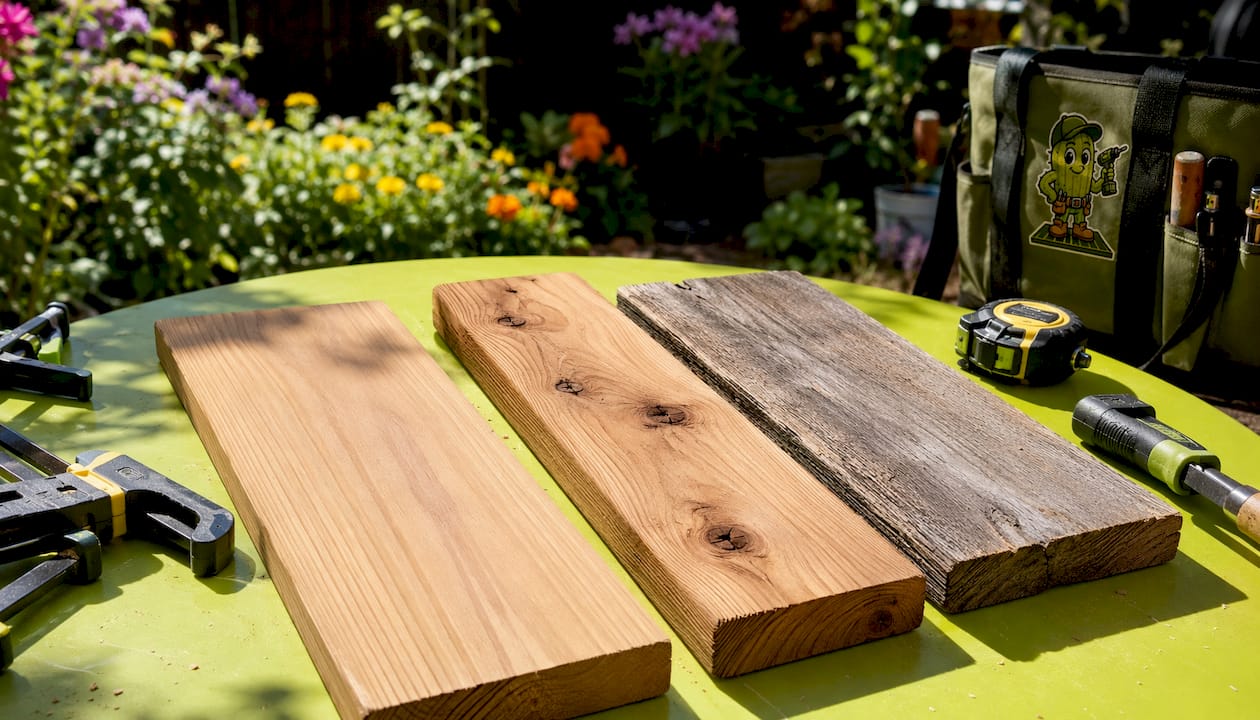
Cedar board pricing varies by profile and grade. A standard 5/4×6 tight-knot board serves as a baseline; knotty grades are typically less expensive, while clear and FOHC grades carry a significant premium. Clear cedar is worth the premium on visible surfaces; knotty is fine for hidden framing members.
Railings, stairs, and accessories
Railings and stairs are often underestimated. A 40-linear-foot railing run in cedar can add a substantial amount to a project’s total cost. Deck railing systems in cable or aluminum cost more upfront but require less maintenance. Stairs are priced per staircase, not per step, and a double-wide stair with a landing can run $3,000–$5,000.
| Cost Category | Typical Share of Total | Notes |
|---|---|---|
| Decking materials | A significant portion | Species, grade, and profile drive this |
| Framing and hardware | A moderate portion | Joists, beams, posts, fasteners |
| Labor | The largest portion | Regional rates vary significantly |
| Permit and inspection | A minor portion | Varies by jurisdiction |
| Contractor overhead | A noteworthy markup | Often built into quotes |
| Contingency | Planned allowance | Covers waste and surprises |
Contractor overhead of 13%–22% is one of the most common blind spots on homeowner budgets. It’s rarely called out as a line item, but it’s built into every professional quote. If you’re comparing bids, ask each contractor to break out overhead separately so you’re comparing apples to apples.
Which cedar species should you choose?
Species selection comes down to three things: where you live, how much you want to spend, and how long you want the deck to last without major intervention.
| Species / Grade | Material Cost (per sq ft) | Expected Lifespan | Best For |
|---|---|---|---|
| Western Red Cedar (knotty) | $4–$6 | 15–25 years | Pacific Northwest, general use |
| Western Red Cedar (clear/FOHC) | $7–$10 | 20 years | Premium visible surfaces |
| Eastern White Cedar | $3–$5 | 15 years | Northeast, budget-conscious builds |
| Alaskan Yellow Cedar | $5–$14 | 25–40 years | High-moisture, coastal climates |
| Composite (e.g., Trex) | $5–$14 | 25–30 years | Low-maintenance priority |
Western Red Cedar is the industry standard for rot resistance and is widely available in the Pacific Northwest, which keeps prices competitive locally. Eastern White Cedar is often cheaper in the Midwest and Northeast because it’s regionally sourced. Alaskan Yellow Cedar is denser and more durable than either, but the price premium is real.
Grade options and what they mean for your budget:
- Knotty / Tight Knot: Most affordable, natural rustic look, fine for most residential decks
- A & Better: Fewer knots, cleaner appearance, moderate premium
- Clear: Nearly knot-free, premium pricing, best for railings and visible trim
- FOHC (Free of Heart Center): Most stable, least likely to cup or check, highest price
Trex and other composite brands sit in the $5–$14 per square foot material range. The upfront cost is comparable to mid-grade cedar, but composites eliminate most of the recurring staining and sealing costs. Cedar wins on natural aesthetics and the ability to sand and refinish; composite wins on maintenance simplicity. Neither is objectively better — it depends on what you value.
DIY vs. hiring a contractor: what’s the real difference?
DIY labor savings can be significant but must be weighed against tool rental costs, permits, time commitment, and skill level; a modest-sized deck often takes several weeks for experienced builders.
Tasks homeowners can safely DIY:
- Staining, sealing, and finishing
- Installing decking boards on a pre-built frame
- Lighting installation (low-voltage)
- Demolition of an old deck (with permit if required)
Tasks that should go to a licensed contractor:
- Ledger attachment to the house (requires flashing, lag bolts, and often a structural inspection)
- Footing excavation and concrete pours
- Structural framing and beam sizing
- Permit application and inspection coordination
The ledger is the single most failure-prone element on DIY decks. An improperly flashed ledger causes rot inside the house wall, which is far more expensive to fix than the labor you saved. For structural work, new deck installation service is the lower-risk path.
Red flags in contractor quotes:
- Price more than 30% below other bids with no explanation
- Vague scope (“deck boards and framing” with no species, grade, or dimensions)
- No permit plan or “we’ll handle it informally”
- Unwilling to provide references from the last 12 months
- Requests more than 30%–40% upfront before work begins
What does cedar deck maintenance actually cost?
Cedar requires active maintenance to stay looking good. Annual maintenance includes periodic pressure washing and resealing, which can collectively cost a few hundred dollars annually; full staining or resurfacing events add more substantial expenses depending on deck size and product choice.
The two main strategies are letting it weather or actively oiling it:
- Let it weather: Costs $0 per year in product, but cedar turns a silver-grey patina within 6–12 months. The wood is still protected by its natural oils, but the color is gone. Some homeowners love the look; others don’t.
- Oil-stain and maintain: Costs roughly $0.45 per square foot per year on a biennial recoat schedule. On a 320-square-foot deck, that’s about $144 per year, or $288 every two years when you actually apply the product.
Over 25 years, the oil-stain path adds roughly $3,600 in product and labor to a 320-square-foot deck. That’s real money, but it preserves the wood’s color and extends its useful life meaningfully compared to letting it go grey and dry.
Maintenance timeline for a typical cedar deck:
- Year 1: Pressure wash, apply initial sealer or oil ($100–$250 for washing, $150–$300 for product)
- Years 2–3: Inspect for loose fasteners, check ledger flashing, spot-treat any grey boards
- Years 4–5: Full recoat ($550–$1,250 for a professional application)
- Years 10–15: Expect to replace a few boards, re-drive fasteners, possibly refinish railings
Pro Tip: Specify 305 or 316 stainless steel fasteners in your build contract. Galvanized screws react with cedar’s natural tannins and leave dark streaks that are nearly impossible to remove. The stainless premium runs about $0.55 per square foot — on a 320-square-foot deck, that’s roughly $176 extra, and it’s worth every cent. For coastal builds within five miles of saltwater, 316 stainless is required.
Permits, timeline, and site-prep costs
Most jurisdictions require a permit for any deck over 200 square feet or elevated more than 30 inches above grade — but rules vary, so check with your local building department before assuming. Permit fees vary by jurisdiction and can add several hundred dollars, with inspection timelines potentially extending project duration by weeks.
Typical project timeline:
- Design and estimate: 1–2 weeks
- Permit application and approval: 2–6 weeks (varies by jurisdiction)
- Site prep and material delivery: 3–5 days
- Framing and structural work: 3–7 days
- Decking installation: 2–5 days
- Railings, stairs, and finishing: 2–4 days
- Final inspection: 1–3 days after completion
Most builds take multiple weeks from contract signing through final inspection, with permit approval often being the main timing factor.
Site-prep costs that often surprise homeowners:
- Grading and drainage correction: $500–$2,500
- Tree removal or root grinding: $300–$1,500 per tree
- Access restrictions (narrow side yards, fencing removal): $200–$800
- Disposal of old deck materials: $5–$15 per sq ft
- Utility marking and clearance: typically free, but required
For Everett deck design service, working with a contractor who handles the permit application is worth the overhead. Permit rejections and resubmissions can add weeks to a project.
A sample contractor-style cost breakdown
A realistic line-item quote for a medium-sized cedar deck includes a range of costs for decking boards, framing lumber, fasteners, railing systems, staircases, labor, permits, cleanup, contractor overhead, and contingency—all contributing to a total cost that can vary widely depending on specifics.
A well-written quote separates fixed-scope items (permit fee, staircase count) from allowance items (decking species, railing style). Ask your contractor to flag which line items are fixed and which are allowances — that’s where change orders come from.
The custom deck installation process at Cactusdecking follows a design → permit → build → final inspection sequence, which means the permit and inspection costs are built into the project from day one, not added as surprises at the end.
How to get quotes you can actually compare
Getting three bids is standard advice. Getting three comparable bids takes a little more work.
Questions to ask every contractor:
- What species and grade of cedar are you pricing?
- What fastener type (stainless, galvanized, hidden clip)?
- Does your quote include permit application and inspection?
- What’s your warranty on labor and materials?
- What’s your timeline from signed contract to start date?
- Who handles cleanup and debris disposal?
- Can you provide two references from projects completed in the last year?
Bid comparison template — columns to request from each contractor:
| Column | What to Compare |
|---|---|
| Scope (sq ft, features) | Identical across all bids |
| Species and grade | WRC tight-knot vs. clear, etc. |
| Fastener type | Stainless vs. galvanized |
| Labor rate ($/sq ft) | Separate from materials |
| Permit handling | Included or extra |
| Warranty | Labor and material terms |
| Start date | Availability matters |
Red flags that should make you pause:
- A bid more than 30% below the others with no explanation of what’s excluded
- No permit plan (“we don’t usually pull permits for this size”)
- Species or grade listed as “cedar” with no further specification
- No written warranty or a warranty that only covers materials the contractor didn’t supply
- Pressure to sign quickly or a large deposit requirement before any design work
Key Takeaways
A cedar deck installed in the U.S. typically costs $14–$35 per square foot, with labor accounting for 60%–70% of the total, making contractor selection and scope clarity the two biggest budget levers.
| Point | Details |
|---|---|
| Installed cost range | Budget $14–$35 per sq ft installed; most 16×20 builds land between $4,480 and $11,200. |
| Biggest cost drivers | Labor (60%–70% of total), species/grade choice, railings, and contractor overhead (13%–22%). |
| Maintenance trade-off | Oil-staining costs roughly $0.45/sq ft/year; letting cedar weather costs $0 but produces a grey patina within 6–12 months. |
| Fastener choice matters | Specify 305 or 316 stainless steel fasteners; galvanized reacts with cedar tannins and causes permanent staining. |
| Cactusdecking | Cactusdecking handles design, permitting, and cedar installation in Everett, WA with warranty-backed, in-house crews. |
The numbers are only half the story
Most homeowners focus on the per-square-foot price and miss the two things that actually determine whether a cedar deck project goes smoothly: scope clarity and contractor overhead.
A quote that says “$18 per square foot” tells you almost nothing without knowing the species, the fastener spec, whether the permit is included, and what the contractor’s overhead markup looks like. The difference between a $12,000 quote and a $19,000 quote for the same deck is almost never the decking boards. It’s labor rates, overhead, railing scope, and whether the contractor priced in contingency or plans to bill it as change orders.
Cedar is genuinely a good material for the Pacific Northwest. It handles moisture well, it’s locally available, and it can be refinished when it starts to look tired. The homeowners who end up unhappy with cedar decks are usually the ones who skipped the stainless fasteners, let the deck go five years without a recoat, or hired based on the lowest bid without checking what was actually in scope. The wood itself rarely disappoints when it’s installed and maintained correctly.
Cactusdecking builds cedar decks in Everett, WA
Getting an accurate cedar deck price means more than plugging numbers into a calculator. It means knowing your site conditions, your local permit requirements, and which species and grade actually make sense for your climate and budget.
Cactusdecking builds custom cedar decks in Everett and the surrounding area, handling everything from deck design and permit coordination through framing, installation, and final inspection. The process runs design → permit → build → inspection, with an in-house crew and warranty-backed work on every project. If you want to see finished examples before committing, the project gallery shows local cedar and composite builds across a range of sizes and styles. Ready to get a real number for your project? Request a quote and get a line-item estimate built around your actual site.
Useful sources and tools
- Angi: Cedar Decking Cost Guide — per-sq-ft ranges, size examples, and maintenance cost data
- HomeAdvisor: Cedar Deck Cost — labor rate breakdowns and regional variation
- DeckMath Cedar Deck Calculator — species and grade cost modeling, 25-year TCO, fastener guidance
- Homewyse: Cedar Decking Estimates — contractor overhead ranges and local zip-code pricing
- CurrentCost: Western Red Cedar Price Guide — board-foot and linear-foot pricing by grade and region
- Decks.com Cost Calculator — material comparison tool covering cedar, composite, and other species
- For local permit rules, check your city or county building department directly. Permit thresholds, fees, and inspection requirements vary by jurisdiction and are not covered by national cost guides.
- Cactus Decking service directory — local Everett contractor for cedar deck builds, replacements, and upgrades