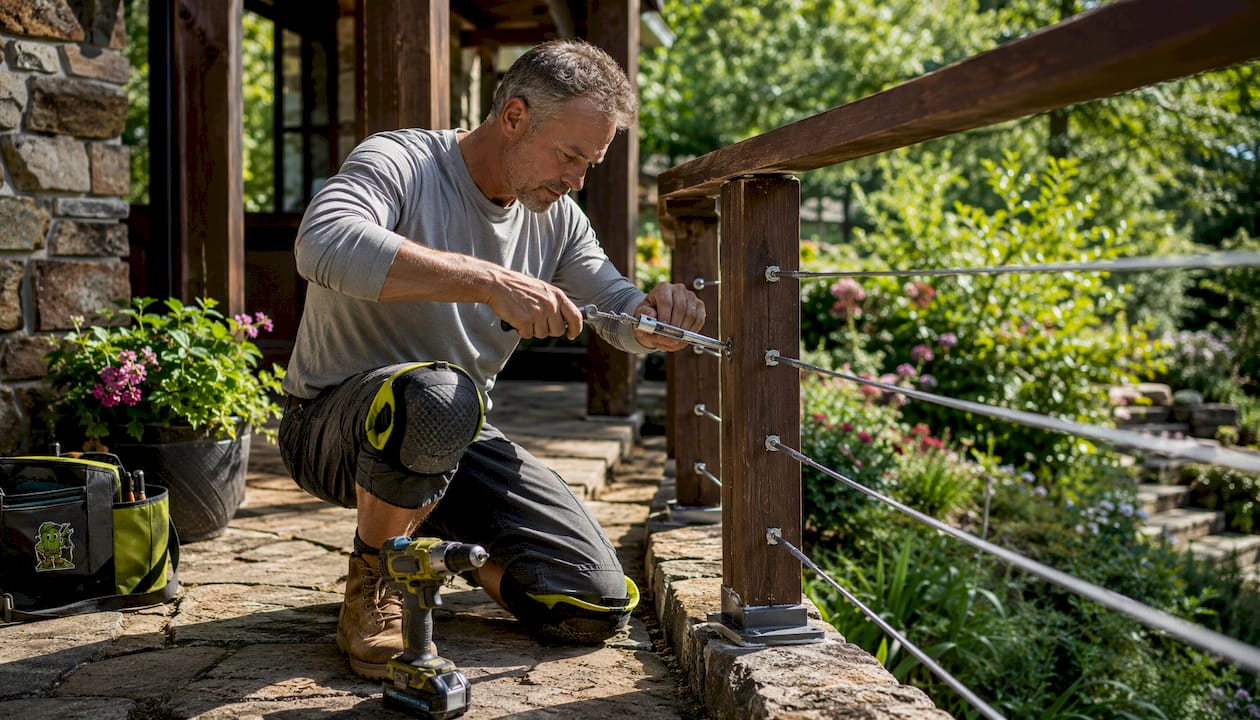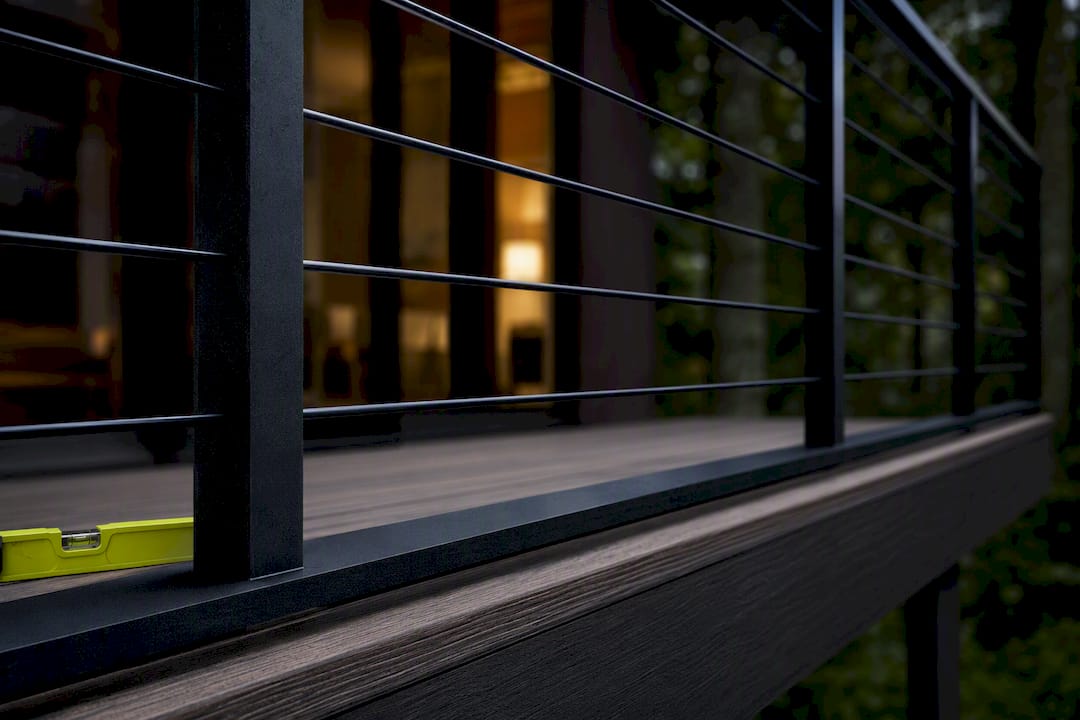


A wind resistant deck railing is not a special product. It is a railing whose posts, infill and connections are designed, fastened and inspected as one system, so that gusts, people leaning on it and years of weather all end up in the deck frame and the house instead of in a failure. Solid panels catch more wind than open ones, and rusted fasteners or a weak post base fail long before the railing material does. Below we cover what to choose, what the code requires, and how to check the railing you have.
TL;DR
- Wind force on a railing travels through the infill, into the posts, through the post connections and into the deck frame and house. The weakest link sets the limit.
- Open or perforated infill does not develop significant negative wind pressure the way solid glass can, but glass is still a sound choice when it is engineered and installed correctly.
- Corrosion-resistant fasteners and connectors, and a continuous load path, matter more than the brand of railing.
- In Everett, a deck attached to a house, more than 30 inches high, over 200 square feet or serving the main exit needs a permit, and the plans must show guardrail details.
- Check posts and the ledger first. Soft wood, loose hardware or a ledger held with nails alone calls for a professional.
Table of Contents
- How wind actually loads a deck railing
- Infill choices: solid, open or in between
- Posts and connections matter more than the panel
- What code requires in the U.S. and in Everett
- Our perspective on wind and railings in the Northwest
- How to check the railing you have
- Planning a wind resistant railing project
- Let us build your railing system
- FAQ
- Sources
How wind actually loads a deck railing
Picture a railing as a sail with a fence under it. Wind pushes on the infill, the infill hands that force to the rails, the rails hand it to the posts, and the posts hand it to whatever they are bolted to. If any handoff is weak, the railing moves, loosens over time, or eventually lets go.
The building-science guidance from the Building America program makes the same point for attached structures: they need strong connections and a continuous load path to resist expected wind forces, with corrosion-resistant fasteners, and deficient ledger and guardrail connections are named as common causes of deck failure. Professional deck inspection guidance adds that decks must be designed to resist lateral and uplift loads from wind or seismic activity.

That has a practical consequence. When a homeowner asks us for a railing that will stand up to wind, the answer starts below the railing: how the posts attach to the framing, what hardware is used, and whether the framing itself is sound.
- Post connections. A post that is only screwed to the face of a rim joist, or notched and weakly bolted, flexes under every push. Over seasons the holes enlarge and the post wobbles.
- Hardware that corrodes. A fastener that rusts loses strength invisibly. Rust stains at a bracket or bolt head are an early warning.
- Rotted wood at the base. Water collects where posts meet the deck surface. Soft wood there cannot hold a bolt, no matter how strong the railing is.
Infill choices: solid, open or in between
Infill is the part that catches wind, so its type changes the load. Structural engineers writing in STRUCTURE magazine explain that railing material affects wind load: solid glass railings can develop negative pressures, while perforated or open railings cannot develop significant negative pressures. In plain terms, a solid glass panel behaves more like a wall, and an open picket or cable system lets air through.
That does not make glass a bad idea. It means glass must be specified and mounted for the loads it will see, and the posts and base connections must be sized for it. Here is how the common options compare for wind.
| Infill type | Wind behavior | Maintenance | Best fit |
|---|---|---|---|
| Tempered or laminated glass panels | Solid surface catches more wind, so posts and bases must be built for it | Regular cleaning; hardware should be corrosion resistant | Exposed view lots, modern designs |
| Vertical metal balusters | Open, so air passes through | Low, if coated or corrosion resistant | Most homes, easy code compliance |
| Cable or horizontal rails | Open, though see our note on horizontal designs below | Cables need periodic tension checks | Views, contemporary styling |
| Composite or PVC rail with balusters | Open, with sleeves or rails that stiffen the posts | Low; no painting | Low-maintenance Northwest decks |
| Cedar pickets and rails | Open, but wood needs sealing and inspection | Higher; stain or seal on a schedule | Traditional look |
A few notes on the choices:
- Glass. In regions with wind-borne debris rules, such as those written into the Florida Building Code, design professionals note that glass in railing infill must be laminated glass. Everett is not in such a region, but the example shows why the glass type and its mounting matter.
- Metal. Aluminum and powder-coated steel are common because they resist weather. If your deck is exposed to salt air, which is rare inland but possible near Puget Sound, our guide to coastal deck materials and fasteners covers what contractors specify.
- Horizontal designs. They look good but raise code and safety questions, which we explain in our piece on horizontal deck railing safety and codes.
If you are still choosing a look, our deck railing ideas article walks through styles and the safety tradeoffs of each.
Posts and connections matter more than the panel
Most people shop for the visible part. Wind resistance lives in the hidden part.
What to look for in the post system
- Posts attached to the structure, not just the surface. Strong railings tie into the framing, not only the decking boards. This is why a railing replacement is a good moment to look at what is underneath. We explain how that works in inspect posts first when you replace deck railings.
- Corrosion-resistant fasteners and connectors. The Building America guidance calls for them explicitly for attached structures exposed to wind and water.
- A continuous load path. Every connection from the railing to the framing to the foundation should be intended to carry load. A strong post on a weak joist is still a weak system.
- Coordinated hardware. Mixing metals can speed corrosion. Use the hardware the railing manufacturer and the framing call for rather than whatever is on hand.
Wind ratings on any product only help when you can see how they were established. It is the same principle roofing homeowners are told to follow when they ask for wind rating documents rather than a sales claim: request the paperwork, and make sure the installation matches the tested assembly.
The ledger is part of the railing story
If the deck is attached to the house, its ledger board carries a great deal of load, and guardrail posts often tie to the same framing. The North American Deck and Railing Association says visible nail heads as the only hardware on a ledger are a sign of a potentially unsafe connection that needs a professional inspection. A railing is only as safe as the deck it stands on.
What code requires in the U.S. and in Everett
Code sets a floor, not a wind rating. It does, however, define the geometry and loads that make railings behave well in wind.
Height and openings
Under the International Residential Code, guards are generally required on decks more than 30 inches above grade, at a minimum of 36 inches high, with infill that prevents a 4-inch sphere from passing through, according to a summary of IRC deck guidance. That source also notes a 200-pound load resistance for the guard. Always confirm figures with your local building department, since jurisdictions can adopt amendments.
The ICC’s structural design criteria add that guard balusters and infill panels must resist a horizontal load of 50 pounds applied to a 1-square-foot area. That is why flimsy or poorly fastened infill gets flagged at inspection.

The 42-inch question
Many readers ask when a 42-inch railing is needed. For typical single-family decks under the IRC the figure is 36 inches, and 42 inches commonly appears in rules for other building types or where a local jurisdiction requires it. Many builders choose 42 inches anyway for comfort and a margin of safety. Confirm with your building department before you order materials. Our full breakdown is in deck railing height: what every homeowner must know.
Guardrail versus handrail
They are not the same thing. A guardrail keeps people from falling off an edge, and a handrail gives a hand-hold on stairs. Inspectors check them separately, and mixing them up is a frequent reason for a failed inspection. See guardrail vs handrail code for homeowners and, for the stair side, our deck stairs code guide.
Permits in Everett
The City of Everett requires a residential building permit for a deck that is attached to a building, more than 30 inches above the ground, more than 200 square feet, or serving the main exit, according to the city’s residential decks handout. The same document says plans for permitted decks must include connection details and guardrail details such as height, post spacing and picket spacing.
That means a railing replacement on a high or attached deck is not always a casual swap. Depending on the scope, the work may need to be shown on plans. Our deck permit requirements guide lists what to check, and if plans need an engineer’s stamp, see how engineered deck plans come together. Confirm with the city whether your specific project needs a permit.
Our perspective on wind and railings in the Northwest
We build decks in Everett and nearby communities with our own in-house crew, not subcontractors, and the railing conversations we have are rarely about wind alone. Here is how we see it.
Start with the frame, not the catalog. When a customer calls about a railing that shakes, the cause is usually underneath: a post attached only to the surface, a tired fastener, or soft wood at the base. Swapping the infill on top of those problems leaves the real weakness in place. That is why a replacement project begins with an inspection of posts and connections.
Choose materials for the climate you have. Our region means rain, moisture and the occasional strong windstorm more than constant gale-force exposure. Composite, PVC and cedar each have a place. Composite and PVC reduce upkeep, and cedar suits those who like its look and will maintain it. For hardware, we favor corrosion-resistant fasteners because water finds every connection eventually.
Open infill is the simplest answer, glass is a design decision. If a homeowner wants the view of a glass railing, we treat it as an engineering question: panel type, post size and base connections all get planned for the added load. If wind is the main worry and the view is not, open balusters are the easier path.
Warranty-backed work needs clean details. A railing that passes inspection and stays tight is mostly the product of consistent detailing: right fasteners, right spacing, right attachment. We would rather explain a detail you cannot see than leave it to chance.
— Vlad
How to check the railing you have
You can do a preliminary check in 20 minutes. This does not replace a professional evaluation, but it tells you whether to call one.
- Start at the bottom. Professional inspection guidance says to work from the ground up, starting at the bottom before inspecting the decking and handrails. Look at footings, posts and framing first.
- Probe the wood. NADRA’s safety checklist suggests using a screwdriver or ice pick to test for soft wood in posts and ledgers, and to look for loose or corroded fasteners. Soft or crumbling wood is a red flag.
- Push on the railing. Lean into each post and section. Any movement at the base, any clicking or flexing at a connection, deserves a closer look.
- Inspect the hardware. Look for rust streaks, stripped heads and missing bolts. Hardware that was fine at installation can fail slowly.
- Look at the ledger. If the only visible hardware is nail heads, stop and get it evaluated. NADRA recommends annual professional inspections as the best way to prevent collapse, whatever the deck’s age.
- Measure. Check guard height, and check that no opening lets a 4-inch sphere through. Note also anything that looks like a child could climb.
Repair, reinforce or replace?
| What you find | Usual next step |
|---|---|
| Slight post wobble, sound wood | Have a contractor reinforce post connections |
| Rusted hardware, sound wood | Replace hardware with corrosion-resistant fasteners |
| Soft wood at post bases or in the ledger | Professional repair or replacement before anything else |
| Nails alone on the ledger | Professional inspection right away |
| Railing is below current guard height | Replace to current code, and ask the city whether a permit applies |
| Whole deck is aged, with multiple problems | Consider a full deck replacement |
A railing on a failing deck is not worth saving. In that case a full deck replacement usually costs less in the long run than patching one problem at a time.
Planning a wind resistant railing project
When you hire out the job, these questions keep the project on track.
- What is the railing attached to? Ask how posts will be connected to the framing and what hardware will be used.
- Will the work need a permit? In Everett, decks meeting the city’s thresholds need plans that show guardrail details. Your contractor should know this.
- What are the post spacing and infill specs? These should be on the drawings and match what is installed.
- What materials will be used? Compare composite, PVC, cedar and metal on upkeep as well as price.
- What does the warranty cover? Ask for it in writing.
- Who does the work? Ask whether the crew is the company’s own or a subcontractor.
If you want the railing to look like part of the whole deck, plan it with the deck. Our Everett deck design service service lets us coordinate railing, stairs, lighting and covers from the start, and a new deck installation service gives you control over every detail.
Let us build your railing system
Our crew designs and installs deck railing systems in Everett and nearby cities, in composite, PVC, cedar and other materials. We start with the posts and connections, handle permitting where it applies, and back installations with a warranty. Tell us what your current railing is doing and we will tell you whether it needs reinforcing or replacing.

Start on our Cactus Decking home page to request a consultation.
FAQ
What is the most wind resistant deck railing?
No single material wins on its own. Open infill such as metal balusters or cable lets air pass through and avoids the large pressures that solid surfaces can develop, while the posts and their connections to the frame decide whether the railing holds. A well-attached, corrosion-resistant system of any open type usually beats a poorly mounted premium one.
Is a glass deck railing good in high wind?
It can be, if it is engineered for the load. Tempered or laminated glass is durable, but solid panels catch more wind than open infill, so the posts and base connections need to be sized for that. Ask your installer how the system was specified rather than assuming any glass railing is equal.
How high does a deck railing need to be?
Under the International Residential Code, decks more than 30 inches above the ground generally need a guard at least 36 inches high, with openings small enough to stop a 4-inch sphere. Some jurisdictions or building types call for 42 inches. Check with the City of Everett or your local building department before you build.
Do I need a permit to replace a deck railing in Everett?
Everett requires a permit for decks attached to a building, more than 30 inches high, over 200 square feet, or serving the main exit, and the plans must show guardrail details. Whether a railing-only replacement triggers review depends on the scope, so ask the city or your contractor before starting.
How do I know if my railing is unsafe?
Push on each post, probe the wood at the bases with a screwdriver, and look for corroded or loose hardware. Any movement, soft wood, or a ledger fastened with nails alone is a reason to call a professional for an inspection.
Sources
- Porches, Carports, and Deck Attachments, Building America Solution Center
- Frequently Asked Wind Questions, STRUCTURE magazine
- How to Perform Deck Inspections, NACHI
- How Ledger Boards Impact Deck Safety, NADRA
- Check Your Deck, NADRA
- Residential Decks, City of Everett Permit Services
- Structural Design Criteria, International Code Council
- Deck & Porch Construction Best Practices, InspectAPedia
- Designing with Laminated Glass, AIA Florida