5.5 Inch Deck Board Widths Homeowners Use to Avoid Short Orders
Why use dressed 5.5 inch boards, not nominal labels. Learn how thickness affects joist spacing, calculate quantities, and when to call Cactus Decking.
5.5 Inch Deck Board Widths Homeowners Use to Avoid Short Orders
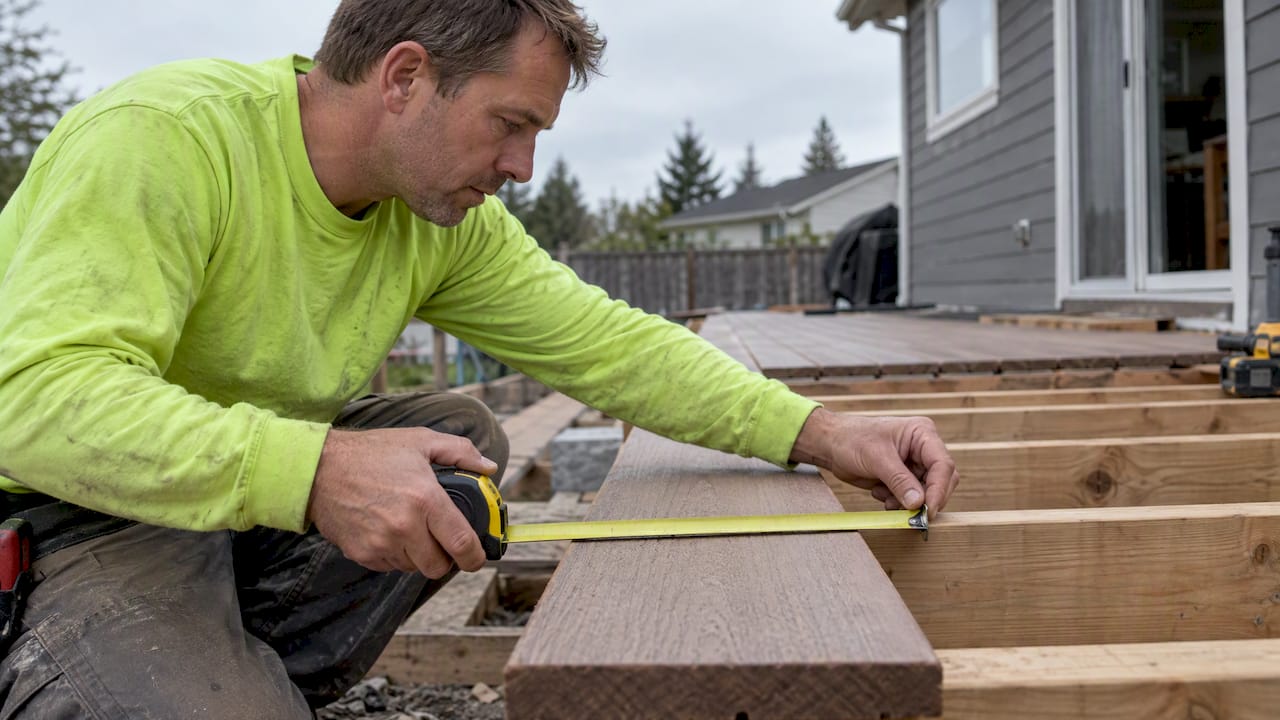
Plan with a 5.5-inch face width, the actual coverage of a 5/4x6 or 2x6 board, as your default for layout and ordering. Nominal labels like “2x6” describe rough-cut lumber before milling, not what you measure on-site, so using them for takeoffs leads to short orders. Thickness also matters: it controls how far your boards can span between joists, so check span guidance before committing to wider stock.
TL;DR:
Use manufacturer span tables for composite and PVC, since their ratings can differ from wood; 5/4 inch wood commonly needs joists 16 inches on center.
For a 12 by 18 foot deck with boards running across the 12 foot side, the example requires 26 rows before adding about 10% for waste.
Space kiln dried wood and composite boards 3/16 to 1/4 inch apart; wet pressure treated lumber is installed tight and opens as it dries.
Have a contractor verify framing before choosing boards 7.25 inches or wider, especially when spans exceed prescriptive tables or the deck has complex framing.
CactusdeckingPlan Your Deck Boards With ConfidenceCactus Decking builds custom decks in Everett, with material options including composite, PVC, and cedar to suit your outdoor space.Visit Cactus Decking
Table of Contents
Nominal vs. actual deck board widths at a glance
How thickness and material affect your joist spacing
Matching board width to your deck’s scale and climate
Calculating how many boards you need
Narrow, standard, and wide boards: trade-offs
Gaps, fasteners, and drainage: getting installation right
Cactus Decking checklist: what contractors measure and confirm before you order
Author perspective: practical recommendation
How Cactus Decking can help with width and span questions
Sources
Nominal vs. actual deck board widths at a glance
Lumber is sold under a nominal name but milled smaller, a sizing convention that trips up a lot of first-time planners. A 2x6 or 5/4x6 board actually measures 5.5 inches across the face, while a 2x4 comes in at 3.5 inches. Wider dimensional stock like a 2x8 dresses down to 7.25 inches.
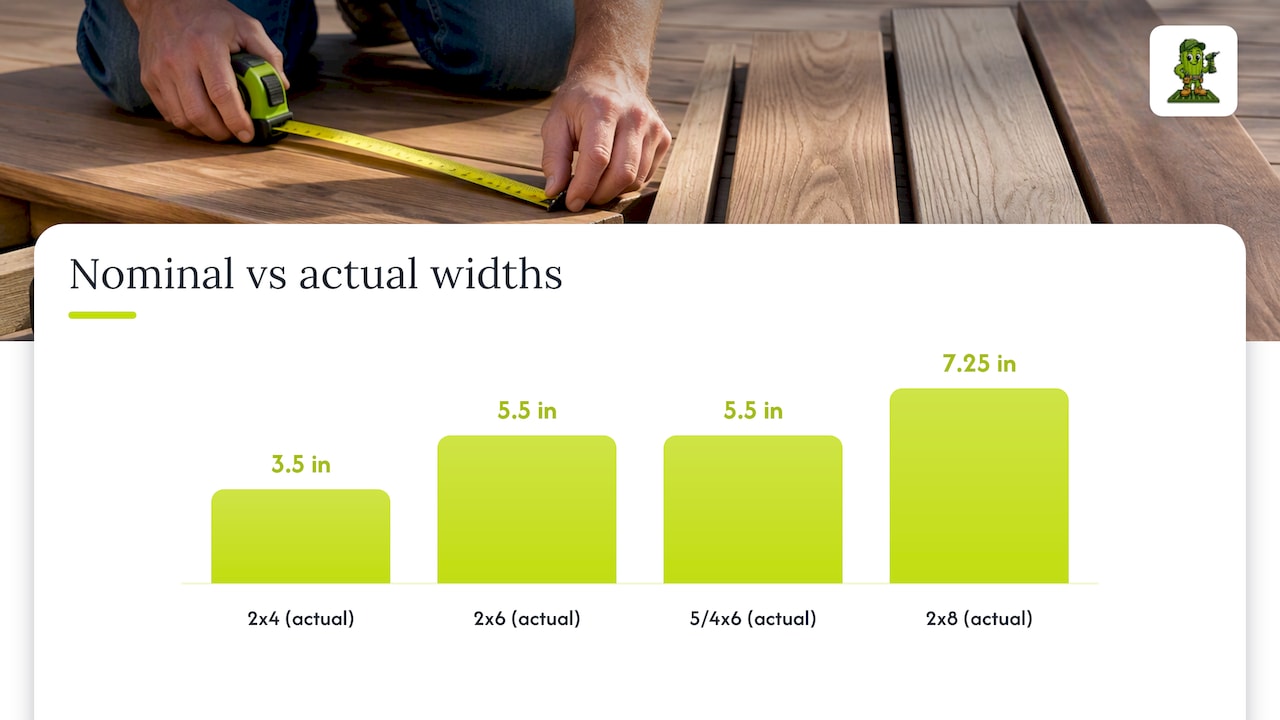
Composite and PVC boards typically run close to that same 5.5-inch face, though manufacturers vary the exact dimension by product line. Before you finalize an order, confirm the dressed width printed on the supplier’s spec sheet rather than trusting the nominal name alone.
How thickness and material affect your joist spacing
Thicker boards resist bending over a longer unsupported span, which is why thickness and joist spacing are decided together, not separately.
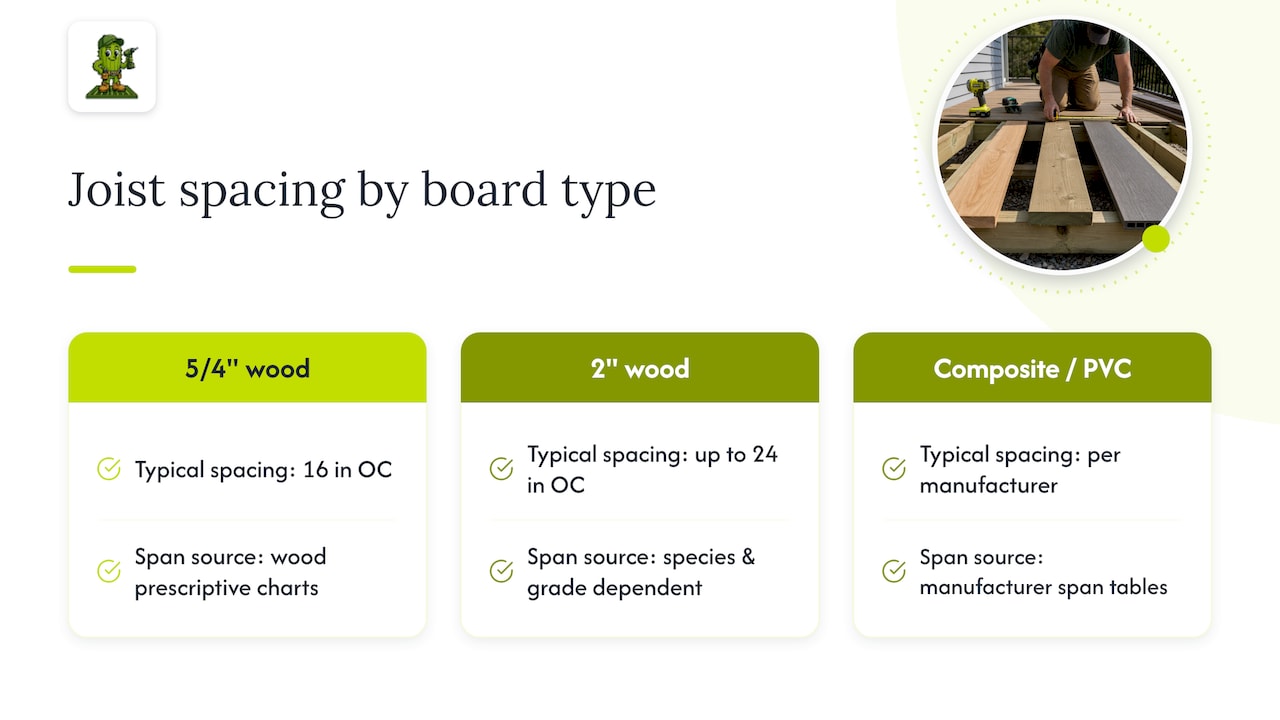
Composite and PVC products often carry their own span ratings that differ from wood, so manufacturer span tables take priority over generic lumber charts for those materials. A 5/4-inch wood board commonly needs joists set at 16 inches on center, while a full 2-inch board can sometimes stretch to 24 inches on center depending on species and grade. Choosing a thicker board or tightening joist spacing becomes necessary once you move past standard prescriptive limits.
For the framing details behind these numbers, including ledger attachment and minimum bearing requirements, the AWC’s DCA 6 guide is the prescriptive reference most permitting offices check against, and it is worth reviewing before you lock in a framing plan.
Matching board width to your deck’s scale and climate
A deck’s size, how it gets used, and your local climate should all weigh into the width decision, not just appearance. Standard 5.5-inch boards tend to suit small and medium decks well because they flex less visually across short spans and forgive minor framing imperfections. Wider boards look striking on large, open platforms but ask more of the substructure underneath.
A few factors worth weighing before you decide:
Traffic and load: Heavily used decks benefit from thicker boards or closer joist spacing regardless of width.
Material movement: Composite boards expand and contract with temperature, while wood dries and shrinks, so gap sizing needs to match the material.
Design patterns: Picture-frame borders or mixed-width layouts can visually anchor a space and hide minor cuts at the perimeter.
For inspiration on how different widths and patterns play out in practice, our deck gallery shows a range of completed layouts.
Calculating how many boards you need
Once you know your target width and gap, the math is straightforward. Start with coverage per row: actual face width plus your chosen gap. A 5.5-inch board with a 1/8-inch gap covers about 5.625 inches per row.
Divide your deck width by the coverage-per-row figure and round up to get the number of rows.
Multiply rows by the run length to get total linear footage needed.
Divide run length by your stock board length, rounding up, to get boards per row.
Add a waste allowance of about 10% for cuts and defects.
As a worked example, say a deck measures 12 feet by 18 feet and you are using 5.5-inch boards with a 1/8-inch gap running across the 12-foot width. That is 144 inches divided by 5.625 inches, which rounds up to 26 rows. For fasteners, a common planning rule is about 350 screws per 100 square feet, adjusted upward if your joist spacing is tighter than 16 inches on center.
Narrow, standard, and wide boards: trade-offs
Wide boards (7.25 inches and up) cut installation time because there are fewer rows and fasteners to place, but they show seasonal movement more visibly and demand tighter substructure control. Standard 5.5-inch boards remain the most balanced choice for most residential projects: they are cost-effective, forgiving for DIY framing, and widely stocked. Narrow boards give a classic, traditional look but mean more seams, more fasteners, and longer install time.
Gaps, fasteners, and drainage: getting installation right
Gap sizing depends on what you are installing and the best underlayment options for moisture management. See how to use synthetic underlayment and self adhered at eaves to protect your deck structure. Wet pressure-treated lumber is typically installed tight and opens to roughly 1/8 inch as it dries, while kiln-dried wood and composite boards should be spaced open from the start, usually 3/16 to 1/4 inch. Every decking segment needs to bear on a minimum number of joists per DCA 6 prescriptive guidance, and end joints need blocking so boards do not flex at the seam. Fasteners should match the board’s treatment chemistry to avoid corrosion, particularly with pressure-treated lumber.
Pro Tip: Running decking diagonally across the joists adds real stiffness to the structure as a whole, which can help with lateral load resistance on taller or more exposed decks.
Cactus Decking checklist: what contractors measure and confirm before you order
Before placing a material order, we confirm dressed widths and stock lengths directly with the supplier rather than relying on nominal names. We also check joist spacing, deflection, and ledger attachment, since many existing decks pass a visual inspection but fall short on deflection for wider modern planks. Call a professional when your project involves a ledger inspection, complex or multi-level framing, a permit trigger, or spans that exceed standard prescriptive tables. Those are the points where a small sizing mistake becomes an expensive one.
Author perspective: practical recommendation
Default to 5.5-inch boards for most residential decks. Reach for wider stock only once your framing has been verified, either by your own careful measurements or by a contractor who has checked the spans.
— Vlad
How Cactus Decking can help with width and span questions
If you would rather hand off the framing math, our deck design consultations verify board width, joist spacing, and permit requirements before a single board gets ordered, and our in-house crew carries that plan through deck installation or custom deck installation for wider or patterned layouts. If you are replacing an aging deck, deck replacement covers reframing where spans no longer meet current guidance.
Bring your deck dimensions, photos of the existing ledger and joists if you have them, and the board profile you have in mind. We will tell you plainly whether your framing supports it before you commit to materials.
FAQ
Are deck boards actually 6 inches wide?
No. A board sold under a “6 inch” nominal name is milled to an actual face width of 5.5 inches. That dressed measurement, not the nominal label, is what you should use for ordering and layout.
Are deck boards 1x6 or 2x6?
Residential decking is typically sold as 5/4x6 or 2x6, both milled to the same 5.5 inch face width but different thicknesses. A true 1x6 is too thin for structural decking spans and is not standard for this use.
How thick is a 5/4 deck board actually?
That thinner profile generally calls for closer joist spacing, often 16 inches on center, compared to thicker dimensional lumber.
Should a deck use 2x6 or 2x8?
Both dress to the same widths relative to their nominal names, but a 2x8 is thicker and can span farther between supports than a 2x6. The right choice depends on your joist spacing and span, which DCA 6 and your local building code should confirm before you build.
Sources
How to choose the right deck board size and layout — Advantage Lumber blog
DCA 6 — Prescriptive residential wood deck construction guide (AWC).