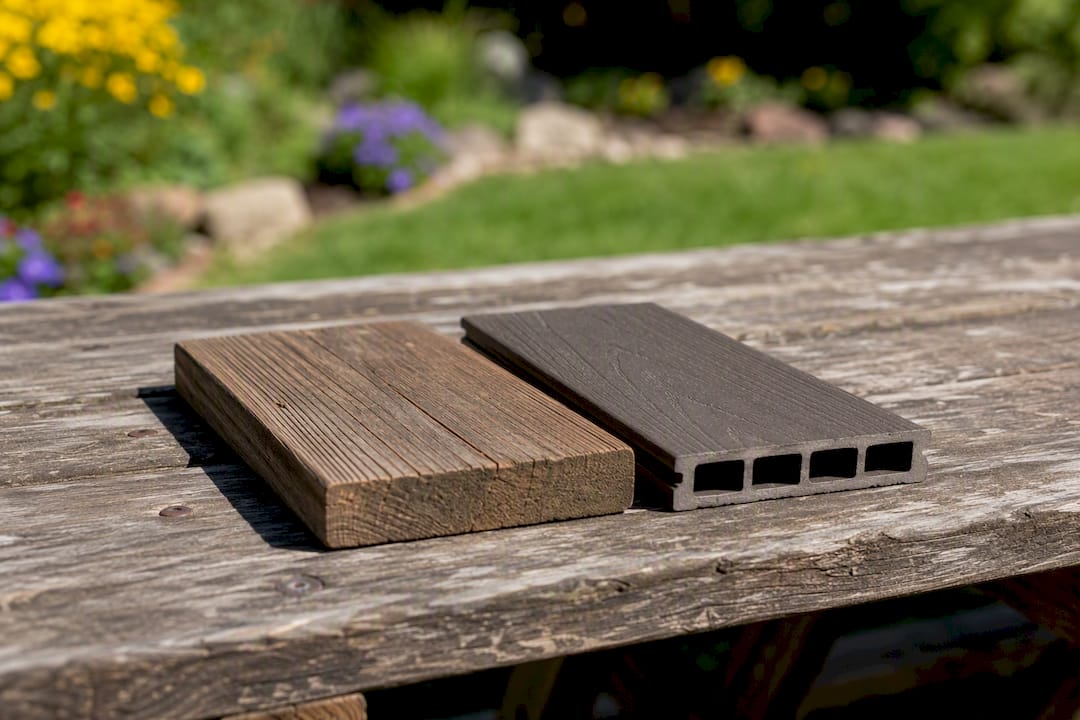


Most wood decks give you somewhere between 10 and 25 years, and the spread comes from the species you choose, how the deck is built, and how well it is cared for. Pressure-treated pine is commonly put at about 15 years, cedar at about 20, and redwood at more than 25, according to This Old House. Below you will find what moves a deck toward the top or bottom of that range, how to check yours, and when replacing makes more sense than repairing.
TL;DR
- Typical figures for wood: about 15 years for pressure-treated, about 20 for cedar, 25+ for redwood.
- Moisture is the main enemy. Design that sheds water and finishes that repel it matter more than the species name.
- Cedar and redwood resist decay mostly in their heartwood, so the grade you buy affects how long the deck lasts.
- Check the ledger, joists and posts yearly. A deck can look fine on top and be weak underneath.
- Widespread rot, soft framing or a failing ledger usually means replacement, not patching.
Table of Contents
- How long wood decks last by material
- What shortens or extends a wood deck’s life
- Cedar deck lifespan: grade matters
- A maintenance routine that protects the deck
- Joists, posts and the ledger: the parts you can’t see
- When to repair and when to replace
- Our perspective
- Planning a replacement in Everett
- FAQ
- Sources
How long wood decks last by material
No single number covers every wood deck. The USDA Forest Service notes that service life depends on the structure, the treatment, the application and the location, and that good data on residential decks is limited. What homeowners and builders use in practice are ranges from trade and home-improvement publications.
| Material | Typical lifespan | What stretches it |
|---|---|---|
| Pressure-treated pine | About 15 years | Treatment rated for the exposure, sealing every few years, good drainage |
| Cedar | About 20 years | Heartwood-rich grades, water-repellent finish, airflow below the deck |
| Redwood | 25+ years | Heartwood grades, regular sealing |
| Untreated softwood | A few years | Not suited to a ground-exposed or rain-exposed deck |
| Ipe (tropical hardwood) | 40+ years with a UV-blocking treatment | Occasional UV protection |
The first four rows come from This Old House’s lumber guide. The ipe figure comes from its decking material overview, which says ipe can last at least 40 years with one UV-blocking treatment. Ipe is a dense imported hardwood, so it is a different category from the domestic softwoods most decks are built from. Fine Homebuilding lists similar numbers for pressure-treated and cedar.
Treat these as planning ranges, not guarantees. A shaded deck on damp ground and a sunny, well-ventilated deck of the same lumber will age very differently.

Why “it lasts 15 years” often means something else
Here is a detail that surprises many owners. The Forest Service reports that treated lumber’s potential durability can exceed the ages at which residential decks are actually removed, and that decks are often torn out for cosmetic reasons rather than decay or insect failure. Gray, cracked, splintery boards push people to replace a deck whose frame may still be sound. That is useful to know: with good framing, resurfacing is sometimes an option, and a proper inspection tells you which situation you are in.

What shortens or extends a wood deck’s life
Two forces do most of the damage: water and sun. Everything else, from fasteners to board spacing, is really about managing them.
Moisture and trapped water
Wood that stays wet for long periods is where decay starts. This Old House’s winter guidance explains that trapped moisture cycling through freezing and thawing can warp, crack and rot wood, and that UV rays and ice-melt salt add to the wear. In rainy or humid regions, the same publisher says composite and tropical hardwoods outperform most lumber types. If you love the look and feel of real wood in a wet climate, the answer is careful design and upkeep, not giving up on wood.
Design choices that help:
- Drainage and airflow. Leave gaps between boards and keep the underside open so the frame can dry.
- Fewer moisture traps. The Forest Service guidance recommends designing to minimize moisture traps and field cuts, where water can sit in joints and end grain.
- Treat every cut. The same guidance advises applying supplemental preservative to saw cuts and bolt holes, because cutting exposes untreated wood inside the board.
- The right treatment for the exposure. Pressure-treated lumber should be chosen for the specific application using the AWPA Use Category System, which matches the preservative level to ground contact or above-ground exposure.
Sun and weathering
UV breaks down the surface fibers, which is why unsealed boards turn gray and rough. That is mostly cosmetic at first, but a rough, cracked surface also holds more water. A UV-screening finish slows the process.
Pressure-treated behavior
Treated wood resists rot, decay and insects, but it can crack, split and warp as it dries. Applying a water repellent about every two years helps preserve it, according to the same source. Those small surface checks are normal, and a good finish keeps them from growing.
Cedar deck lifespan: grade matters
Cedar is usually quoted at around 20 years, and properly maintained cedar and redwood can last over 20 years. The nuance is in the phrase “properly maintained” and in which part of the tree your boards came from.
UMass Amherst’s building-science team points out that calling cedar rot resistant is an oversimplification. Durability is mainly a heartwood property: untreated sapwood of virtually all species has little decay resistance, so cedar or redwood sapwood can fail quickly in a wet exposure. The same source adds that water-repellent treatment is still worthwhile on decay-resistant heartwood, because it improves dimensional stability in weather.
What that means when you buy:
- Ask for heartwood-rich grades rather than boards with a lot of pale sapwood. Our cedar decking grades guide explains how to read them.
- Plan to seal. Cedar can be left to weather to a silver-gray, or sealed every few years to hold its color, as This Old House notes. If you want to compare finishes, see stain versus oil on cedar.
- Weigh your options side by side. We compare redwood and cedar and ipe and cedar for homeowners deciding between premium woods.
A maintenance routine that protects the deck
Here is a practical annual rhythm. It follows the research cited above and takes a weekend or two a year.
Spring: inspect and clean. Look over the surface and the underside. Sweep debris from between boards, since packed leaves hold water against the wood.
Every two to three years: re-coat. Pressure-treated decks commonly need staining or sealing every two to three years. Pick a water-repelling, mildew-resistant, UV-screening product. The wood must be dry first: three or four rain-free days is a typical drying period, and 15% moisture content or less is a readiness check. A pin-type moisture meter takes the guesswork out of that.
Choosing the finish. Different products suit different jobs, and a general guide to matching a finish to the job can help you sort water-repellent sealers from film-forming coatings before you buy.
Fall and winter: protect. Clear leaves, keep snow from sitting in piles against the boards, and be careful with ice-melt salt, which the winter guidance flags as a source of damage.
Every year: check the frame. The surface is the part you see, but the structure is the part that matters for safety. See the next section.
Joists, posts and the ledger: the parts you can’t see
People search for how long deck joists last, and the honest answer is that no reliable universal figure exists. The Forest Service says residential-deck service-life data is limited, and that location, design, treatment and moisture exposure control durability. So assess condition instead of counting years.
- Look from below. Check joists at least once a year, especially at intersections where water collects.
- Probe the wood. InterNACHI describes a pick test using an ice pick, awl or screwdriver: sound wood resists and splinters, while decayed wood breaks away with few splinters and little sound. The test cannot find decay deep below the surface.
- Treat soft, spongy or flaking wood as a problem. It needs replacement or a professional assessment.
- Check the ledger. InterNACHI identifies the house ledger connection as the most common location for serious deck-collapse problems, and it notes that decay worsens over time as exposed wood degrades. Also look at joist hangers, posts and fasteners.
If something looks doubtful, have a qualified deck contractor look at it before the next gathering on the deck. Our deck safety inspection guide walks through what to check, and the Everett deck inspection process shows how a local inspection goes.
When to repair and when to replace
Not every worn deck needs to come out. Bob Vila’s guidance says fading or splintering on the surface may only justify replacing boards, while replacement is more appropriate when a deck is near the end of its expected life and has significant rot or damage in several areas.
Board replacement is usually enough when:
- Damage is limited to a few boards.
- The frame, posts and ledger pass a probe test.
- The deck is well under its expected lifespan.
Replacement is the better call when:
- Soft, darkened wood or fungus growth appears in multiple locations. Bob Vila lists these as signs of rot, and extensive rot may require full replacement.
- The ledger connection is compromised or the posts are decayed.
- Boards are loose, warped or splintered across the deck. This Old House’s inspection guidance treats these as hazards needing prompt attention and recommends probing visible cracks and splits.
- You are already past the typical range for your material and repairs keep multiplying.
When a deck does need to come out, it is a chance to change what you build. Some owners rebuild in cedar or another wood; others move to composite or PVC for lower upkeep. Our wood versus composite comparison and composite lifespan guide lay out both paths.
Our perspective
We build decks in Everett and the surrounding area, and the pattern we see is consistent: decks last longest when someone planned for water before the first board went down.
That is why we start with the frame, the drainage and the connections, not the surface. A well-detailed deck in pressure-treated lumber, cedar or redwood can give years of good service, and a well-detailed deck in composite or PVC gives you another route when you want less upkeep. Our in-house build crew, not subcontractors, handles the work, and our installations are warranty-backed.
If you choose cedar or redwood, ask for heartwood. If you choose treated lumber, make sure the treatment fits the exposure. Either way, seal on a schedule and look underneath once a year. Our approach to materials is eco-conscious and tailored to Northwest conditions, so the choice fits your site and your budget.
When the old deck is at the end of its life, a clear process from consultation to construction makes replacing it far less stressful than most people expect.
Vlad
Planning a replacement in Everett
If your inspection points toward replacement, we can walk the deck with you, talk through cedar, composite or PVC, and handle design, permitting and construction with our own crew. Start with our deck replacement service, or explore new deck installation service if you want a new layout.
Railings, stairs, covers and lighting are part of the same project, so the finished deck can be safe, comfortable after dark and usable in more weather. See deck railing systems, deck stairs and deck lighting in Everett. To see finished work, look at our composite deck replacement with gated stairs. Ready to talk? Reach us through cactusdecking.com.
FAQ
How long does a wood deck last?
Most wood decks last roughly 10 to 25 years, depending on species and care. Common planning figures are about 15 years for pressure-treated lumber and about 20 for cedar, per This Old House. Drainage, sealing and ventilation decide where yours lands in that range.
How long does a cedar deck last?
About 20 years is the usual figure, and properly maintained cedar can exceed that. Heartwood-rich boards and regular sealing make the difference, because sapwood has little decay resistance. Ask your builder which grade is going into the deck.
How often should I seal a wood deck?
Pressure-treated decks usually need staining or sealing every two to three years, and cedar can be sealed every few years to keep its color. Make sure the wood is fully dry first, since coating damp boards traps moisture. Drying guidance suggests three or four rain-free days and 15% moisture or less.
How can I tell if my deck needs replacing?
Look for soft or darkened wood, fungus, rot in several places, a questionable ledger connection, or loose and splintered boards across the surface. A screwdriver probe on joists and posts is a simple first check. If anything feels spongy or the ledger looks suspect, have a professional deck contractor assess it.
Is a deck usually replaced because it has rotted?
Not always. The USDA Forest Service reports that residential decks are often removed for cosmetic reasons rather than decay or insect failure. An inspection of the frame shows whether you need full replacement or a resurfacing.
Sources
- USDA Forest Service: Guidelines for selection and use of pressure-treated wood
- This Old House: How to Select the Best Lumber for Your Deck
- This Old House: Choosing the Right Decking Material
- This Old House: How to Prep and Protect Your Deck for Winter
- This Old House: How to Inspect Your Deck and Make Sure It’s Safe
- Fine Homebuilding: 7 Types of Decking
- UMass Amherst: Wood Myths: Facts and Fictions About Wood
- InterNACHI: How to Perform Deck Inspections (2014)
- InterNACHI: How to Perform Deck Inspections (2013)
- Bob Vila: Should I Repair or Replace My Deck?