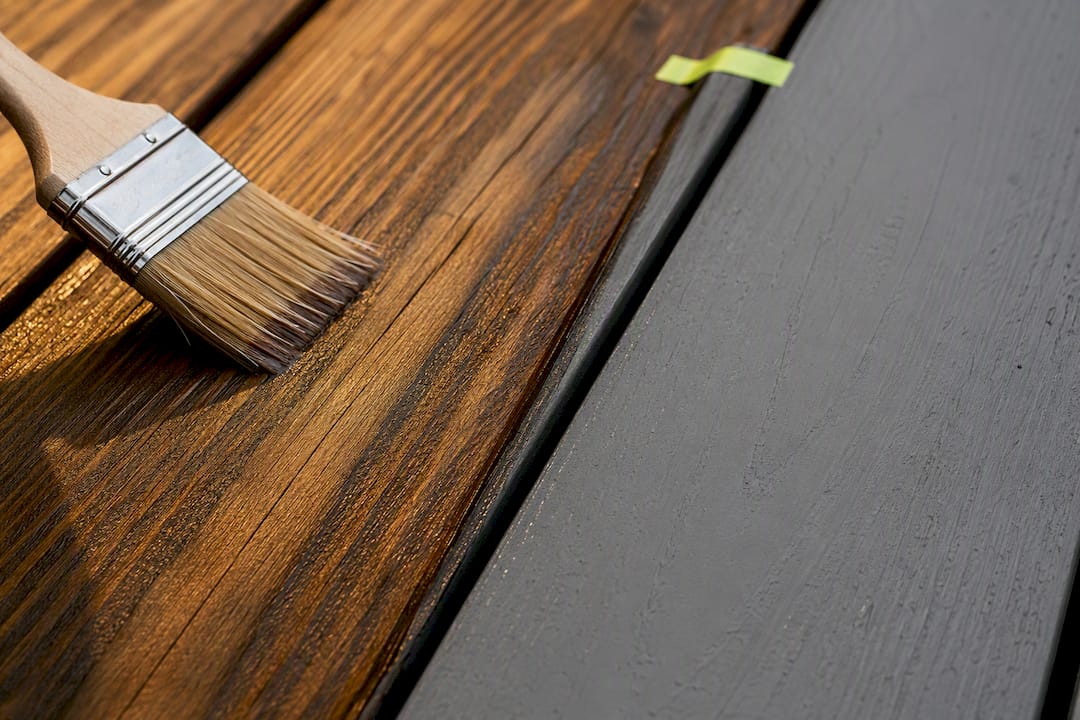

For a cedar deck, a pigmented oil-based semi-transparent stain is the safer default, because the pigment is what shields the wood from sunlight. A clear oil keeps the most natural look, but it adds no color, gives only limited protection from UV light and moisture, and needs to be reapplied often. Pick the oil if you love bare-wood cedar and don’t mind the yearly chore. Pick the stain if you want a finish that holds up longer between coats.
The rest of this guide explains why, what each finish does on the board, and how to apply either one without lap marks or a blotchy result.
TL;DR
- Stain carries pigment. Pigment adds color and blocks sunlight, which is what slows graying and fading on a cedar deck.
- Clear oil soaks in and shows off the grain, but it has no pigment, so UV protection is limited and it needs frequent reapplication.
- An oil-based semi-transparent stain penetrates instead of forming a surface film, so it does not blister or peel the way film-forming finishes can.
- Cedar must be clean and dry before either goes on. Brush it on, work with the grain, and pick a dry, mild weather window.
- Leave cedar unfinished and it weathers to gray, not always evenly. That is a choice, not a failure, but it asks for regular cleaning.
Table of Contents
- What people mean by “stain” and “oil” on cedar
- How the two finishes compare
- What happens if you skip both
- How to choose: five questions
- Prep: where most finishes succeed or fail
- Application: weather, tools and technique
- Perspective: how we approach cedar finishes
- When refinishing is not enough
- Thinking about a new or replacement deck?
- FAQ
- Sources
What people mean by “stain” and “oil” on cedar
The two words overlap, which is why the search results are confusing. Here is how we use them in this guide.
Oil here means a clear or lightly tinted penetrating finish. It soaks into the wood fibers and leaves a natural, close-to-the-grain look. Because it has little or no pigment, it behaves like what the cedar industry calls a clear or transparent finish.
Stain here means a finish with meaningful pigment. Stains come in transparent, semi-transparent and solid-color versions, and in oil-based and water-based (latex) formulas. The pigment is the working ingredient: it adds color and protects the wood from sunlight.
The two categories are not opposites. Many of the best cedar deck finishes are oil-based stains, so you are often choosing between “oil with pigment” and “oil without it.” The decision is really about how much pigment you want and how much maintenance you will accept.
How the two finishes compare
The technical guidance published by the cedar industry, in an Architectural Record continuing-education paper on finishing cedar, draws the key lines. Stains contain pigments that add color and protect cedar from sunlight. Clear finishes add no color and give limited protection from UV light and moisture, and transparent finishes have short service lives in sun and weather, so they need frequent reapplication.
Here is that, translated into deck terms:
| Clear or lightly tinted oil | Oil-based semi-transparent stain | Solid-color stain | |
|---|---|---|---|
| Look | Natural cedar, grain fully visible | Cedar tone with grain still visible | Opaque, grain mostly hidden |
| UV protection | Limited | Better, because of pigment | Highest pigment load |
| Reapplication | Frequent | Less frequent than clear | Depends on product and wear |
| Recoating prep | Minimal | Clean the surface first | Can be harder to refinish |
| Best for | Owners who want bare-wood looks and accept upkeep | Most cedar decks | Covering a tired or mismatched surface |
The table is a guide, not a promise. Service life depends on sun exposure, foot traffic, product quality and how well the wood was prepared.
Appearance: what you will see
Clear oil gives the richest, most natural cedar look in the first season: the honey and red tones deepen and the grain pops. The tradeoff is that without pigment, sunlight keeps working on the wood, and the color will not hold the way a pigmented finish does.
Semi-transparent stain keeps the grain visible but evens out color variation between boards. That matters on a deck, where boards from different parts of a log can look quite different. Solid-color stain hides the grain and behaves more like paint. If that is the look you are after, our comparison of stain versus paint for decks walks through the labor tradeoffs.

Protection: what happens in rain and sun
Oil-based semi-transparent stains on cedar penetrate the wood without forming a surface film and do not blister or peel, even if excessive moisture gets into the wood. That is a real advantage on a horizontal surface. A deck takes standing water, foot traffic and sun on the same boards, and a film that traps moisture can lift and flake.
That is also why film-forming finishes are hard on a deck over time. The same source notes they can be difficult to refinish and maintain.
Maintenance: the real cost of each choice
The same source puts the service life of latex semi-transparent stains at roughly two to four years, and describes clear and transparent finishes as needing frequent reapplication. The exact interval for an oil-based product depends on the label and your exposure. Check the manufacturer’s recoat guidance for the specific can you buy.
The upside of transparent and penetrating finishes is that they are easily reapplied with minimal surface preparation. Refinishing cedar that carries a latex semi-transparent stain may take more prep. In other words, oil asks for your time more often, but each session is lighter.
What happens if you skip both
Cedar is naturally durable, so the question comes up often: do you need a finish at all? Left unfinished, Western Red Cedar weathers to gray, though it may not weather uniformly. Dirt and mildew should be removed regularly, and you should take steps to let the wood dry after it gets wet to reduce decay risk.
In the Pacific Northwest, where wet months are long and shaded decks stay damp, that last point matters. A deck under tree cover or on the north side of a house dries slowly. An unfinished surface there will go gray in blotches and grow mildew in the shade. If you like the silver look, plan on cleaning rather than finishing. If you want to keep the warm cedar tone, you need pigment, and you need a schedule.
How to choose: five questions
- How much sun does the deck get? Full sun beats up a clear finish fastest. Pigment is your friend here.
- Do you want to see the grain? If yes, choose oil or semi-transparent stain. If you are fine hiding it, solid-color stain is an option.
- How often will you realistically recoat? Be honest. A clear oil that is skipped for two seasons does less than a stain that is kept up.
- Is the deck new, old or already finished? New cedar takes oil best. Weathered cedar needs cleaning first. A deck with an unknown old finish needs a test patch.
- Are you refinishing over something? An oil-based semi-transparent stain can be applied over a clear or transparent stain if the surface is cleaned. Going from a film-forming finish to anything else is harder.
If the answers point to a lot of ongoing work and you are weighing other materials, see our cedar versus composite breakdown and the real cost of a cedar deck.
Prep: where most finishes succeed or fail
Before any finish, cedar should be clean and dry. That sounds obvious, and it is the step people rush. Finish sealed over dirt or mildew traps it, and finish applied to damp wood does not penetrate.
A sensible prep order:
- Sweep out debris between the boards.
- Wash the surface and rinse it thoroughly. For method, removing dirt and mildew from cedar is a good starting point, and the Western Red Cedar Lumber Association lists regular yearly cleaning of dirt, mildew and debris as what prolongs the life of the protective coating.
- Let the deck dry fully. Do not guess: give it days, not hours, in damp weather.
- Check for loose boards, raised fasteners and rot. A finish does not fix structural problems.
For new boards, Dunn Lumber advises finishing all six sides of cedar decking boards, meaning face, back, edges and ends, before installation for the best performance. It is a company blog rather than a standard, but the logic is sound: the underside and ends are where water gets in and where you can never reach once the deck is built.
Application: weather, tools and technique
Timing matters as much as product. Consumer Reports advises applying stain when it has not rained for three days and the forecast shows at least two dry days, with temperatures between 50°F and 90°F, and avoiding direct sunlight that could dry the stain too quickly.
Then technique:
- Brush it on. Brushing is generally the best method for penetrating finishes on cedar decks, because it works the product into the wood. The USDA Forest Products Laboratory and the Western Red Cedar Lumber Association both point this way, as summarized in the cedar finishing paper.
- Work with the grain, full board length. Do not stop mid-board. To avoid lap marks, apply the finish along the whole length of each board without pausing.
- Work in small, wet sections so each pass blends into the last.
- Read the can. Follow the label for coverage, recoat time and cleanup. Rags soaked in oil-based products need careful disposal, and the label will tell you how.
A practical tip: finish a few boards in a low-visibility spot first and let them dry. Color on cedar looks different wet than dry, and different from the sample card.
Perspective: how we approach cedar finishes
We build and replace decks in Everett and the surrounding area, and the finish conversation comes up on nearly every cedar job. Our view is simple. Cedar is a beautiful, workable material, and it rewards owners who treat it as a living surface. The finish is not a one-time decision, it is the start of a maintenance rhythm.

For most Northwest cedar decks, we lean toward a pigmented, penetrating finish over clear oil. Rain, shade and moss are the everyday enemies here, and pigment plus a finish that does not form a film gives the wood a fair chance. We steer owners away from film-forming coatings on horizontal boards because they are the hardest to maintain once they start to fail.
We also tell people when cedar is the wrong answer. If you do not want a yearly or every-few-years routine, a different material may suit you better, and we are glad to build with composite, PVC or cedar depending on what you will actually enjoy living with. Our in-house crew builds the deck, so the person who knows how the boards were laid and fastened is the one advising you on care. Our cedar deck maintenance guide and winter deck care plan cover the routine in more detail.
— Vlad
When refinishing is not enough
Sometimes the question is not stain versus oil, but whether the deck is worth finishing. Warning signs:
- Soft spots you can push a screwdriver into
- Boards that cup, split or crumble along the ends
- Rot near the ledger, posts or stair stringers
- Railings that move when you lean on them
Those are structural and safety problems, and a coat of anything will not fix them. If you are seeing them, it is time to price a rebuild. Understanding cedar grades helps you choose better boards for the next deck, and our guide to heartwood in cedar and redwood explains what to ask a supplier for.
Thinking about a new or replacement deck?
If your cedar deck has outlived its finish, or you would rather skip the recoating cycle, we can help. Cactus Decking designs and builds decks in Everett, WA and nearby communities, using cedar, composite or PVC, with permitting handled, a clear process from consultation to construction, and warranty-backed installations. Our own build crew does the work rather than subcontractors. You can start with deck replacement or talk to us about new deck installation service.

We do not publish set prices, because every deck differs in size, access, material and railing. Tell us what you have and what you want, and we will walk through the options with you.
FAQ
Does cedar need stain or oil at all?
No, but expect it to change. Unfinished Western Red Cedar weathers to gray, and not always evenly. You will still need to clean off dirt and mildew regularly and let the wood dry after it gets wet. A finish is what keeps the warm color.
Is oil-based or water-based stain better for cedar?
For decks, oil-based semi-transparent stain is the stronger default because it penetrates without forming a film and does not blister or peel. Latex semi-transparent stains have a service life of roughly two to four years and can take more prep to refinish, per the cedar finishing guidance. Always follow the product label.
Can I put stain over oil on cedar?
Often yes, if the surface is cleaned first. An oil-based semi-transparent stain can be applied over a clear or transparent finish once the wood is clean. If you do not know what is on the deck, test a small hidden area before committing to the whole surface.
What is the best way to apply a finish to a cedar deck?
Brush it on, following the grain along each board’s full length without stopping, to avoid lap marks. Choose a stretch with no rain for three days before and at least two dry days after, at 50°F to 90°F, and out of direct sun, as Consumer Reports advises.
Sources
- Proper Finishing of Cedar for Exteriors and Interiors, Architectural Record (2024)
- Western Red Cedar Decking Care & Maintenance, Real Cedar
- How to Stain a Deck, Consumer Reports
- Best Practices for Staining and Finishing Cedar Decking, Dunn Lumber