Questions to Ask a Deck Builder Before You Sign Anything
Ensure your deck building project is a success by asking these essential questions before signing a contract. Get verified answers!
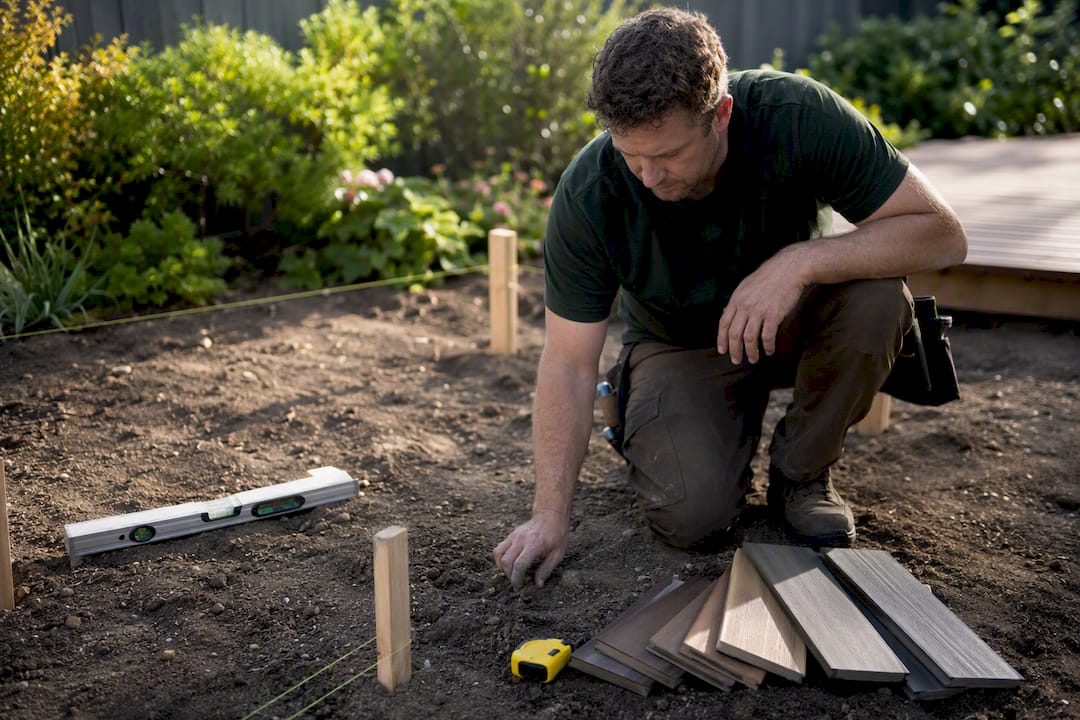
Questions to Ask a Deck Builder Before You Sign Anything
Before you sign a contract, insist on specific answers and paperwork: license and insurance certificates, a written scope with a milestone payment schedule, proof of similar completed projects, a clear permit plan, and a warranty that names both the manufacturer and the builder. Deck construction questions feel overwhelming when you’re staring at three bids and no framework for comparing them, but the fix is simple. Bring a checklist to every deck builder interview and refuse to sign until each item is answered in writing.
Here’s the nonnegotiable list to work through before any contract gets a signature:
License number, general liability insurance, and workers’ comp certificates, all current and verifiable
References plus photos from at least three comparable projects, and permission to call past clients
A written, line-item estimate covering materials, labor, permits, and disposal
Confirmed materials, manufacturer warranty terms, and a maintenance plan in writing
A phased timeline with milestones, one named point of contact, and a documented change-order process
A workmanship warranty and a scheduled final walkthrough with a punch list
Pro Tip: Print this list and bring it to every estimate appointment. A contractor who bristles at written questions is telling you something about how the rest of the project will go.
Key Takeaways
A written contract with license and insurance proof, a milestone-based payment schedule, manufacturer warranty documents, and a documented final walkthrough are the five things that separate a smooth deck build from a stressful one.
Point | Details |
|---|---|
Verify credentials directly | Check the license number with your state board and call the insurance carrier to confirm coverage is active. |
Vet references with specific questions | Ask past clients about schedule adherence, change-order transparency, and daily site cleanup, not just satisfaction. |
Tie payments to milestones | Structure payment around completed phases, holding the final payment until after inspection sign-off. |
Get warranties in writing | Request both the manufacturer’s material warranty and the builder’s separate workmanship warranty. |
Cactus Decking models the paperwork | Its in-house crew provides insurance certificates, permit handling, and manufacturer warranty documents as standard practice. |
Table of Contents
Questions to Ask a Deck Builder About Credentials and Insurance
How Do You Vet a Deck Builder’s Real Experience?
What to Ask About Decking Materials and Long-Term Care
Who Handles Permits and Inspections on Your Deck?
Timeline Questions: Milestones, Crew Size, and Delays
Contract Terms: Estimates, Payment Schedule, and Change Orders
What Should a Deck Builder’s Communication Plan Look Like?
Warranty Coverage and the Final Walkthrough Process
Why Cactus Decking: Model Answers and Documents You Should Expect
What Happens When a Deck Project Hits Unexpected Site Conditions?
How Do Deck Contracts Handle Disputes and Cancellations?
Where to Verify Contractor Credentials and Codes
What Homeowners Consistently Get Wrong When Interviewing Deck Builders
Get a Deck Built by a Crew That Shows the Paperwork First
Sources
Questions to Ask a Deck Builder About Credentials and Insurance
Ask to see the license number itself, not just a business card that says “licensed and insured.” Every state maintains a public lookup where you can confirm the license is active and matches the name on your estimate. If a contractor hesitates or promises to “email it later,” treat that as a red flag, not an oversight.
Request current certificates for general liability insurance and workers’ compensation, and read the coverage amounts, not just the policy numbers. A certificate that expired three months ago protects nobody. Ask directly whether subcontractors carry their own coverage or fall under the general contractor’s policy, and whether the company is bonded. Bonding matters most if the builder disappears mid-project or does substandard work that requires a third party to finish.
Verify the license number against your state’s contractor licensing board, not the contractor’s own paperwork
Confirm liability and workers’ comp certificates list current dates and adequate coverage limits
Ask who covers you if a subcontractor gets hurt on your property
Get copies of every document attached to the signed contract, not promised separately
Pro Tip: Call the insurance carrier listed on the certificate directly. A five-minute phone call confirms the policy is real and active, which a photocopy alone can’t do.
How Do You Vet a Deck Builder’s Real Experience?
A glossy photo gallery tells you a builder can take good pictures. It doesn’t tell you whether the ledger board was flashed correctly or whether the footings meet frost-depth requirements in your area. Push past the portfolio and ask for specifics tied to your actual project.
Request contact information for at least three homeowners with completed projects similar in size, material, or site complexity to yours.
Ask each reference three direct questions: Did the project finish on schedule? Were change orders explained and priced before the work happened? Was the site cleaned up daily, not just at the end?
Ask to see photos of structural details, ledger flashing, footing depth, joist hangers, not only the finished decking surface.
Look for repeat customers or homeowners who hired the same builder for a second project. That pattern says more than fifty photos of a finished railing ever will.
Pro Tip: Ask a reference this exact question: “What went wrong, and how did they handle it?” Every real project has at least one hiccup. How the builder responded tells you everything about how yours will go.
What to Ask About Decking Materials and Long-Term Care
Ask why the builder is recommending a specific material for your yard, not a generic pitch about composite versus wood. A south-facing deck in full sun behaves differently than a shaded one, and a builder who’s paying attention will explain that tradeoff before you ask.
Get the exact product name and brand, not just “composite decking.” Ask about fastener type, flashing details at the ledger, and whether the manufacturer requires certified installation to keep the warranty valid. Major decking manufacturers run certified-installer programs, and skipping that certification can quietly void coverage you thought you had.
Dark composite boards run noticeably hotter underfoot in direct sun than lighter tones or cedar, which matters if you’re barefoot by the pool. Ask about slip resistance in wet conditions and how much fading or color drift to expect over five to ten years.
Request the manufacturer’s written warranty document, not a verbal summary
Ask for a maintenance schedule specific to the recommended material
Confirm whether the installer needs manufacturer certification for the warranty to apply
Get straight answers on heat, slip resistance, and expected fade before you commit to a color
Cactusdecking’s deck design process walks through these tradeoffs with clients before a single board gets ordered, which is the order these conversations should happen in every bid you collect.
Who Handles Permits and Inspections on Your Deck?
Ask directly whether the contractor pulls permits and schedules inspections, or whether that responsibility falls on you. This should never be ambiguous. A builder who says “you probably don’t need one” for a raised deck attached to your house is either wrong or hoping you won’t check.
Confirm which elements get inspected, typically footings, the ledger connection, and guard-rail height, and ask what happens financially if an inspection fails. A builder confident in their work will include correction costs in the original price, not bill you separately for a redo they should have gotten right the first time.
Get it in writing: who pulls the permit, who schedules inspections, who pays for failed-inspection corrections
Ask for copies of the permit and every inspection sign-off for your own records
Confirm the permit requirements specific to your municipality before work starts
Timeline Questions: Milestones, Crew Size, and Delays
Vague timelines cause more homeowner frustration than almost anything else in a deck build. Nail down specifics before signing.
Ask for a phased schedule listing start dates and estimated completion for each stage: site prep, footings, framing, decking, railings, and finish work.
Ask how many active projects the crew is juggling right now, and whether the same crew that gives the estimate is the one that shows up to build.
Discuss how weather delays and material back orders get communicated and documented, not just absorbed silently into a longer end date.
Tie every progress payment to a completed milestone, and hold back the final payment until the project passes inspection and you’ve signed off.
Guides on deck construction consistently recommend milestone-based payment schedules tied to phases rather than a flat deposit-then-balance structure, because it keeps both sides honest about progress.
Contract Terms: Estimates, Payment Schedule, and Change Orders
A verbal quote is not an estimate. Insist on a line-item breakdown that spells out materials, labor, permit fees, disposal costs, and anything explicitly excluded from the price. If a builder can’t produce that in writing, assume the final invoice will hold surprises.
Payment structure matters as much as the total price. A reasonable pattern looks like a modest deposit, one or two milestone payments tied to completed phases, and a final payment held until the work passes inspection and you’re satisfied. Anyone asking for half the total cash upfront, or refusing to put terms in writing, should lose the bid on that basis alone.
Get a written estimate itemizing materials, labor, permits, disposal, and exclusions
Confirm the payment schedule ties to completed milestones, not arbitrary dates
Define exactly how change orders get approved: written sign-off, agreed pricing method, and who has authority to approve scope changes
Walk away from contractors demanding large upfront cash payments or resisting a written contract entirely
Pro Tip: Ask what happens if you want to add a built-in bench or swap railing styles mid-project. A builder with a clear change-order process will answer in one sentence. One who fumbles the question probably handles surprises badly, too.
What Should a Deck Builder’s Communication Plan Look Like?
Ask who your actual point of contact will be during construction, by name, not “someone from the office.” Then ask who the site supervisor is, because those are sometimes different people, and you want both identified before day one.
Agree on how often you’ll get updates, daily during active phases or weekly during slower stretches, and through what channel, text, email, or a project-management app. Experts who study contractor disputes point to clear communication protocols and a single point of contact as one of the strongest predictors of a low-stress build.
Get a named point of contact and site supervisor, not a general office number
Set a specific update cadence and preferred communication channel before work begins
Ask how the crew protects landscaping, fencing, and access paths during construction
Confirm how warranty or punch-list requests get submitted and how fast you can expect a response
Warranty Coverage and the Final Walkthrough Process
Manufacturer warranties and workmanship warranties are not the same thing, and you need both in writing. The manufacturer covers material defects; the builder’s workmanship warranty covers installation errors, and a contractor who only mentions one is leaving a gap.
Schedule a formal final walkthrough with a written punch list before final payment changes hands. Documented walkthroughs with written punch lists are standard practice precisely because they prevent “I’ll get to it” from turning into six months of unreturned calls.
Request both manufacturer and workmanship warranties in writing, with term lengths spelled out
Ask who pays for post-inspection corrections and how many business days a response typically takes
Keep every document, contract, warranties, permits, inspection sign-offs, in one folder for resale or insurance claims later
Why Cactus Decking: Model Answers and Documents You Should Expect
Every question in this checklist maps to a specific document. Cactusdecking’s process is built around producing that paperwork before you ask twice, using an in-house crew rather than rotating subcontractors, warranty-backed installations, and eco-conscious material options across composite, PVC, and cedar.
License and insurance verification: current certificates on request, no chase required
Permit handling: Cactusdecking manages permit filing and inspection scheduling as part of custom deck installation
Material proof: manufacturer warranty documents provided for whatever product gets installed
Final walkthrough: a documented punch list before the last payment is due
Portfolio evidence: a browsable deck gallery showing completed projects across material types
The strongest signal isn’t a stack of glossy photos. It’s a builder who hands you the permit copy, the manufacturer warranty, and the punch list without being asked twice.
Treat this as a template for what any builder’s answers should look like on paper, whichever company ends up on your contract.
What Happens When a Deck Project Hits Unexpected Site Conditions?
Ask this question before you sign, because the honest answer separates experienced builders from ones guessing at your site. Rot hidden behind old ledger boards, soil that won’t pass a footing inspection at the expected depth, or a property line survey that shifts the deck’s footprint by a foot, all of these show up mid-project more often than homeowners expect.
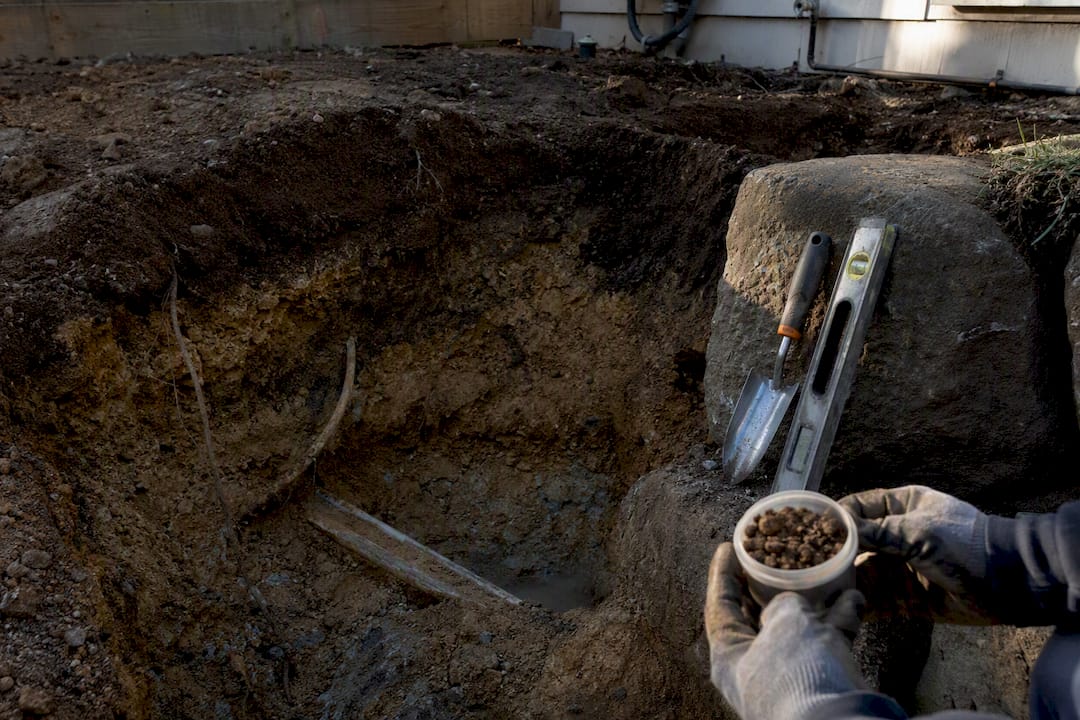
Ask specifically how the contractor prices and communicates surprises once digging or demolition starts. A builder should be able to describe their process in one breath: stop work, document the issue with photos, price the fix as a written change order, and get your sign-off before proceeding. If the answer is vague, “we’ll figure it out,” that’s a preview of how disputes over cost will play out later.
Ask whether their estimate includes a contingency line for unforeseen conditions, and how large it typically runs. Some builders build a modest buffer into the original price for common issues like minor soil correction or unexpected utility lines; others price tight and treat every surprise as a separate change order. Neither approach is wrong, but you need to know which one you’re signing up for.
Ask about soil testing or site evaluation before the contract is finalized, particularly on older properties or sloped lots. A builder who walks the site carefully before quoting is far less likely to discover expensive surprises once the crew shows up with equipment.
How Do Deck Contracts Handle Disputes and Cancellations?
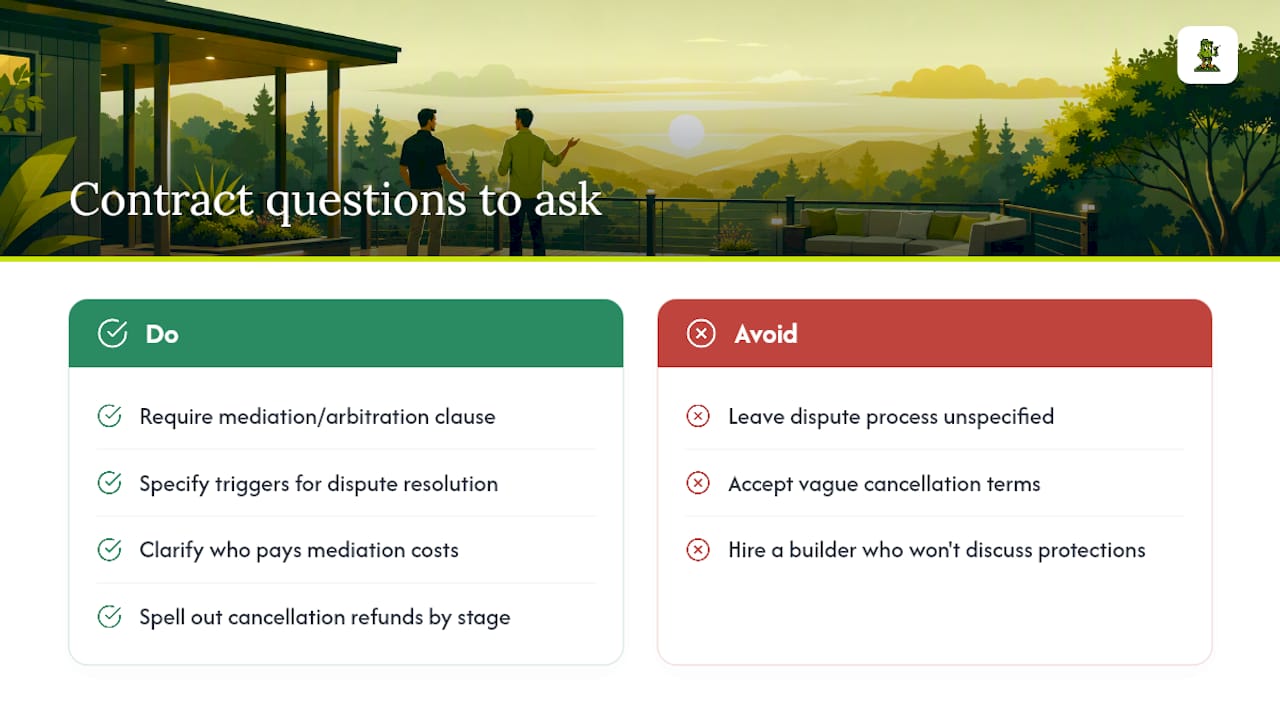
Every contract should spell out what happens if things go wrong, not just what happens if they go right. Ask what the dispute resolution process looks like before you need it, because negotiating those terms after a disagreement starts is a much weaker position.
Look for a contract clause specifying mediation or arbitration before either side can pursue legal action. This step usually resolves disagreements faster and cheaper than a lawsuit, and a builder who includes it upfront is signaling confidence in their own work. Ask what triggers that process, missed milestones, quality disputes, payment disagreements, and who covers the cost of mediation if it comes to that.
Ask about cancellation terms specifically. What happens if you need to cancel before work starts, after the deposit is paid, or partway through construction? A fair contract spells out how much of your deposit is refundable at each stage and what costs you’re responsible for if materials have already been ordered on your behalf.
Ask, too, what recourse exists if the contractor is the one who fails to perform, missed deadlines with no explanation, abandoned work, or repeated quality problems. A contract should protect both sides, and a builder unwilling to discuss that balance is telling you where their priorities sit.
Where to Verify Contractor Credentials and Codes
The North American Deck and Railing Association and the National Association of the Remodeling Industry both maintain contractor directories and credentialing standards. A contractor-interview checklist from Axenia Construction covers similar ground for other home projects.
What Homeowners Consistently Get Wrong When Interviewing Deck Builders
Most homeowners rank price first and credentials second. That ordering is backward, and it’s the single biggest mistake I see in how these bids get compared. Three quotes that differ by a few thousand dollars tell you almost nothing until you know whether all three builders are pulling permits, carrying adequate insurance, and pricing the same scope of work.
The conventional advice, “get three quotes and compare,” treats deck building like buying a commodity. It isn’t. A low bid that skips permits or uses uncertified installation on composite decking can cost you the manufacturer warranty entirely, and you won’t discover that gap until the boards start fading years early.
Prioritize documentation over charisma. A builder who’s slower to answer but hands you real paperwork, insurance certificates, itemized estimates, manufacturer warranty terms, beats a smooth talker with a vague quote every time. The interview isn’t about liking the person. It’s about confirming they can produce proof for every claim they make before a single footing gets dug.
— Vlad
Get a Deck Built by a Crew That Shows the Paperwork First
Cactusdecking answers every question on this checklist before you have to ask twice, which is the real advantage over piecing together bids from contractors who treat documentation as optional. As an in-house crew serving Everett, Washington, Cactusdecking doesn’t rotate through subcontractors for the parts of the job that matter most, framing, flashing, footings, so the same team that quotes your project is the one that builds it.
Every installation comes with a workmanship warranty on top of manufacturer coverage, and material options span composite, PVC, and cedar depending on your climate and maintenance preferences. If you’re ready to compare what a real written estimate looks like against the vague quotes you’ve collected so far, start with a deck design consultation to get a scoped, buildable plan with the documentation this checklist demands built in from the first conversation.