12 Deck Skirting Ideas for a Modern, Budget-Friendly Finish
Discover budget-friendly deck skirting ideas that enhance your outdoor space. Explore options for style, maintenance, and hidden storage!
12 Deck Skirting Ideas for a Modern, Budget-Friendly Finish
Vinyl lattice wins on budget and airflow, composite panels win on low maintenance, horizontal cedar slats win on modern looks, and faux-stone veneer wins when you want the deck to look anchored to the house rather than floating above the yard. There’s no single best deck skirting idea because the right pick depends on what’s bothering you most right now: cost, upkeep, curb appeal, or storage.
Quick verdict by priority:
Tightest budget: Vinyl lattice panels, framed or unframed
Cleanest modern look: Horizontal composite or cedar slats
Least maintenance long-term: Composite panels (Trex, TimberTech/AZEK)
Best for hiding storage: Framed lattice or board-and-batten with a hinged access door
Most upscale appearance: Faux-stone veneer panels (GenStone)
Best for a quick weekend fix: Perforated metal panels, screwed to a simple frame
If you want the fast answer: budget projects lean vinyl, storage-focused projects lean framed panels with a door, and modern-look projects lean horizontal slats or clean composite faces.
Key Takeaways
The right deck skirting choice comes down to matching material to your ventilation needs, budget, and maintenance tolerance rather than picking the trendiest style first.
Point | Details |
|---|---|
Match material to priority | Vinyl for budget, composite for low maintenance, horizontal slats for a modern look. |
Ventilation comes first | Keep a 2 to 4 inch ground gap and vent roughly one square foot per 150 square feet. |
DIY fits most panel jobs | Lattice, vinyl, and composite panels suit a weekend DIY; stone veneer usually needs a pro. |
Light adds depth at night | Grazing light across slats or perforated metal turns flat skirting into a feature. |
Cactusdecking handles complex builds | Their in-house crew delivers warranty-backed skirting and drainage work for sites needing more than a weekend fix. |
Table of Contents
Deck Skirting Ideas Worth Considering
How To Match Skirting To Your Site And Budget
DIY Or Hire A Pro? Here’s How To Tell
The Design Detail Most Homeowners Skip
Comparing Skirting Materials At A Glance
Fixing Uneven Ground, Drainage, And Pest Entry
What Actually Matters When You Design Skirting
Get A Custom Skirting Plan Without The Guesswork
Sources
Deck Skirting Ideas Worth Considering
Twelve options cover nearly every yard, budget, and skill level. Some take an afternoon. Others need a weekend and a truck full of stone.
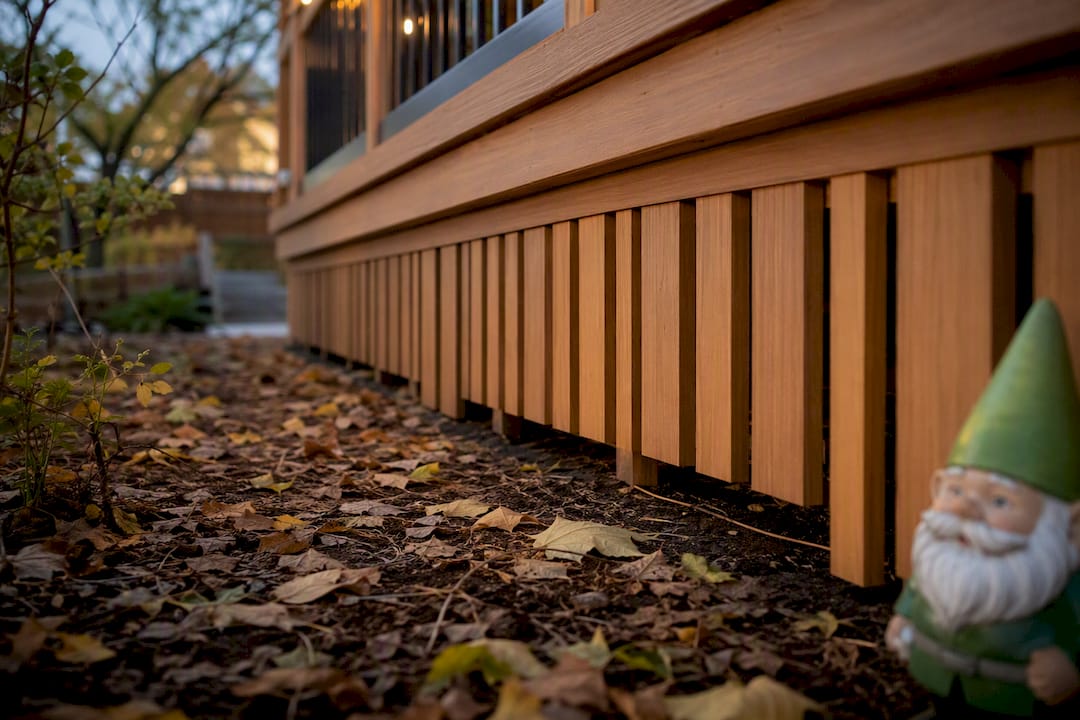
Horizontal wood slats. Cedar or pressure-treated boards run sideways across a simple frame, spaced roughly 3/8 to 1/2 inch apart for airflow, a spacing guideline OmniHomeIdeas calls out specifically for horizontal wood installs. It’s the look most people mean when they say “modern deck skirting.” Pros: contemporary, relatively cheap, easy to stain to match the deck. Cons: wood needs periodic sealing and can warp near ground moisture. DIY difficulty: medium, mostly because keeping slats level across an uneven yard takes patience. Best fit: newer builds where the homeowner wants a clean architectural line without a big budget.
Vertical board-and-batten. Same idea, rotated 90 degrees, with narrow battens covering the seams between wider boards. Pros: hides gaps well, traditional look that suits farmhouse and craftsman homes. Cons: less trendy right now than horizontal runs. DIY difficulty: easy to medium.
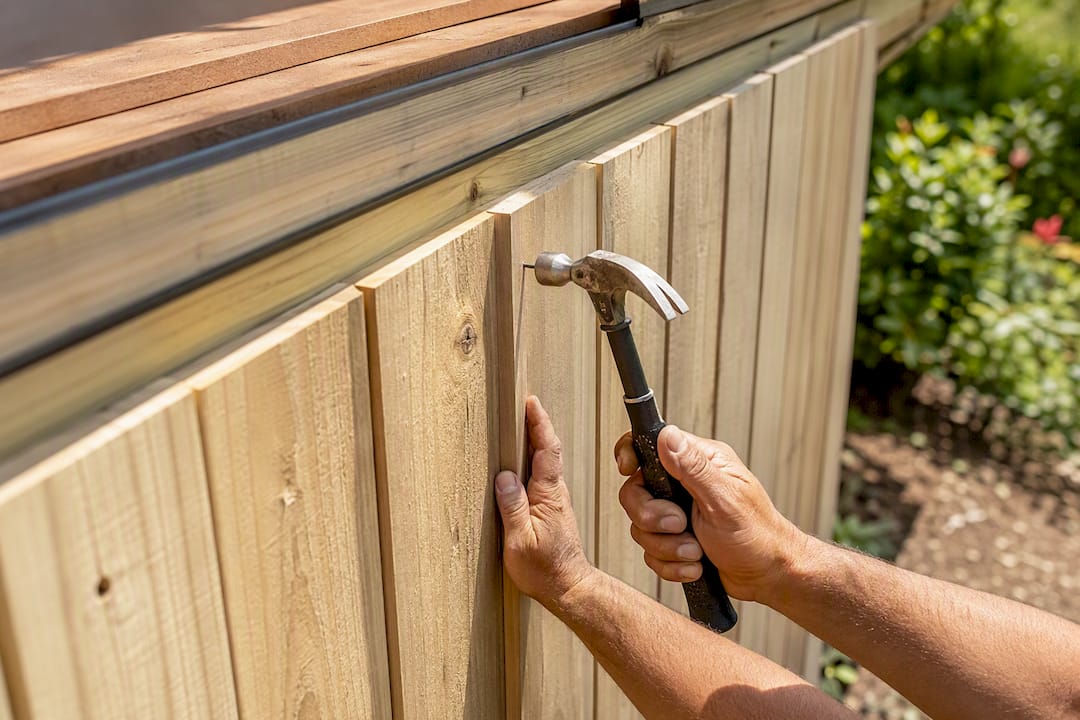
Framed lattice, wood or vinyl. The classic. A lumber frame holds a lattice panel, usually vinyl for longevity. BobVila lists it as one of the most accessible DIY options because panels come precut at any home center. Pros: cheap, ventilates well, sold everywhere. Cons: reads as dated if left unframed or painted white. DIY difficulty: easy. Best fit: rental properties, starter homes, anyone who wants function over flash.
Composite panels. Solid or louvered panels from brands like Trex or TimberTech (AZEK) snap into a frame and never need staining, painting, or sealing. Pros: extremely low upkeep, color-matches composite decking above. Cons: higher upfront cost than wood or vinyl. DIY difficulty: medium. Best fit: homeowners who already installed composite decking and want a seamless match.
PVC or faux-wood panels. Lighter and cheaper than composite, PVC panels mimic wood grain without the rot risk. Pros: budget-friendly, weatherproof. Cons: can look slightly plasticky up close. DIY difficulty: easy.
Corrugated or perforated metal panels. A favorite for modern and industrial-style homes. Pros: fast install, sheds water, striking at night with backlighting. Cons: can dent, and dark colors get hot in direct sun. DIY difficulty: easy, especially with prefabricated panels like those from Barrette Outdoor Living or LeonLite.
Decorative polymer panels. Molded panels with geometric or botanical patterns give texture without the weight of stone. DIY difficulty: easy. Best fit: small budgets that still want visual interest.
Stone or faux-stone veneer. GenStone-style panels click together over a frame and mimic real fieldstone or ledgestone for a fraction of the cost. Pros: upscale look, ties the deck to a stone or brick home exterior. Cons: heavier, pricier than panel systems, needs a solid backing structure. DIY difficulty: medium to hard.
Brick or masonry. Full masonry skirting is the most permanent and expensive route. DIY difficulty: hard, generally a pro job.
Living planters and trellis screens. Built-in planter boxes or a trellis with climbing vines soften a deck’s edge and double as landscaping. DIY difficulty: easy to medium.
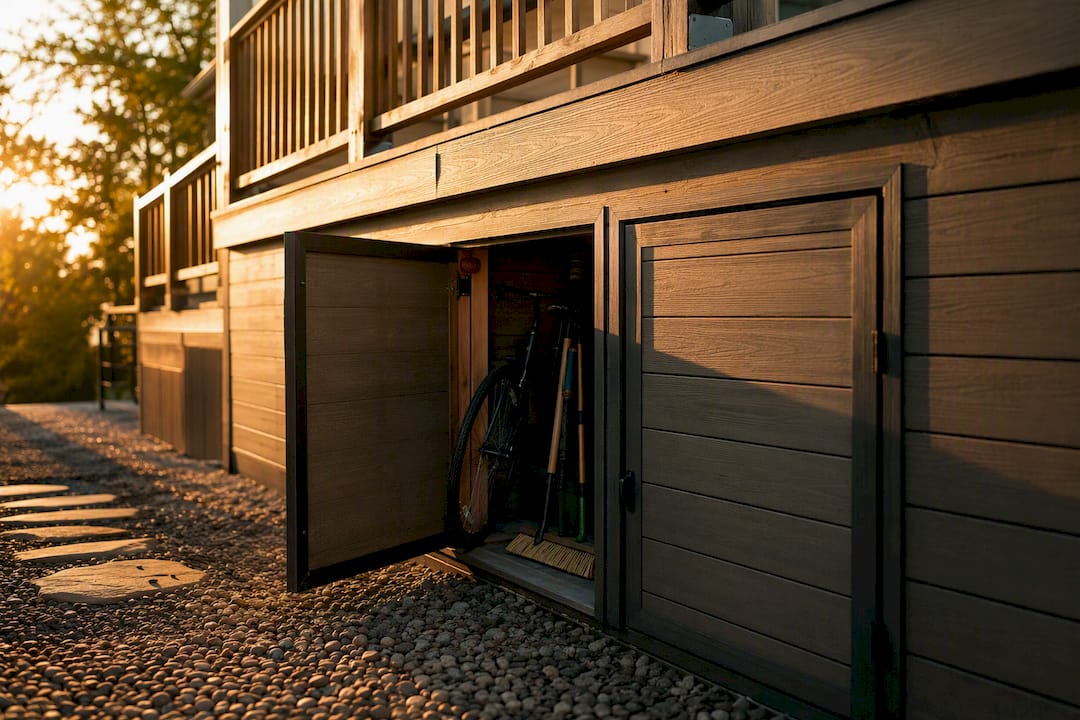
Under-deck sheds and hinged doors. Rather than pure decoration, this treats the skirted area as storage. Framed access doors or a full shed conversion turn dead space into a place for the lawn mower and pool toys.
Gabion cages and bamboo screens. Wire cages filled with stone (gabion) or woven bamboo panels are two of the more creative, less common choices. Both adapt well to uneven ground since you can stack or trim to grade.
Pro Tip: If your yard slopes, skip solid panels that force you to notch every piece. Stepped or tapered panel sections follow the grade far more cleanly and cut installation time roughly in half.
How To Match Skirting To Your Site And Budget
Before falling in love with a look on Pinterest, run it against your site conditions. Skirting that looks perfect in a photo can trap moisture or block a utility shutoff if you skip this step.
Weigh these factors:
Airflow needs: Solid panels look cleaner but need vents; slatted and lattice styles ventilate by design.
Ground contact and drainage: Keep the bottom edge off bare soil to stop wicking and rot, a point B&B Decks stresses across every material type.
Access: Decide now if you need a door for irrigation valves, crawl space access, or storage.
Budget and lifecycle cost: Vinyl costs less upfront; composite costs more but skips repainting.
Maintenance tolerance: If you hate yard work, cedar slats are the wrong choice.
Local code and flood zones: Some municipalities require breakaway panels or minimum vent area near water.
On-site checklist: measure skirting height at three or four points around the perimeter, note where the ground slopes, mark any utility access points, and decide on storage access before you cut a single board.
Pro Tip: Leave a small gap at the bottom of any skirting and aim for sufficient vent opening to keep air moving and moisture from pooling under the deck.
DIY Or Hire A Pro? Here’s How To Tell
A basic vinyl or wood-frame skirting job is a realistic weekend project for most homeowners. Stone veneer, masonry, or anything touching structural footings usually isn’t.
Tools for a standard DIY job:
Circular saw and a speed square
Cordless drill with driver bits
4 foot level and a string line
Pressure-treated framing lumber
Masonry trowel and adhesive, only if installing veneer panels
Rough timelines and costs: a lattice or vinyl panel skirting job typically runs a single weekend and lands in the low end of the cost range for materials plus fasteners. Composite or PVC panel systems take a bit longer to frame correctly but still fit a DIY weekend for a modest deck. Stone veneer, masonry, or anything requiring engineered footings is a multi-day job better handled by a professional crew.
Call a pro if you’re in a flood zone, dealing with major grade changes, installing code-required breakaway panels, or if the skirting needs its own foundation. Getting that wrong isn’t just a redo. It can mean a failed inspection.
The Design Detail Most Homeowners Skip
Skirting looks flat in daylight and disappears at night unless you design for shadow. Treat the panel or slat run as a textured plane, then add low-angled light to graze across it.
A few low-profile inground fixtures, spaced along the base of the skirting, throw light upward across slats or perforated metal and create depth that a flat, evenly lit panel never achieves. Cactusdecking’s lighting work uses this exact grazing technique to turn plain skirting into a nighttime feature. Slat spacing and perforation size both change how the shadows fall, so test a sample panel before committing to a pattern.
Wider slat gaps throw bolder shadow lines
Perforated metal scatters light into a dappled pattern
Fixtures spaced regularly keep light even without hot spots
Pro Tip: Match the skirting’s proportions to your house trim, not just the deck. A skirting panel that’s too shallow or too busy compared to your siding reads as an afterthought instead of part of the architecture.
Comparing Skirting Materials At A Glance
Best For | Material | Cost Tier | Maintenance | DIY Difficulty | Durability |
|---|---|---|---|---|---|
Budget | Vinyl lattice | Low | Low, occasional hosing off | Easy | Good, resists rot |
Modern look | Horizontal wood or composite slats | Medium | Wood needs sealing; composite needs none | Medium | Composite outlasts wood significantly |
Low maintenance | Composite panels (Trex, TimberTech/AZEK) | Medium to high | Very low | Medium | Excellent, weather resistant |
Storage/utility | Framed panels with hinged door | Low to medium | Low | Medium | Good |
Upscale appearance | Faux-stone veneer (GenStone) | Medium to high | Very low | Medium to hard | Excellent |
Vinyl remains the go-to budget pick because it resists rot, needs no repainting, and comes in louvered, lattice, or solid styles that all handle DIY framing well, a point D and G Flooring’s vinyl guide backs up in detail. Composite and PVC cost more but essentially eliminate the maintenance column entirely. Whatever you choose, keep the ground gap and vent allowance from the previous section in mind. Skipping ventilation is the fastest way to turn a good-looking material choice into a moisture problem two years later.
Fixing Uneven Ground, Drainage, And Pest Entry
Sloped yards, wet soil, and curious critters cause most of the skirting headaches homeowners run into after installation.
For uneven ground, use stepped panel sections, a gravel or paver base to level your starting line, or tapered panels cut on-site. For drainage, keep that ground gap, slope soil away from the deck, and consider an under-deck drainage system if the space below doubles as a patio. For ventilation, stick with slatted or perforated styles, or add discrete vents to solid panels.
To keep rodents and insects out, bury galvanized hardware cloth a few inches into the soil along the skirting’s base.
Pro Tip: Never let skirting touch bare dirt. Even pressure-treated lumber wicks moisture over time, and that’s how rot starts from the bottom up.
If your lot is near water or in a flood zone, check with your local building department before finalizing panel choice. Some areas require breakaway panels or a minimum open-vent percentage.
What Actually Matters When You Design Skirting
Most skirting advice online treats it as an afterthought, something to slap up after the deck itself is finished. That’s backwards. The skirting is the part of the deck people see from the yard, the driveway, and the street, arguably more than the decking surface itself.
The biggest misconception is that “modern” skirting requires an expensive material. It doesn’t. Horizontal slats and perforated metal panels read as modern because of the pattern and shadow, not the price tag. A vinyl lattice panel painted the same tone as your siding and lit with grazing light at dusk can outperform an unlit stone veneer job that cost three times as much.
If you take one thing from this list, prioritize ventilation and the ground gap before you pick a style. A gorgeous panel that traps moisture will need replacing in a few years regardless of how much it cost. Get the airflow right first, then chase the look you want.
Get A Custom Skirting Plan Without The Guesswork
Cactusdecking builds skirting the way it builds decks: with an in-house crew, warranty-backed installation, and materials chosen for your specific site rather than whatever’s on the shelf. Composite, PVC, or cedar skirting with proper ventilation, drainage, and code-compliant access takes coordinating framing, grade work, and sometimes masonry, exactly the kind of multi-trade job a solo weekend project struggles to match.
If your yard has slope, drainage issues, or you just want the horizontal slat or faux-stone look done right the first time, browse the Cactusdecking gallery for finished examples, then request a consultation through Cactusdecking to get a plan built around your deck.
Sources
10 Deck Skirting Ideas Will Dress Up Your Outdoor Space - BobVila
Deck Skirting Guide: Materials, Ventilation & Access | B&B Decks
Vinyl Deck Skirting: Complete Guide for Homeowners - D and G Flooring