
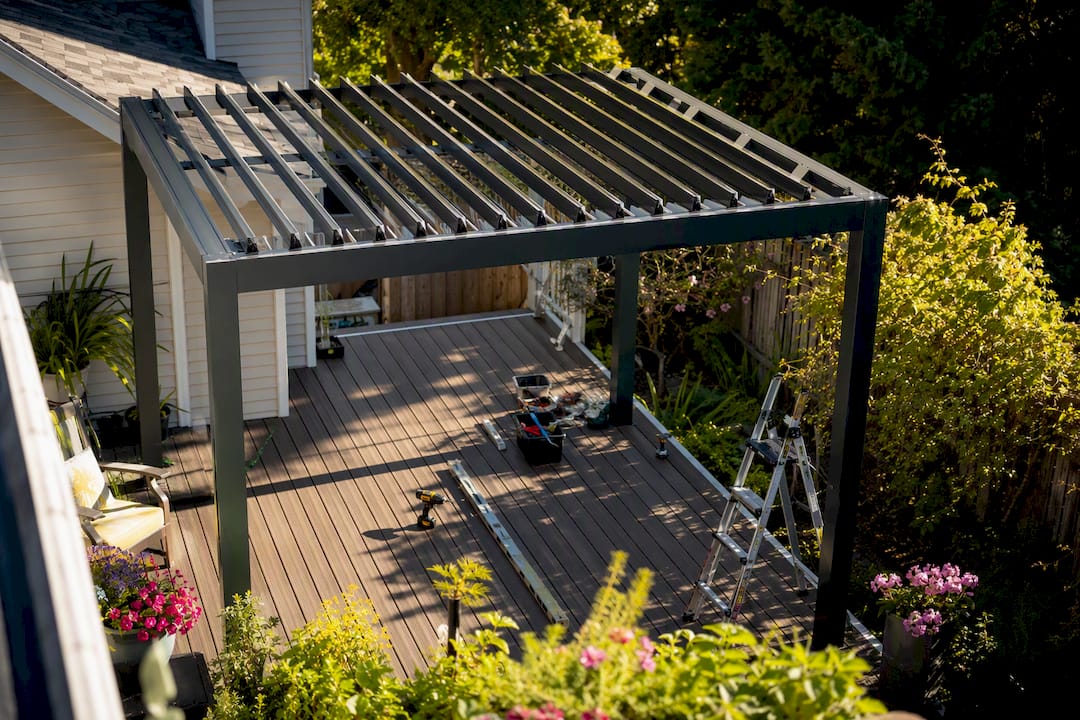
A louvered pergola typically runs $6,500 to $18,000 installed, or roughly $45 to $125 per square foot depending on whether you go manual or motorized. Manual systems land at $45 to $110 per square foot, motorized ones run $55 to $125 per square foot, and smart automated versions push higher still. Your exact number depends on footprint, site prep, and how much electrical work your yard needs.
TL;DR:
- Manual pergolas cost between $45 and $110 per square foot, while motorized and smart automated versions range from $55 to over $125 per square foot.
- Larger structures often have a lower cost per square foot due to economies of scale, but site prep and electrical work can significantly increase the total price.
- The main cost drivers include foundation issues, electrical upgrades, engineering requirements, and additional features like lighting or heaters.
- Quotes vary widely based on site conditions, with complicated terrains or insufficient electrical capacity increasing costs substantially.
- Proper budgeting requires detailed, itemized quotes that specify scope, materials, electrical, and permits, along with verifying footing and electrical conditions upfront.
Table of Contents
- How Much Does a Louvered Pergola Cost Installed?
- What Does a Louvered Pergola Cost by Size?
- Motorized vs. Manual vs. Smart Automated: Where the Money Goes
- What Drives Your Quote Up (or Down)?
- How Do You Get an Accurate, Comparable Quote?
- What Do Contractors See Go Wrong on Real Jobs?
- How Can You Keep Costs Down Without Cutting Corners?
- How Long Does Installation Take and What Does Ownership Cost?
- Is a Louvered Pergola Worth the Money?
- What I’ve Learned Building These for Real Homeowners
- How Cactus Decking Handles Your Pergola Project
- Sources
How Much Does a Louvered Pergola Cost Installed?
Most homeowners pay a wide range for a fully installed louvered pergola, with the final price mainly depending on the choice of the drive system. Manual hand-crank models are the budget entry point, priced at $45 to $110 per square foot installed. Motorized versions cost more to buy and wire, running $55 to $125 per square foot for the same footprint.
Smart automated systems, the ones with rain sensors, wind sensors, and app controls, sit above that motorized band. You’re paying for the hardware plus the labor to integrate sensors and programming, and that combination can add meaningfully to the base motorized price.
Here’s how that plays out in real projects:
- Low scenario: A small manual louvered pergola on an existing patio slab, minimal wiring, straightforward anchoring. Total lands near the bottom of the range.
- Mid scenario: A mid-size motorized unit with a new electrical circuit and standard footings. This is where most suburban installs actually land.
- High scenario: A large custom motorized or smart-automated structure with sensor integration, upgraded finishes, and site work like grading or drainage.
Square footage matters, but so does everything attached to the job, permits, electrical runs, and how much your yard needs before a crew can even start building.
What Does a Louvered Pergola Cost by Size?
Size drives the total price more than any other single factor, but the relationship isn’t perfectly linear. Larger footprints often carry a slightly lower cost per square foot because mobilization, permitting, and site prep get spread across more area. Here’s what that looks like across common sizes:
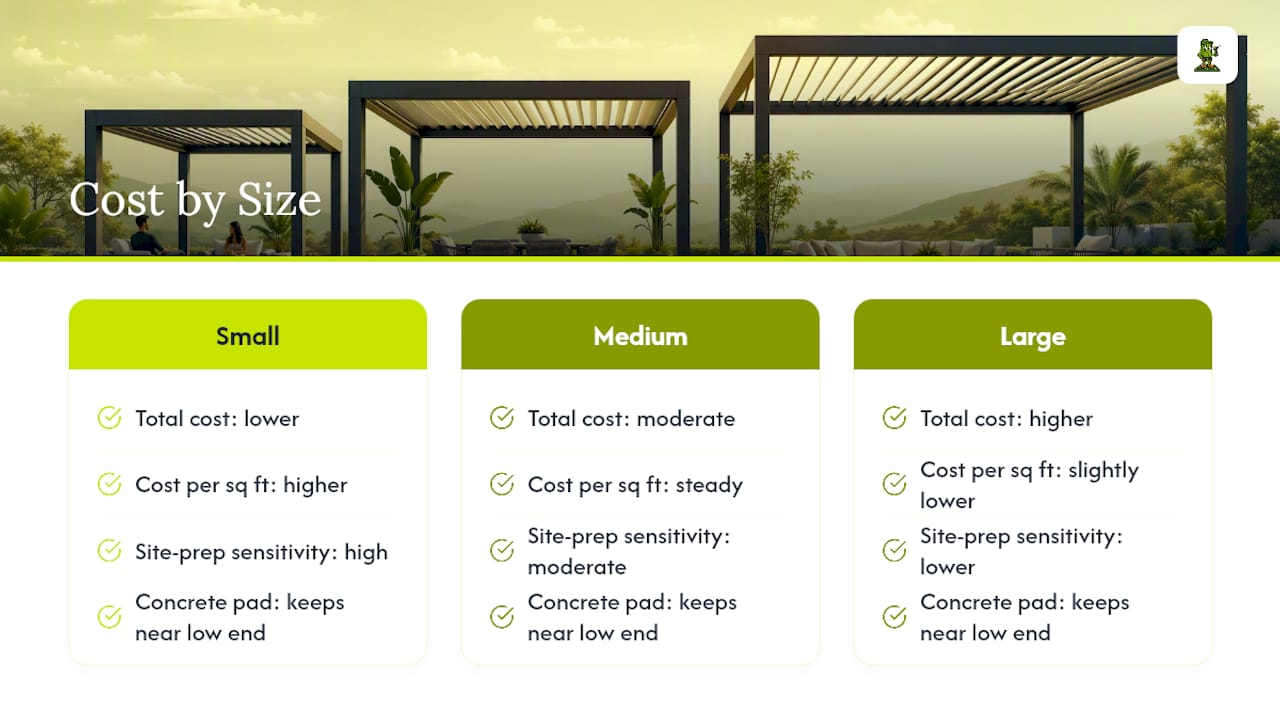
These figures assume a reasonably accessible site with an existing flat surface and don’t include separate deck construction, extensive electrical trenching, or premium finishes. A concrete pad already in place keeps you near the low end; a sloped yard needing new footings pushes you toward the high end. The per-square-foot math holds fairly steady across sizes, which is why the national pricing data treats these bands as reliable planning anchors.
Motorized vs. Manual vs. Smart Automated: Where the Money Goes
The jump from manual to motorized isn’t just a convenience upcharge, it’s a different build. Motorized louvered pergolas add a motor assembly, wiring, a control switch or remote, and often a dedicated electrical circuit run from your panel. Smart automated tiers stack on rain sensors, wind sensors, and sometimes app-based scheduling, each with its own installation labor.
Component costs break down roughly like this:
- Motor and controls: A meaningful chunk of the motorized premium, $2,000 to $8,000 depending on brand and how many louver zones need independent operation.
- Sensor suites: Wind and rain sensors add hardware cost plus the labor to wire and calibrate them.
- Electrical scope: New circuits, conduit, and sometimes a subpanel upgrade if your existing service is maxed out.
- Full smart automation: Budget kits start near $3,900, while premium custom motorized installations with integrated automation can exceed $55,000 on large or highly customized projects.
Motorization earns its cost back through actual use. A manual crank is fine if you’re closing louvers twice a season. But homeowners who adjust shade daily, or who want the structure to close automatically before a storm rolls through, tend to use motorized systems far more, which protects outdoor furniture and extends the useful life of everything underneath.
Pro Tip: If you’re on the fence about automation, ask your contractor for motorized wiring now with manual override, then add sensors later. It’s cheaper to run conduit during the initial build than to retrofit it in a finished structure.
What Drives Your Quote Up (or Down)?
Two identical-looking pergola quotes can differ by thousands of dollars, and the gap almost always comes down to what’s happening below and around the structure, not the structure itself — understanding your site’s preparation needs is essential, as detailed in this rain garden installation cost guide.
- Site prep and anchoring: Uneven ground, soft soil, or the need for new concrete footings adds labor and material cost before framing even starts.
- Structural engineering: Local wind and snow load requirements can mandate engineer-stamped drawings and heavier posts, particularly in coastal or high-wind regions where corrosion-resistant hardware becomes necessary.
- Electrical work: Running a new circuit, trenching underground, or upgrading panel capacity for motorized systems is often billed separately from the pergola itself.
- Permits and HOA review: Municipal permit fees and homeowner association approval processes add time and, occasionally, design constraints that affect cost.
- Add-ons: Integrated LED lighting, infrared heaters, drop-down screens, or upgraded finish materials all stack onto the base price.
Site conditions and engineering complexity are usually the reason a “premium” project climbs into the $25,000 to $150,000-plus range rather than staying in the standard band. If your yard already has a solid slab and your electrical panel has room to spare, you’re starting well ahead of a project that needs both from scratch.