
If you are building or replacing a deck in Everett, the code asks for less lighting than most people expect, but it asks for it in specific places. In Washington, an exterior stairway needs an artificial light source at the top landing, and any lighting you add has to be powered and installed to electrical code. A permit may be involved, depending on how the lights are wired. Below is what the rules say, how they apply to a typical Snohomish County deck, and how to light the space so it is safe and not merely compliant.
TL;DR
- Washington requires an artificial light source at the top landing of an exterior stairway. If the stairs lead from outdoor grade to a basement, a light is also required at the bottom landing.
- The model code also expects a “means to illuminate” every stair, landing and tread, so one porch light is sometimes not enough.
- Everett enforces the 2021 International Residential Code and the 2023 National Electrical Code, both as amended by Washington State.
- Most line-voltage deck lighting work needs an electrical permit and inspection. Some low-voltage systems on a listed Class 2 power supply may be exempt.
- Plan the lighting during design, before the framing and decking go down, so the wiring is hidden and the inspection is simple.
Table of Contents
- Does a deck need lighting by code?
- Which codes apply in Everett
- Electrical rules that affect deck lighting
- Do you need a permit for deck lighting?
- Code minimum versus a deck that is actually safe
- Low-voltage, line-voltage and solar
- Perspective: how we plan lighting on a build
- A practical sequence for adding deck lighting
- Lighting a new or replacement deck with us
- FAQ
- Sources
Does a deck need lighting by code?
A deck surface itself does not have to be lit. The requirement attaches to stairs. The model residential code, section R303.6, covers illumination of exterior stairways, and Washington amends it in WAC 51-51-0303, effective March 16, 2024. Under that rule, an exterior stairway must have an artificial light source at the top landing. Where the stairs give access to a basement from outdoor grade, a light source is also required at the bottom landing.
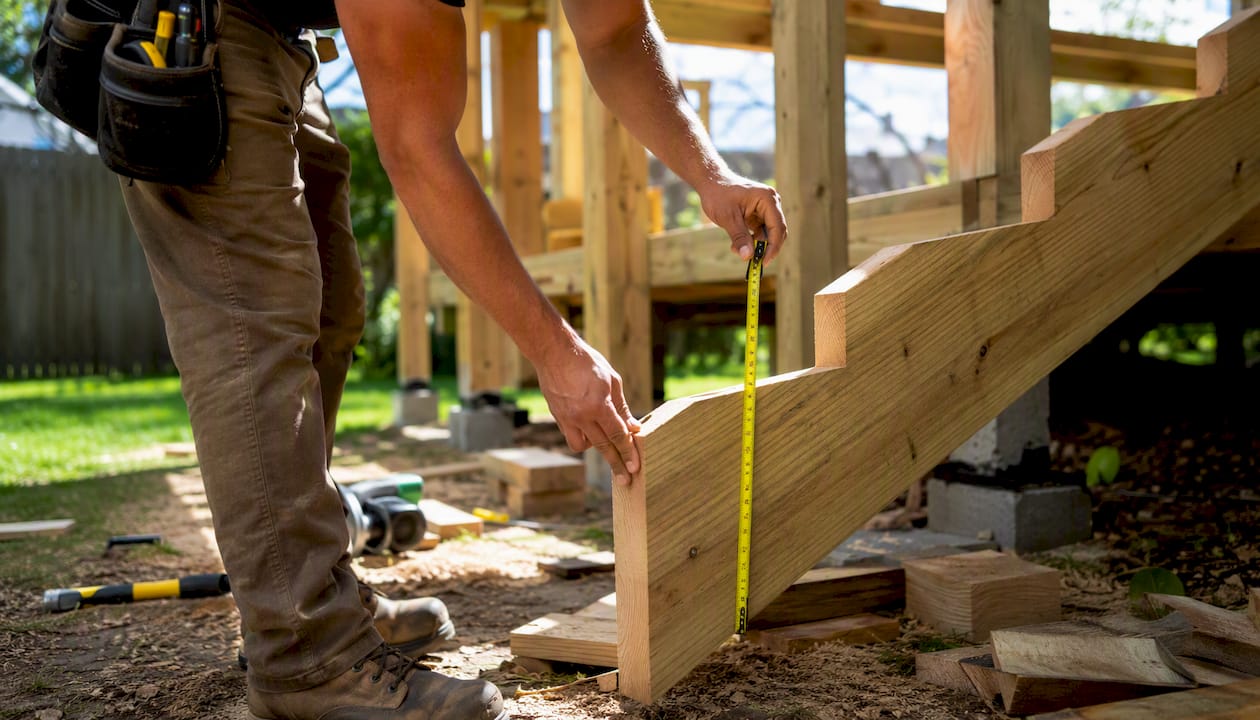
So a raised deck with a staircase down to the yard needs a fixture near the top of those stairs. A ground-level deck with no stairs, or with a single step, is a different situation, and what applies depends on how the inspector reads the stairs on your plans. If you are unsure whether your steps count as a stairway, ask the city before you build, not after. Our guide to deck stairs code and IRC compliance walks through rise, run, handrails and landings, which are the details that decide how a stairway is classified.
What the model code intends
The International Residential Code’s stair lighting section contains two separate ideas. The Ask NADRA column, quoting the ICC’s deck code commentary on the 2009 IRC, explains that section R303.6 has two requirements: one fixes the location of a light source, and the other requires that the stairs be illuminated. Those are not contradictory, and each applies on its own.
In practice, that means:
- A fixture must exist at the top landing. This is the “where” rule.
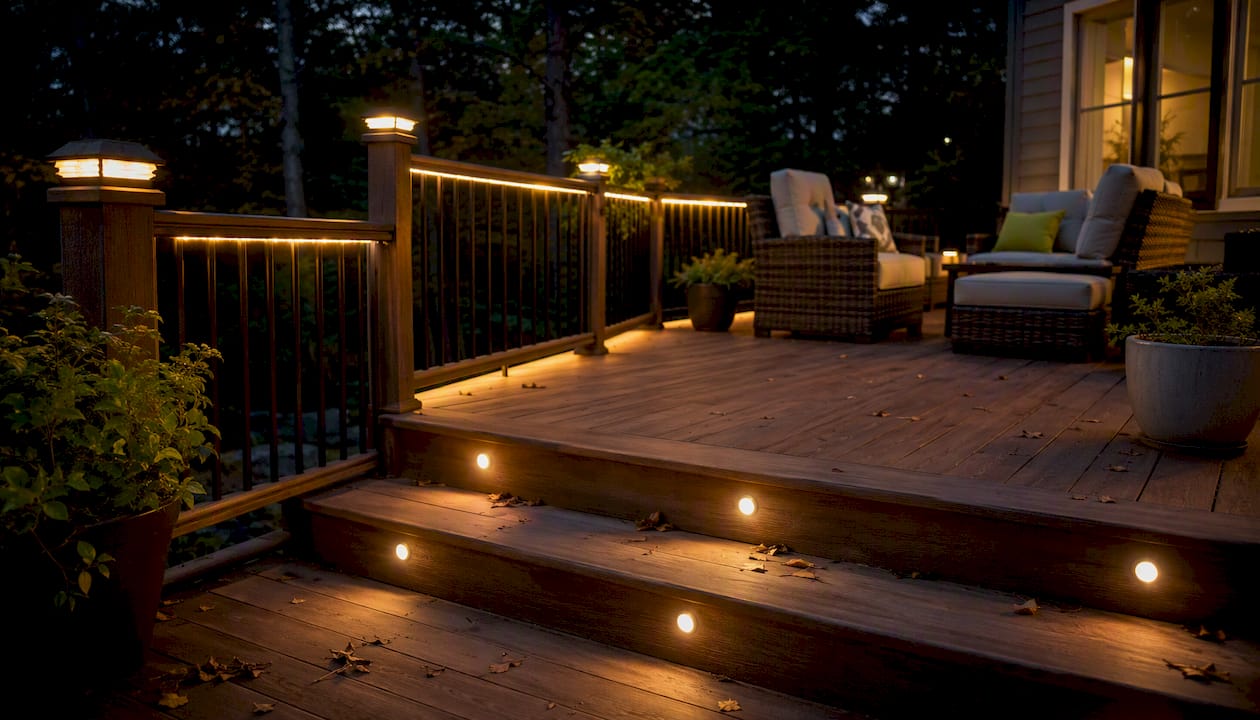
- The stairs, landings and treads need a means to illuminate them. This is the “result” rule. That means can be a floodlight on the house wall, or small low-voltage lights spread through the stair components.
- One light may or may not be enough. Depending on the layout, the size and wattage of the top-landing fixture, a single light might cover the whole stairway, or additional sources may be needed.
- If you use low-voltage lights as the means to illuminate, at least one fixture has to sit at the top landing.
That commentary was written about the 2009 edition and published in 2011, and Washington has since adopted its own amended wording, so treat it as an explanation of the intent, and treat the WAC as the rule you build to. The ICC’s own commentary on the code makes the safety reasoning plain: adequate stairway lighting matters because stairs are part of the egress path and a fall hazard.
Which codes apply in Everett
The City of Everett lists the codes it enforces on its construction codes page: the 2021 International Residential Code and the 2023 National Electrical Code (NFPA 70), as amended by the State of Washington. The city also adopts WAC 296-46B-010, the state’s electrical rules, alongside the NEC.
Three layers therefore sit on top of each other on any Everett deck:
| Layer | What it governs for deck lighting |
|---|---|
| International Residential Code (2021) with Washington amendments | Where stair lights are required and that stairs must be illuminated |
| National Electrical Code (2023) | How fixtures, cables, receptacles and power supplies are wired and protected |
| Washington electrical rules and the Washington Cities Electrical Code | Who may do the work, permits and inspections |
Nearby cities such as Marysville, Lake Stevens, Snohomish and Bothell each administer their own permit process, and local amendments or submittal checklists can differ. If your deck is outside Everett, confirm with your own building department. You can see how we handle lighting jobs in other towns on our pages for Marysville, Lake Stevens, Snohomish and Bothell.
Electrical rules that affect deck lighting
The lighting rules tell you where a light must be. The electrical rules tell you how it gets power safely. Several points come up on almost every project.
Power comes from the building wiring
WAC 51-51-0303 states that stairway illumination must receive its primary power from the building wiring. A plug-in string of lights run from an extension cord does not satisfy the stair lighting requirement, however nice it looks. The required fixture needs a permanent circuit, usually tied to a switch inside the house.
Outdoor outlets need GFCI protection
If your deck plan includes receptacles for plug-in lanterns, heaters or holiday lights, they fall under outdoor outlet rules. An electrician’s summary of the 2023 NEC as adopted in Washington notes that all outdoor receptacles need GFCI protection. Your electrician will confirm the exact protection method on your circuit. Weatherproof in-use covers, the kind that close over a plugged-in cord, are standard practice for outdoor outlets.
Extension cords are not a permanent plan
The Washington Department of Labor & Industries advises matching a cord’s amperage rating to what you plug into it and using the right wire gauge in its electrical safety tips for your home. That advice is for temporary use. If you find yourself running a cord across the deck every evening, that is a sign you need a real circuit or a proper low-voltage system.
Fixtures must suit wet locations
Deck fixtures sit in rain, snow melt and Pacific Northwest damp for most of the year. Choose fixtures listed for wet or damp locations as the manufacturer states, and ask whoever installs them to seal every connection. Inspect covers and gaskets each season. Cracked or missing gaskets let moisture reach the electrical parts, and that is where outdoor failures usually begin.
Do you need a permit for deck lighting?
Often, yes. The Washington Cities Electrical Code says permits for electrical work come from the Code Official, and all work must meet state and local standards. The same document says electrical work generally requires a permit unless it is exempt. Exemptions can include like-in-kind replacement of certain devices and low-voltage wiring supplied by a listed Class 2 power supply.
That gives you a rough sorting rule:
- New circuits, new switches, new line-voltage fixtures or new outdoor outlets: expect an electrical permit and an inspection.
- Swapping an existing fixture for a similar one: may be exempt, depending on the device and the code language.
- Low-voltage post, rail or stair lights on a listed Class 2 supply: the low-voltage wiring may be exempt, but the transformer’s own connection to house power usually is not.
When in doubt, ask. Permit rules are interpreted by the Code Official, and the answer for your specific fixture is theirs to give. For the structural side of a permit, including the setback rules that trip up many Everett projects, see our post on avoiding permit delays with Everett’s deck setback rules.
Why skipping the permit costs more later
The Department of Labor & Industries points out that electrical permits and inspections protect safety and property value, and that illegal or uninspected electrical work can put homeowners insurance at risk. Uninspected wiring on a deck is also the kind of thing a buyer’s inspector flags during a sale. A permit finaled years ago is far cheaper than a disclosure problem discovered at closing.
Code minimum versus a deck that is actually safe
Meeting code and being safe after dark are not the same thing. A single fixture at the top landing can satisfy the location rule while leaving the bottom three treads in shadow. The model code’s second requirement, a means to illuminate every stair, landing and tread, is the one that protects your guests.
Here is how we think about each part of the deck.
Stairs
Light the treads, not just the landing. Small low-voltage lights set into the risers or the stringer sides make each step edge visible and keep glare out of people’s eyes. Keep at least one fixture at the top landing, as the code expects. If the stairs turn or have a mid-landing, add a light there, because a turn is where people misjudge a step.

Railings and posts
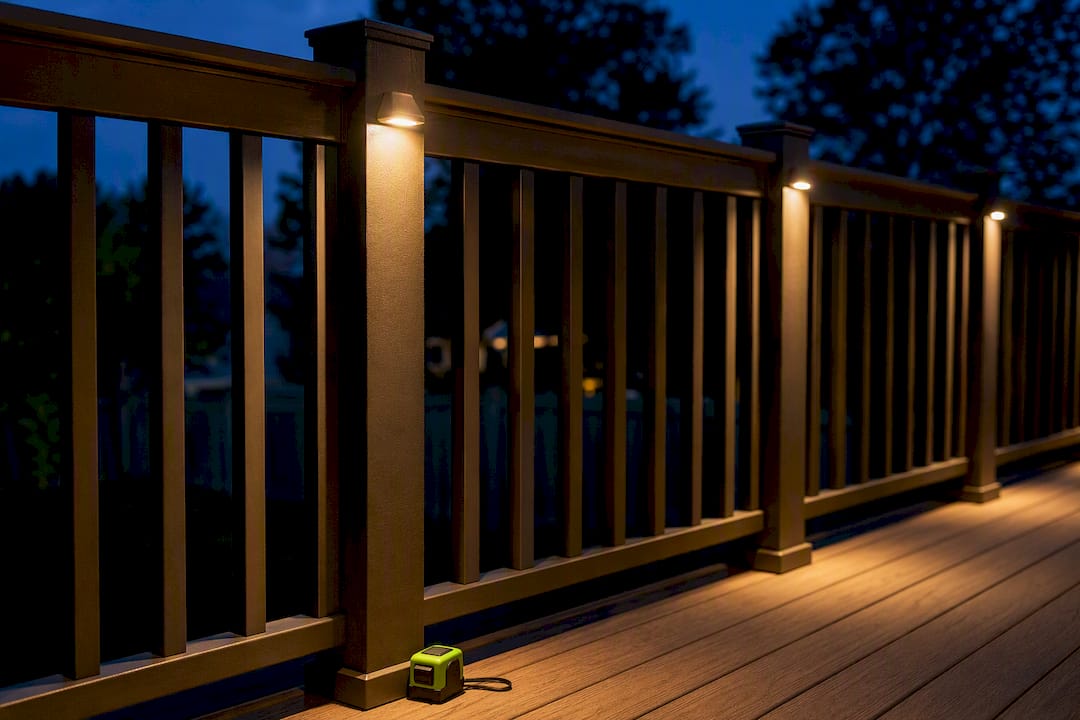
Post cap lights and under-rail lights spread soft light across the deck surface and make the perimeter obvious. They also help guests find the edge of a deck that has no overhead cover. If you are planning new guards, we design the lighting channels in with the deck railing systems so the wire is concealed and not stapled to the outside later.
Door and landing areas
The spot where people step out of the house is where most evening trips happen. A wall light by the door, switched from inside, handles that threshold. If a deck is covered, ceiling fixtures or recessed lights under a roof structure add general light. Our deck cover installation service can carry fixtures in the framing so nothing hangs loose.
Control: switches, timers and sensors
The ICC-based commentary suggests stairway lighting that can be controlled from inside the dwelling, or lighting that is continuous or automatic. A timer or photocell that turns lights on at dusk and off later is the simplest way to be sure the stairs are never dark when someone is on them. Motion sensors work for secondary paths, but a sensor should not be the only light on a stair, since a late trigger leaves a person in the dark for the first step.
Low-voltage, line-voltage and solar
Each type has a role.
| Type | Best for | Code notes |
|---|---|---|
| Line-voltage (120V) | Wall lights at doors, ceiling lights under covers, floodlights | Needs a permitted circuit, wet-location fixtures and GFCI where required |
| Low-voltage (Class 2 supply) | Stair risers, post caps, rail lights, deck-edge lights | Low-voltage wiring may be exempt from permit, but the power supply still connects to house power |
| Solar | Accent lighting, existing decks without wiring | Does not meet the requirement to take primary stair power from building wiring |
Solar has improved a great deal. Newer designs use better batteries and USB-C charging, and a guide to solar garden lighting design covers what separates a durable system from a cheap one. For a deck, we treat solar as an accent layer for planters, paths and the yard beyond the stairs. The stair lighting the code requires comes from the building’s wiring.
Perspective: how we plan lighting on a build
We see the same mistake across Snohomish County: the deck is designed, framed and decked, and then someone asks about lights. By then the wire has no place to go, so it ends up on the surface of a new composite board, held by clips, and the finished deck looks like an afterthought.
We do it the other way. Lighting goes into the design conversation next to the layout, the railing and the stairs. Because our build crew is in-house and not subcontracted, the person who frames the stair stringer knows where the light channel runs, and the installation follows the plan instead of improvising around it. Permits are part of our process, so the inspection is on the schedule from the start and not a surprise after the last board.

Material matters here too. Composite, PVC and cedar each handle fasteners, heat and moisture differently, and fixtures in the Northwest climate need to be sealed for constant damp. We choose the combination with that in mind, and we are glad to talk through eco-conscious material options as part of the same plan.
My advice: treat the code as a floor. If a light is required at the top landing, put one there, and then ask what a guest carrying a tray would need on the bottom step in the rain at 9 p.m. Light that.
— Vlad
A practical sequence for adding deck lighting
Whether you build new or replace an old deck, this order saves rework.
- Confirm which stairs count. Count the steps and landings and check the rules with your building department.
- Map the use. Note where people walk at night: the door, the grill, the stairs, the seating area.
- Choose the power source. Decide what runs from a permitted house circuit and what runs from a low-voltage supply.
- Design the fixtures into the structure. Plan channels in posts, rails, risers and framing before the decking goes down.
- Pull the permit. Include the electrical work if it is not exempt.
- Install and test at dusk. Walk the stairs in the dark and move any fixture that creates glare or leaves a shadow.
- Schedule seasonal checks. Look at covers and gaskets each year before the wet season.
For more on style choices, such as warm versus cool light and how to avoid glare, see our deck lighting ideas post.
Lighting a new or replacement deck with us
If you are planning a new deck or replacing a worn one in Everett, we can build the lighting plan in from day one. We handle design, permitting and construction with our own crew, and our installations are warranty-backed. Start with deck lighting in Everett, or look at new deck installation service and deck replacement if the whole structure needs attention. We do not publish prices, because every deck and lighting plan is different, so the first step is a consultation.
FAQ
Does my deck need lights by code?
The deck surface itself does not, but exterior stairs do. In Washington, an exterior stairway needs an artificial light source at its top landing, plus one at the bottom if the stairs lead from outdoor grade to a basement. The model code also expects a way to illuminate all stairs, landings and treads.
Can I use solar lights to meet the stair lighting requirement?
Not as the required light. Washington’s rule says stairway illumination must get its primary power from the building wiring. Solar lights make good accents along paths and planters, but the required stair light should be on a circuit in the house.
Do I need a permit to add deck lights in Everett?
Usually for new circuits, outlets or line-voltage fixtures. Like-in-kind replacements and low-voltage wiring on a listed Class 2 power supply may be exempt under the Washington Cities Electrical Code. Confirm with the City of Everett’s permit office before you start.
Which code edition does Everett use?
Everett adopts the 2021 International Residential Code and the 2023 National Electrical Code, both as amended by Washington State. Your plans are reviewed against those editions, so older articles written for earlier code years may not match.
Should I hire an electrician for deck lighting?
For any work connected to house power, yes. Washington’s Department of Labor & Industries warns that uninspected electrical work can threaten homeowners insurance coverage, so the connection to your panel or a switch circuit should be done by a qualified, licensed electrician and inspected.
Sources
- WAC 51-51-0303, Washington State Building Code Council
- City of Everett construction codes
- The Washington Cities Electrical Code
- Ask NADRA: Deck Stair Lighting Codes
- ICC: Natural and Artificial Light, 2009 IRC commentary
- Washington L&I: Electrical Safety Tips for Your Home
- GFCI outlet repair and replacement, Konsker Electric