Mold on a composite deck is a surface problem in most cases. It grows on the dirt, pollen and leaf debris that settle on the boards, not on the composite itself, so warm soapy water, a soft brush and a thorough rinse usually clear it. It comes back when the debris and moisture come back. If it keeps returning, shows up under the deck, or the framing feels soft, the cause is water and structure, and a deck replacement is the lasting fix. In the Pacific Northwest, where decks stay damp for long stretches, that is worth knowing before you buy a stronger cleaner.
Cactusdecking
Plan a Deck Built for Outdoor Living
If mold keeps returning or the framing feels soft, Cactus Decking builds custom decks in Everett with composite, PVC, or cedar options.
VisitTL;DR
- Mold needs air, water, warmth and a food source. On composite, the food is pollen, leaves, dirt and debris sitting on the boards.
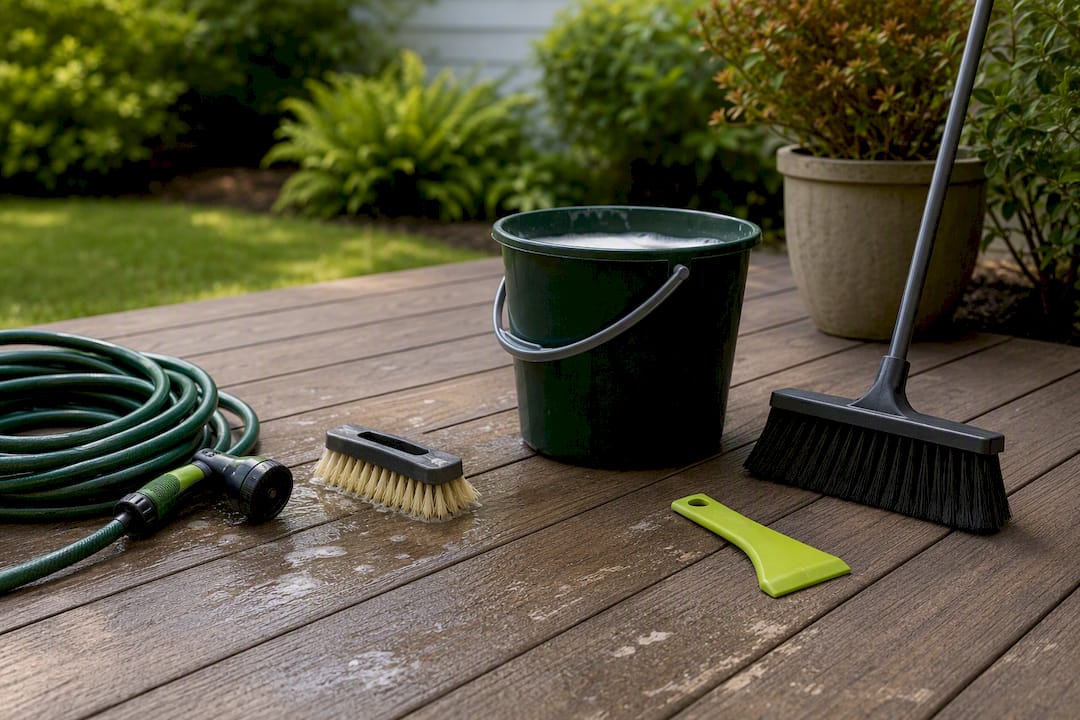
- Start with a hose, warm soapy water and a soft non-metal brush. Never use a wire brush, and never mix cleaning products.
- Pressure washers have manufacturer limits. Trex allows up to 3,100 psi with a fan tip, while Fiberon advises against pressure washing when mold is present.
- Some warranties require you to clean mold within a set window, so read yours before the first cleaning.
- Mold that returns after cleaning, or grows on the framing, points to a moisture problem. That is when repair or replacement is the real answer.
Table of Contents
Why mold grows on composite decking
Composite boards are made to resist rot, but nothing outdoors is mold-proof. Manufacturer care guides agree on the recipe: mold and mildew need air, water, elevated temperatures and a food source such as decaying wood, leaves or pollen. Your deck always has air, and in western Washington it has water for much of the year. That leaves the food source as the one thing you control.
Trex’s care guide puts it plainly: if pollen and dirt stay on the surface, mold feeds on the resulting biofilm. Biofilm is the thin, slightly slick layer of grime that builds up on a surface and holds moisture. Another manufacturer’s guide notes that because mold cannot be completely eliminated outdoors, the goal is to minimize it by removing organic material quickly. That is a more realistic target than a sterile deck.
Mold, mildew, algae or just dirt?
Homeowners use the words interchangeably, and for cleaning purposes you can too. Mildew is a surface mold, often gray, white or powdery. Mold tends to show as black, green or dark speckled patches. Algae looks green and slick, usually in shaded, damp spots. Dirt and tannin stains from leaves look brown and often follow the shape of the debris or the board gaps.

A quick test: scrub a small patch with soapy water. If it lifts, it was surface growth or dirt. If a dark mark remains after a thorough rinse, it may be a stain left behind, and the next section covers how to handle that without escalating to harsher chemistry.
What to do before you scrub
Two checks save you from the most expensive mistakes.
Read your manufacturer’s care guide and warranty. Care instructions differ by brand and by product line. Trex’s stain warranty, for example, covers naturally occurring mold and mildew only if it is removed with soap and water or mild household cleaners within one week of first appearance. The same warranty excludes biocides, fungicides, plant food and bactericides. If you do not know which brand you have, check the board edge or underside for a stamp, or look through your project paperwork.
Look underneath. Mold on the surface and mold on the joists are different problems. If you can see growth on the framing, jump to the section on persistent mold below before you spend a weekend on the top.
How to clean mold off composite decking, step by step
This is the routine the manufacturers’ own guides describe, with the places it tends to go wrong.
- Clear the deck. Move furniture, planters and mats. Mats and pots trap moisture and are a common spot for growth.
- Sweep and clear the gaps. Leaf debris in board gaps holds water. Fiberon notes that when gaps are narrower than 3/16 inch, debris can clog them, water pools, and it steeps into a tannin “tea” that can stain. A garden hose clears most of it. If you use a putty knife, go gently, because it can scratch.
- Wet the deck and nearby plants. Plants near the deck are easier to protect when they are already wet.
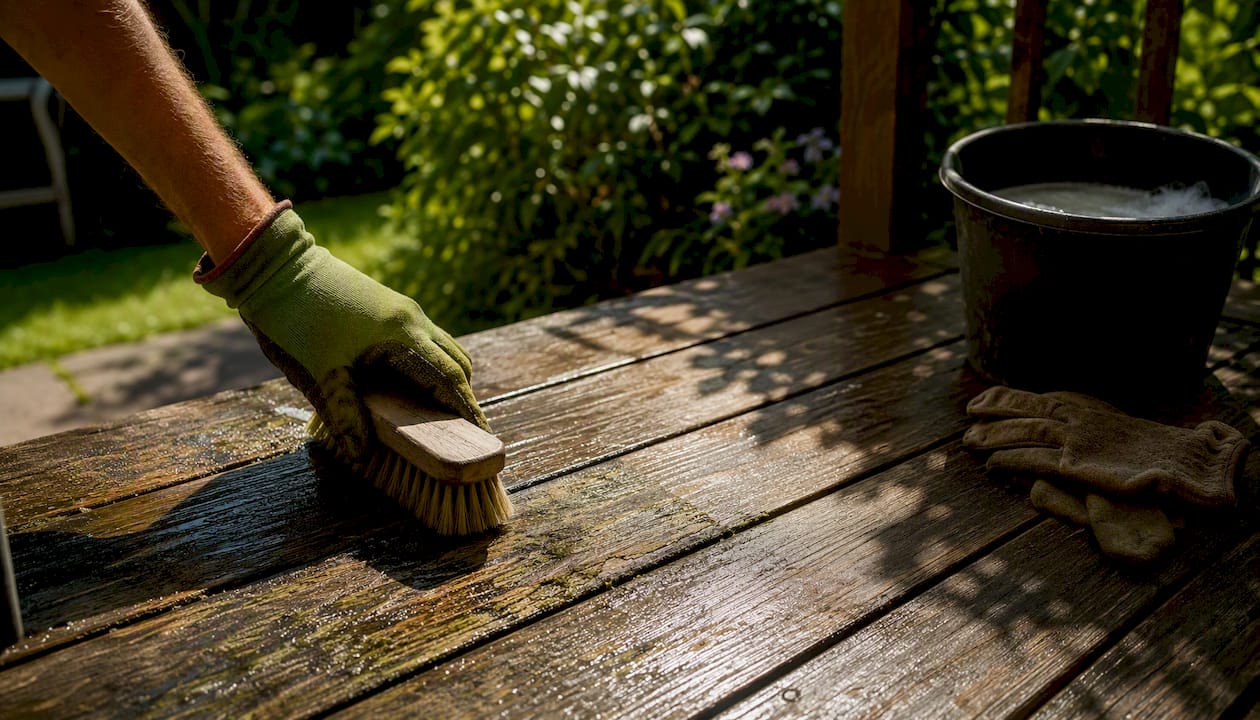
- Wash with warm soapy water. Trex recommends a hose, warm soapy water and a soft-bristle brush, not a wire brush to remove the biofilm and the mold. Scrub along the length of the boards, not across them. This is the same approach the EPA gives for hard surfaces: wiping or scrubbing with water and detergent.
- Rinse thoroughly. Leftover soap becomes a new film that catches dirt.
- Let it dry fully. A deck that stays wet is a deck that grows mold again.
We cover the soap test and cleaning technique in more depth in our guide to cleaning composite decking without ruining it.
When soap and water is not enough
If a stain is stubborn, manufacturers point to a commercial mold and mildew cleaner used exactly as the label says. Fiberon’s guidance is to apply cleaner to a dry deck with a sprayer, work in small sections, and not let it dry on the boards. Its guides also say never to mix cleaning products, and never to mix bleach with acids.
Two cautions apply to any product:
- Trex notes that bleach or acid products can lighten the surface of its boards, so test a hidden spot first.
- For dark staining that remains, repeating the same product on the stained spot with gentle scrubbing is safer than reaching for something stronger. Label directions account for how the product reacts with the material.
Tannin stains from leaf debris are a different job. Trex’s guide says to remove the debris, let the deck dry, and then apply a deck brightener containing oxalic acid following the product directions. Always wear eye protection and gloves with any cleaner, and rinse nearby plants.
Pressure washing: where the limits are
A pressure washer feels like the fast answer, and it is where many homeowners do damage. The limits vary by manufacturer:
| Source |
What it says about pressure washing |
| Trex care guide |
Up to 3,100 psi with a fan attachment, tip no closer than 8 inches. Above 3,100 psi could damage the boards and void the warranty. |
| Fiberon care blog |
Best left to professionals and not recommended when mold or mildew is present. If used, under 2,500 psi at 12 inches with a wide fan tip. |
| Fiberon care and maintenance PDF |
Below 1,500 psi at 12 inches if used at all, and not recommended with mold present. |
The range, from 1,500 to 3,100 psi, shows why the manufacturer’s guide for your boards beats a general rule. When in doubt, hand scrubbing with a soft brush avoids the question entirely. Use a wide fan tip, never a narrow one, and wash with the grain.
Why it keeps coming back
Cleaning removes what is there. It does not change why it grew. The EPA is direct on this: if you clean up mold but don’t fix the water problem, the mold will most likely come back.
On a deck, the usual water and food sources are:
- Shade and tree cover. Decks under evergreens collect needles, pollen and constant moisture. This is common around Everett and Marysville.
- Debris in the gaps. Gaps that stay packed with leaves hold water against the boards.
- Poor airflow below. Fiberon recommends at least six inches of under-deck ventilation, improved drainage so water does not stand, and downspouts directed away from the deck.
- Furniture, mats and planters that sit in one place and stay damp.
- Infrequent cleaning. Fiberon recommends cleaning at least twice a year and removing leaves and debris between cleanings, and Trex describes spring and fall cleaning to keep pollen and debris from building up.
A simple maintenance rhythm for a Pacific Northwest deck: sweep or hose off debris after leaf fall and after heavy pollen, wash with soapy water in spring and fall, and keep the gaps open. If you also deal with fading, our composite deck fading guide walks through a soap test that applies here too.
When mold means more than a dirty deck
Surface mold on a capped composite board is a cleaning job. These signs are not:
- Mold returns within weeks of a proper clean and dry.
- Growth appears on joists, beams or the underside of boards.
- The framing feels soft when pressed, or posts, ledger areas and stair stringers look dark and spongy.
- Water pools on the deck or drains toward the house.
The cause in these cases is usually moisture getting into the structure. The Spruce explains that buildup of mold, mildew and algae under a deck traps moisture and can lead to wood rot, structural damage and pests. You can scrub the underside with a brush and cleaning solution, let it sit about 15 minutes, rinse and let everything dry, but that treats the symptom.
The EPA also notes that porous materials that are wet and moldy may have to be discarded, because mold gets into crevices and can be difficult or impossible to remove completely. For a deck, that translates to rotted or saturated framing and boards that no longer clean up. For widespread growth, a guide to EPA mold thresholds and when a pro is needed explains how to judge when a patch has outgrown a weekend cleanup.
If framing is compromised, painting over it or cleaning the top does not make the deck safe. A deck holds people, so soft posts, ledgers or stringers should be assessed before anyone keeps hosting guests on it. Our guide to removing mold from your deck safely covers the same decision from the wood-and-composite side.

Is it time to replace rather than keep cleaning?
Four questions help:
- How old is the deck, and what are the boards made of? Older uncapped composite is more prone to staining and growth. A fresh, capped board resists it better.
- Is the problem on the surface or in the structure? Surface growth cleans. Soft framing does not.
- How often are you cleaning? If you are re-treating several times a year and the stains stay, the deck may be telling you something about drainage, shade or airflow.
- Do you want the same deck or a better one? Replacement is the moment to fix ventilation, drainage, board spacing and layout, so the same mold problem does not return.
Replacement is where design matters. Gap spacing, under-deck airflow, slope and board choice all affect how much water the deck holds. Our deck replacement service covers composite, PVC or cedar, and our in-house build crew handles the work rather than subcontractors. You can see a finished example in our composite deck replacement with gated stairs in Everett.
Our approach to a deck that stays clean
If you are asking about replacement, here is what we offer. Cactus Decking designs, builds and replaces residential decks in Everett and nearby communities, with permitting handled as part of the process, and installations backed by a warranty. We work with composite, PVC and cedar, including eco-conscious material options suited to the Northwest climate, and we guide you from consultation through construction with a clear, organized process. If your deck is past cleaning, start with a conversation about deck replacement or new deck installation service.

If you like your layout but not the board choice, or want better railings, stairs, lighting or a cover while the deck is open, our Everett deck design service service is where that gets planned together.
Our view on mold and composite
Most mold calls start the same way: a homeowner scrubs, the deck looks better for a month, then the dark patches return. The scrubbing was never the failure. The deck was holding water, or collecting debris faster than anyone could clear it.
That is why we think of mold as a design question as much as a cleaning question. Board gaps, airflow below, drainage and how close the deck sits to trees all decide how often you will be out there with a brush. A deck built with those in mind is easier to live with for years.
We build with an in-house crew, not subcontractors, so the person who plans the airflow and drainage is on the same team as the person who builds it. When a deck has reached the point where the structure is the problem, a well-built replacement in the right material is a better use of your money than another round of cleaners. Composite, PVC and cedar each have a place, and we help you match the material to your site and the Northwest weather.
Vlad
FAQ
What kills mold on composite deck boards?
Warm soapy water and a soft brush remove most surface mold by taking away the biofilm it feeds on. For stubborn spots, use a commercial mold and mildew cleaner exactly as its label directs, and never mix products. Check your board manufacturer’s guide first, since some products can lighten or damage certain surfaces.
Can I use bleach or vinegar on composite decking?
Follow your manufacturer’s guide. Trex notes that bleach or acid products can lighten the surface, and Fiberon says never to mix bleach with acids. Soap and water is the safest first step, and a test on a hidden spot tells you how the board reacts to anything else.
Does mold void my composite deck warranty?
It can affect coverage. One major manufacturer’s stain warranty covers mold only when it is cleaned with soap and water or mild household cleaners within one week of first appearing. Pressure washing above the manufacturer’s limit can also void coverage. Read your own warranty, because terms differ by brand and product line.
Why does mold keep coming back after I clean it?
Because the water or debris that feeds it is still there. Clogged board gaps, shade, poor drainage, little airflow under the deck and furniture that stays damp are the usual causes. If it recurs on a deck you clean regularly, or appears on the framing, have the structure checked and consider replacement.
How often should I clean a composite deck?
Manufacturer guides range from at least once a year to at least twice a year, more often in damp climates. In western Washington, twice a year plus a debris sweep after leaf fall is a sensible rhythm.
Sources
Recommended